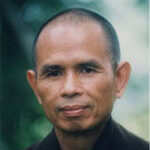
By Thich Nhat Hanh in December 2001
The proposal in brief:
Following are concrete steps that could be taken by the U.S.A. to uproot terrorism and to ensure the peace and safety of the American people and of people in nations around the world that are in relationship to America. The foundation of the whole process is communication, listening to the difficulties and experiences of those involved and using that understanding to inform our actions.
By Thich Nhat Hanh in December 2001
The proposal in brief:
Following are concrete steps that could be taken by the U.S.A. to uproot terrorism and to ensure the peace and safety of the American people and of people in nations around the world that are in relationship to America. The foundation of the whole process is communication, listening to the difficulties and experiences of those involved and using that understanding to inform our actions.
The first step of the process is to listen to and understand the difficulties of American people. A national Council of Sages could be created. The national Council of Sages would be composed of people who have experience in the practice of reconciliation and peace making and who are in touch with the suffering and the real situations of people in America. This national Council of Sages would function as a support for the American government and the Congress by offering advice and insight as to how to reduce the suffering of people within America.
Secondly, an international Council of Sages would be formed to create a forum for listening to the difficulties and the real situations of groups and nations who are believed to be the base for terrorist activity towards the U.S.A. The understanding gained from listening and looking deeply into the situation would be the foundation for implementing concrete strategies to uproot the causes for terrorism and to begin to take actions to heal the wounds of violence and hatred that have been inflicted on the parties involved.
1. The Practice of Listening
A Council of Wise People (sages) could be formed to practice listening deeply, without judgement or condemnation to the suffering of people in America. Representatives of people in America who feel they are victims of discrimination, injustice and exclusion should be invited to express themselves before the Council of Sages. People who experience exclusion may include poor people, minorities, immigrants, homeless people, Jews, Muslims, the elderly, people with HIV/AIDS and so on.
The Council of Sages should be made up of non-political people who have lived closely with and understand the suffering of the above mentioned people. This practice of deep listening (or compassionate listening) should be conducted in an atmosphere of calm and non-fear. It could last from five to eight months or longer. These sessions could be televised so that the American people could participate in the practice. The practice will be a success if the concerned people are able to describe their fears, their anger, their hatred, their despair and their hope.
The question could be asked, "What concrete steps can the American Congress and government take to reduce the suffering of the people living in the U.S.A.?" Representatives of diverse groups in America could answer this question with details in the presence of the Council of Sages. After which the Council of Sages could make a presentation to the American government and Congress offering insight into the current situation and concrete recommendations based on what they have heard from the representatives and their collective wisdom.
Result of the practice: Even before the government and Congress begins to do anything to reduce the suffering, a relief will already be obtained, because the people who suffer, for the first time, will feel that they are being listened to and are being understood. This practice can already inspire respect on the international level, because other nations will see that America is capable of listening to the suffering of her own people.
We can learn from the experience of other countries such as South Africa where the Truth and Reconciliation Commission was established to heal the wounds of apartheid. The Commission was headed by Bishop Desmond Tutu and received the support of both blacks and whites as a legitimate forum for understanding and reconciliation to occur. Televised sessions were organized where members of the different racial groups were able to listen to and to be heard by each other, bringing the tangible result that blacks and whites could begin to find a way to coexist peacefully and respectfully together in South Africa. This is a concrete example of the powerful effect that direct and compassionate communication can have on a national and international level.
2. The Practice of Non-violent Communication
In interpersonal relationships we know that open and caring communication is essential for a healthy relationship. On the national and international level honest and non-violent communication is also essential for healthy and supportive relationships to exist between members of a society and between nations.
Following is an example of how the government of the U.S.A. might address the people and countries who are believed to be the base of terrorism:
"You must have suffered terribly, you must have hated us terribly to have done such a thing to us (the September 11, 2001 attack). You must have thought that we were your enemy, that we have tried to discriminate against you and to destroy you as a religion, as a people or as a race. You may believe that we do not recognize your values, that we represent a way of life that opposes your values. Therefore you may have tried to destroy us in the name of what you believe in. It may be that you have many wrong perceptions about us.
"We believe that we do not have any intention to destroy you or to discriminate against you. But, there may be some things that we have said or done that have given you the impression that we want to discriminate against you or to destroy you. We may have taken actions that have brought harm to you. Please tell us about your suffering and your despair. We want to listen to you and to understand your experience and your perceptions. So that we can recognize and understand what we have done or said that has created misunderstanding and suffering in you.
"We ourselves do not want to live in fear or to suffer and we do not want your people to live in fear or to suffer either. We want you to live in peace, in safety and in dignity because we know that only when you have peace, safety and dignity can we also enjoy peace, safety and dignity. Let us create together an occasion for mutual listening and understanding which can be the foundation for real reconciliation and peace."
3. The Practice of Looking Deeply
Looking deeply means to use the information and insights gained from listening to the suffering of others to develop a more extensive and in depth understanding of our situation.
A safe and peaceful setting should be arranged for representatives of conflicting groups and nations to practice looking deeply. An international Council of Sages facilitated by spiritual leaders could create such a setting and help conduct the sessions of deep listening and deep looking. Plenty of time should be given to this practice. It may take half a year or more. Sessions of deep looking should be televised so that people in many parts of the world can participate and gain a deeper understanding of the experience and real situations of the participants.
This practice should be conducted as a non-political activity. Therefore, it should be supervised by humanist, humanitarian and spiritual leaders who are known to be free from discrimination and partisanship.
Countries representing the six continents (Africa, North America, South America, Asia, Australia and Pacifica, and Europe) should be invited to sponsor and support this practice.
4. Political, Social and Spiritual Solutions to Conflicts
Negotiations for peace, reconciliation and mutual cooperation between conflicting peoples and nations should be made based on the insights gained from this process, namely deep listening and mutual understanding in order to maintain the peace and safety of all nations. People from various sectors of society in the involved countries should be able to participate in each step of the process by expressing their insights and their support for a peaceful resolution.
Military and political leaders could also participate in these processes by listening to the representatives of various peoples from the nations that are in conflict. But priority would be given to listen to those voices that are not represented already in the decision making processes of the involved nations, for example, citizens who are not military or political leaders. These might include schoolteachers, spiritual leaders, doctors, parents, union workers, business people, artists, writers, children, social workers, experienced mediators, psychologists, nurses and so on.
By taking these steps America will show great courage and spiritual strength. If America is capable of such acts of listening and understanding she will be making a great contribution to the peace and safety of the whole world. America will be acting in the spirit and with the support of her forefathers such as Thomas Jefferson and Abraham Lincoln who made great efforts to promote democracy, mutual respect and understanding among peoples of different backgrounds and beliefs, for the peace and security of everyone.