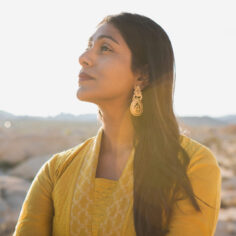
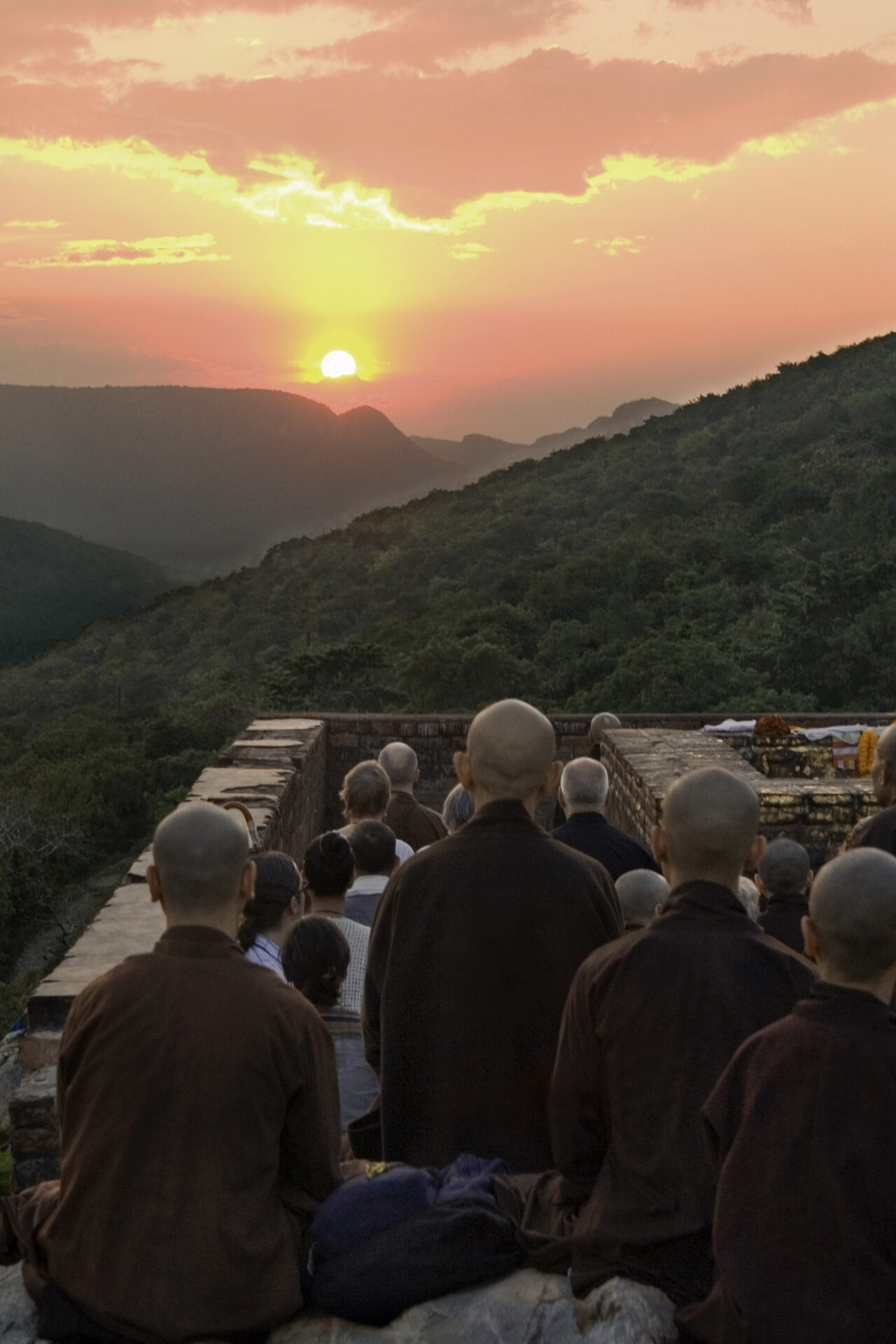
One of our newest Dharma teachers shares her journey of practice that has led to moving into a lay community and helping to found the Thích Nhất Hạnh School of Interbeing.
By Meena Srinivasan on
Moving to Simplicity Hamlet
The air in Simplicity Hamlet feels softer, as if carrying a quiet blessing. From our back windows I see the foothills cradling Deer Park Monastery,
One of our newest Dharma teachers shares her journey of practice that has led to moving into a lay community and helping to found the Thích Nhất Hạnh School of Interbeing.
By Meena Srinivasan on
Moving to Simplicity Hamlet
The air in Simplicity Hamlet feels softer, as if carrying a quiet blessing. From our back windows I see the foothills cradling Deer Park Monastery, afternoon light shimmering all around. Solidity Hamlet is home to the brothers, Clarity Hamlet to the sisters, and now our family has arrived in Simplicity Hamlet, a lay community forming in the monastery’s embrace under the gentle, steady leadership of Thầy Pháp Dung and Thầy Pháp Lưu.
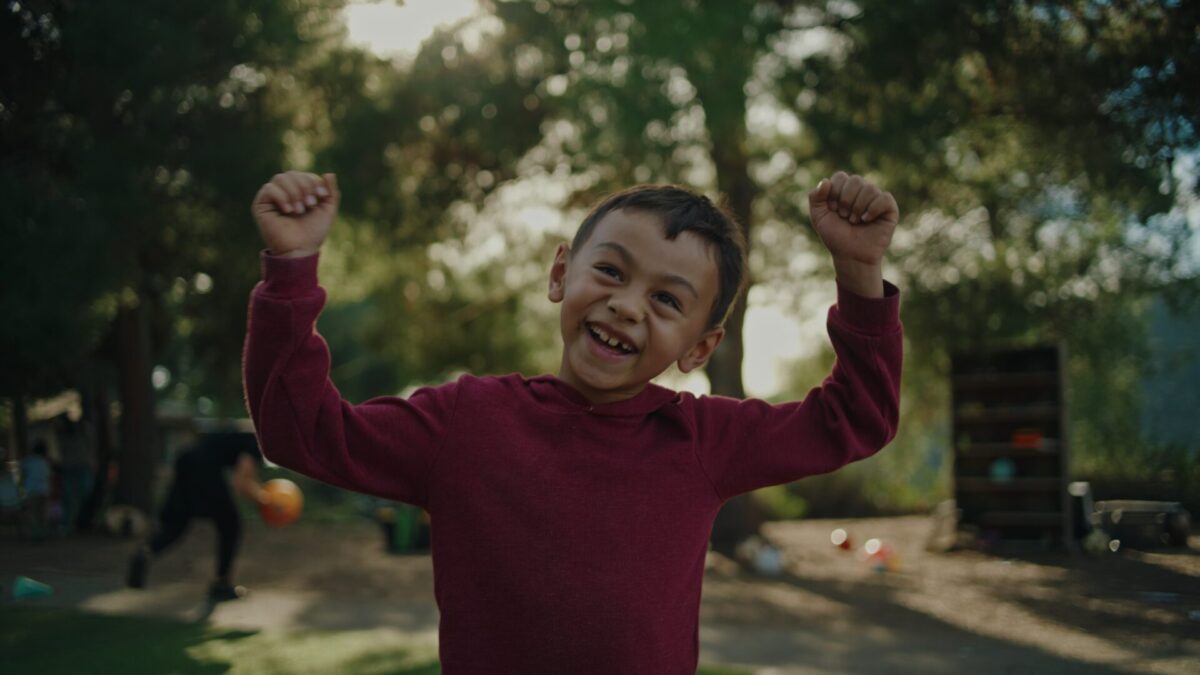
We haven’t come here to run from anything; we’ve come to move closer to what matters most. This moment—boxes still unopened, my seven-year-old son’s soccer ball skimming across the dirt backyard (soil I already imagine becoming a meditation garden beside a little play field for children), the kitchen filling with birdsong—feels like a threshold. A space between the life we’ve known and the one we’re cocreating: a village where children, parents, and monastics live in rhythm with the land, nourished by practice, presence, and belonging.
As the mother of a young boy, Kailash, I feel the rare gift of raising him in a place where compassionate, mindful masculinity is alive in daily life. In a world that often asks boys to harden, he’s surrounded by monks who embody another way, strength grounded in gentleness, leadership rooted in listening, and care held with equanimity. The men of Deer Park model a solidity that has nothing to do with domination, and everything to do with presence, playfulness, and joy.
As a tenderness researcher, I see how culture trains boys to armor up. Here, we’re writing a different story: tenderness as the truest strength, compassion as real courage. I return often to an insight attributed to Ilya Prigogine: When a complex system is far from equilibrium, small islands of coherence in a sea of chaos can shift the whole to a higher order. Deer Park, with monastics and lay friends tending gardens and hearts with equal care, is such an island. In this field, our family is learning that gentleness and strength belong together, seeds that can travel outward into a culture longing for balance.
An intuitive move
This threshold didn’t appear overnight. In 2020, in the midst of the pandemic, my husband, Chihiro, and I moved from the San Francisco Bay Area to San Diego with our two-year-old, not for a job, but because of a quiet, insistent intuition. It felt like stepping into the dark with trust as our lamp. Senior Dharma teachers Peggy Ward and her husband Larry, now a beloved ancestor, were in San Diego then; their presence helped us say yes.
We didn’t fully know why we were being guided south, only that the felt sense was unmistakable. Looking back, it’s clear the universe had plans wiser than our own. That intuitive move became part of a karmic unfolding: we would become the first family to live in Simplicity Hamlet, and our son will be among the first students at the Thích Nhất Hạnh School of Interbeing. It is a story of taking refuge in the mahasangha and discovering that when we step toward community, community steps toward us.
Not a school with a mission, but a mission with a school
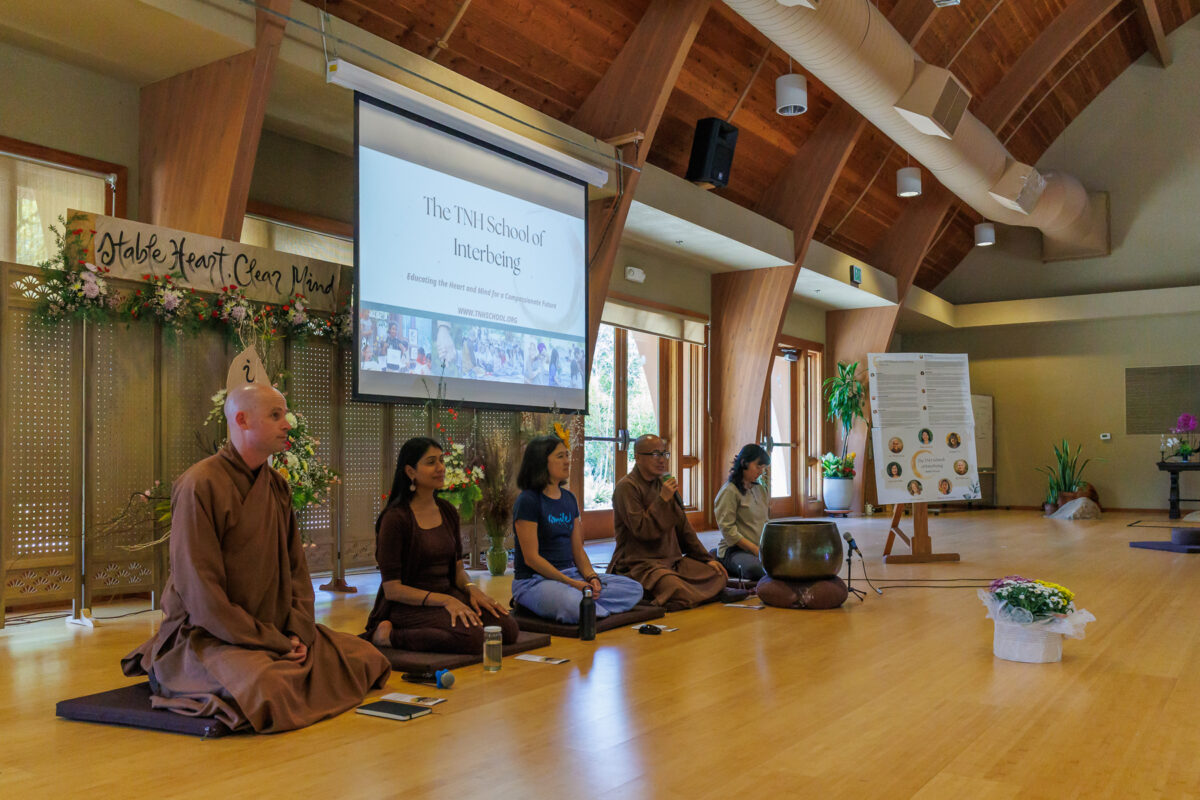
Our move is intertwined with the birth of the Thích Nhất Hạnh School of Interbeing, a K–8 learning village opening in August 2026, just across from Happy Farm at the entrance to Deer Park Monastery, nestled in Escondido’s “Great Hidden Mountain.” The seed was planted decades ago and germinated anew as Thầy Pháp Dung and Thầy Pháp Lưu invited a small circle of educators to radically imagine a school not as a program, but as a living expression of mindful education and interbeing.
This school isn’t separate from Deer Park; it is the monastery’s heart shaped for children. Learning moves with the land and seasons, in relationship with monastics who anchor our Plum Village practice, within a community that cultivates wisdom and compassion as living relationships with people, place, and all beings. Its touchstone is The Five Mindfulness Trainings, a shared ethical root orienting us toward reverence for life, true happiness, loving speech and deep listening, mindful consumption, and collective flourishing.
For me, the school feels like the flowering of a path that began twenty-one years ago in Oakland, when I first touched the Plum Village tradition as a young teacher attending an educators’ sangha led by Dharma teacher Lyn Fine.
First seeds: India, Hindu roots, and a glimpse beyond
I grew up the daughter of Indian immigrants who arrived in the US fifty-five years ago. My father landed in New York with $200, and he and my mother built a life brick by brick. My childhood was steeped in Hindu ritual alongside the relentlessness of the immigrant dream: success measured in education, achievement, upward mobility.
And yet, the summer after graduating from Amherst College and following a year at the London School of Economics, life cracked open. While working at Bloomberg News in New York, I experienced a spontaneous spiritual awakening: on an ordinary evening, the thin film of separation dissolved, and the world shimmered with aliveness. From that moment, the compass of my life quietly shifted.
Teaching as spiritual practice
My path had seemed set: a position at ABC News, professional experiences at Reuters, NBC, UNESCO, and the Woodrow Wilson Center. But the glimpse of the ultimate dimension called me elsewhere. I deferred my start date and accepted a teaching position in São Paulo, Brazil.
There, Parker Palmer’s The Courage to Teach found me: “We teach who we are.” Teaching could be spiritual practice, a way to align my heart with my work and stay connected to that wholeness I had tasted. When I returned to New York for ABC, light drained from my days. Palmer’s words echoed: “Our deepest calling is to grow into our own authentic selfhood…and find our path of authentic service in the world.” I was, at heart, an educator.
India: lineage meeting lineage
Graduate studies at UC Berkeley deepened my training in education while also studying Sanskrit. A spiritual teacher I studied with often spoke of Thích Nhất Hạnh as one of the only living enlightened masters. Seeds were being planted for a path I could not yet see.
Then came the call to move to India, less a choice than a current carrying me forward. My parents were bewildered; they had left India, but I was choosing to return. Yet something in me knew this move was karmic. At my interview for a position at the American Embassy School in New Delhi, I spoke of teaching as a sacred task; the superintendent mentioned an educators’ sangha founded by Dharma teacher Shantum Seth.
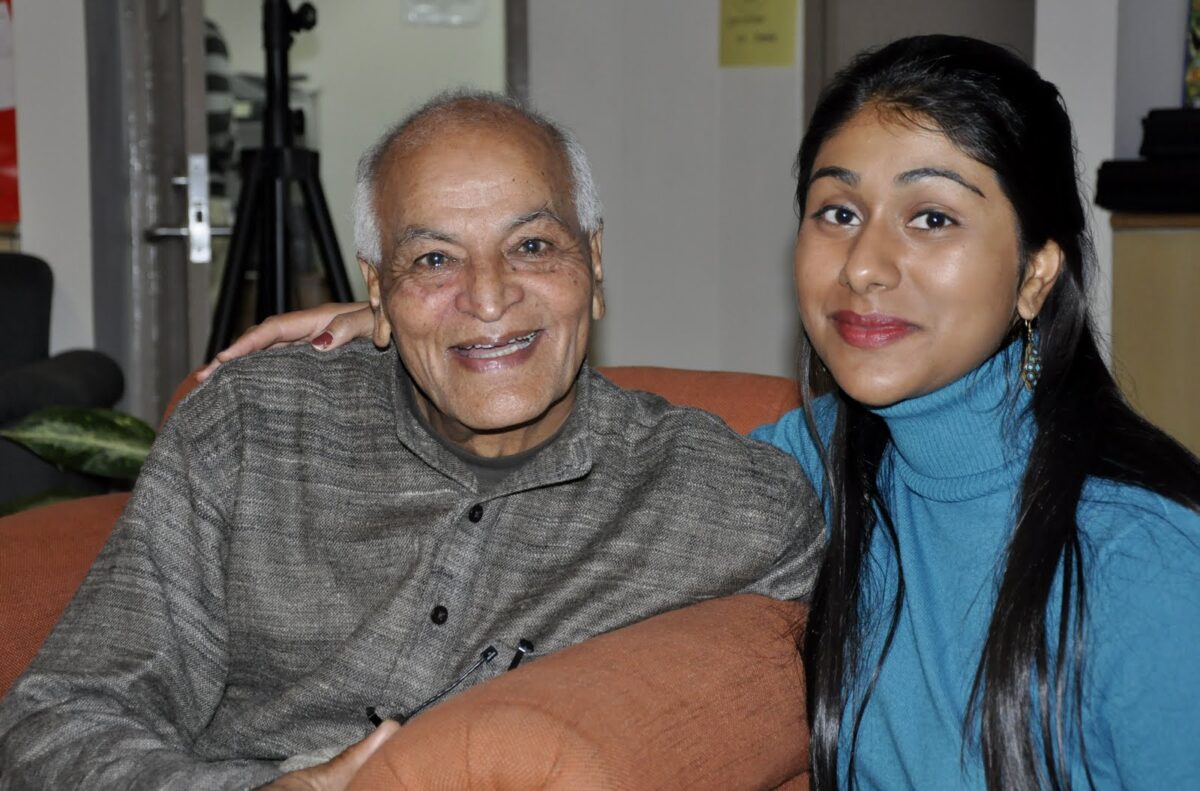
Soon after arriving in India, the ground kept preparing itself. I was blessed to study with Professor Ramchandra Gandhi, grandson of Mahatma Gandhi and student of Ramana Maharshi; his quiet gaze carried the stillness of the sky. “Your breath is your best friend,” he told me. “It is always with you, the last to leave you. You cannot breathe in the future or the past, only now.” Then I met Satish Kumar, who modeled sacred activism and simplicity. These encounters prepared the ground for the moment I met Thầy and the mahasangha at Gandhi Darshan.
To step into Thầy’s presence was to be washed over by boundless love. When he invited Shantum to sing one of my beloved bhajans, it felt like a blessing weaving my Hindu bhakti roots with Plum Village Zen.
At an educators’ retreat in Dehradun, with 500 teachers, I took refuge and received the Dharma name Pure Confidence of the Heart. Days later, I joined a silent peace walk after a month of bombings in my adopted city of Delhi and heard Thầy’s Gandhi Smriti Dharma talk urging us to be the Mahatma’s continuation. That evening, his teaching on interbeing felt like a direct transmission.
A few months later, under the Bodhi tree in Bodhgaya, I felt the magnitude of my vow. I began sharing mindfulness with children and educators across India and throughout South Asia, from Bhutan to Burma to Sri Lanka. In Nagpur at Dikshabhumi, where Dr. B.R. Ambedkar led hundreds of thousands of Dalits to embrace Buddhism, I offered mindfulness to Dalit children, humbled to help water seeds of dignity and presence.
In 2010, I was ordained into the Order of Interbeing in Delhi, receiving the name True Seal of Peace, which has become both a compass and an aspiration.
Returning home: a new kind of practice
In 2011, my mother became gravely ill and needed a double lung transplant. I returned to the US, practicing seeing my breath as her breath, each in-breath a quiet offering for her healing. She survived, a walking miracle of medicine, and I emerged with a deeper intimacy with impermanence.
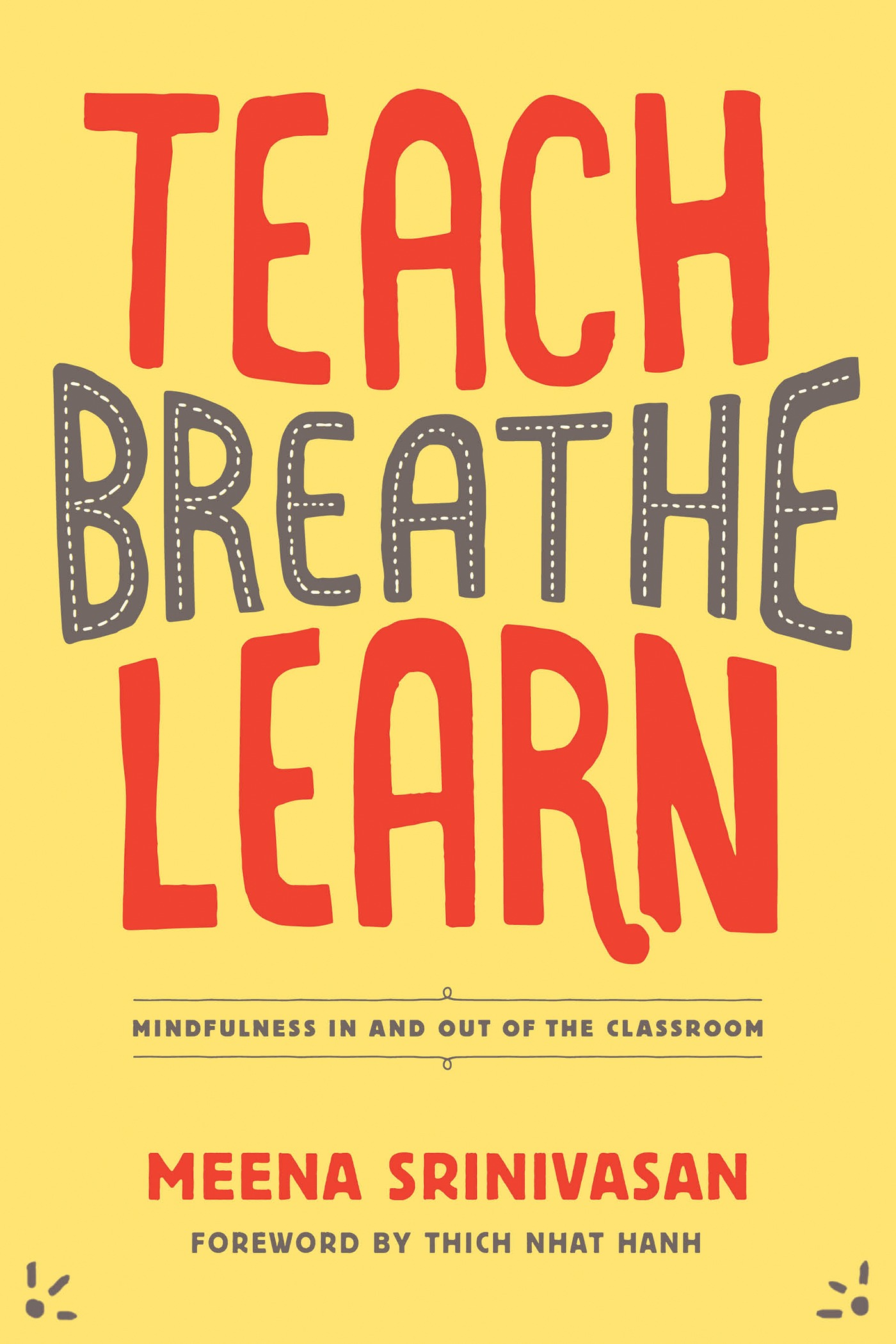
Back in Oakland, I taught at Park Day School where Mindful Schools was founded. What I shared with students became my first book, Teach, Breathe, Learn. When my editor at Parallax Press suggested a well-known secular mindfulness teacher who was my friend for the foreword, he declined, calling the book “too Buddhist.” This was over a decade ago, before many white secular mindfulness teachers began reckoning with appropriation. Even then, I knew in my bones: I had no interest in watering down the Dharma to make it more palatable. I was not here to be a “secular” version of myself.
In hindsight, his “no” was the universe intervening. Literally hours later, Kaira Jewel emailed: Thầy would offer words for the book in the gentle way monastics bring his voice onto the page. His beautiful endorsement became the foreword, imprinting my first book with my lineage and the fullness of the path I walk. It arrived a month before his stroke and sealed my vow: translate the Dharma into everyday language, yes, but never cut its roots.
From SEL to TEL: inner work for outer belonging
In 2013, my mentor Linda Lantieri (one of the founding visionaries of CASEL, the world’s leading organization advancing the research, policy, and practice of Social and Emotional Learning, or SEL) told me it was time to leave the classroom. She saw my capacity to bring SEL’s heart into whole systems. I earned my administrator credential at UC Berkeley, where I now teach SEL Foundations.
For five years I led systemic SEL in Oakland Unified as part of CASEL’s Collaborating Districts Initiative. SEL transformed schools, yet I saw leaders steering the ship while running on empty. That insight became Transformative Educational Leadership (TEL), a fellowship where diverse leaders integrate mindfulness, SEL, and equity in ways that are deeply personal and systemically impactful. TEL lives the truth that transformation begins within but must ripple outward to build Beloved Community.
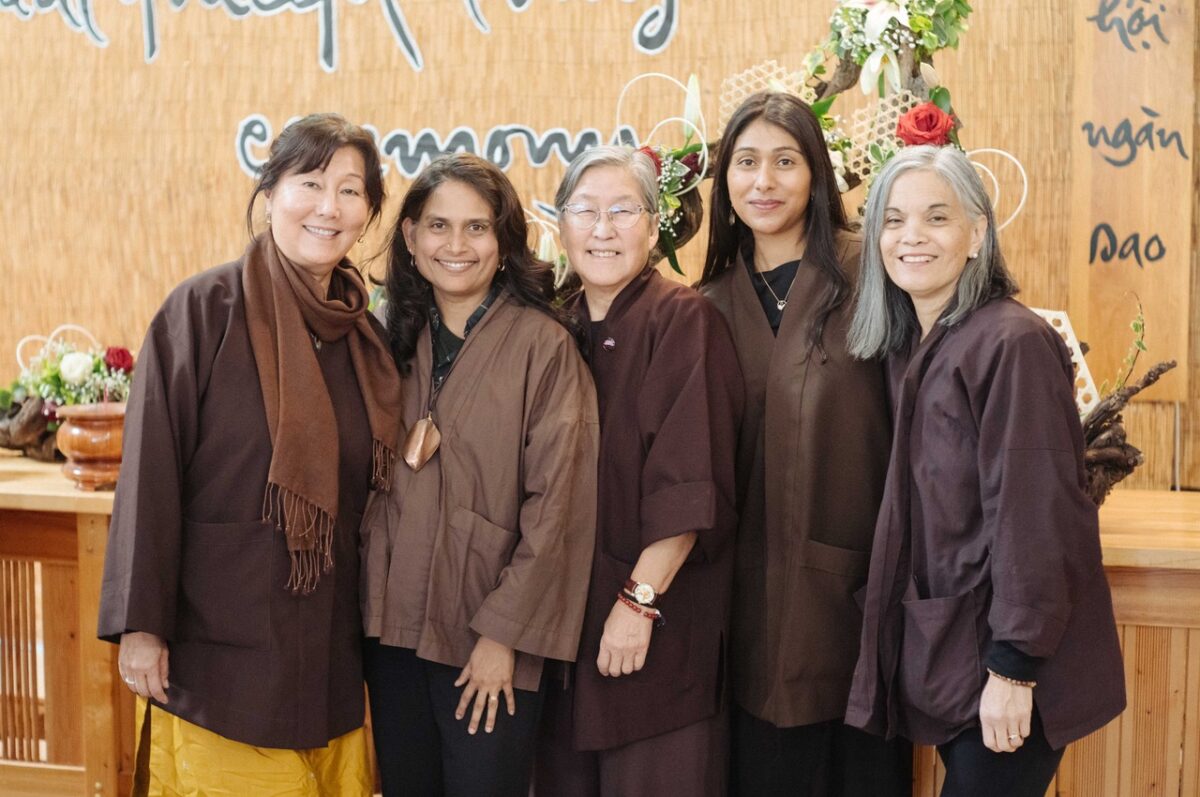
The Lamp before the move: a community light
Just months before our move to Deer Park, I returned to Plum Village. Sixteen years earlier I had come as a young educator, learning to bridge inner life and outer work. This time I returned older, tenderized by life—a mother, a wife, a daughter caring for aging parents, and a leader in heavy times.
I was invited to receive the Lamp Transmission, a sacred ceremony honoring commitment to mindfulness, service, and transformation. During the ceremony I received a transmission gatha, and one line in particular, a nod to Gandhi’s teachings, pierced straight through: “Your everyday life becomes your message.” As I received the Lamp Transmission, a radiant beam of light poured through the stained glass Buddha above Thầy Pháp Dung and me, and the small oil lamp I received burned for over thirty hours before quietly dimming. A teaching: tend, release, begin again.
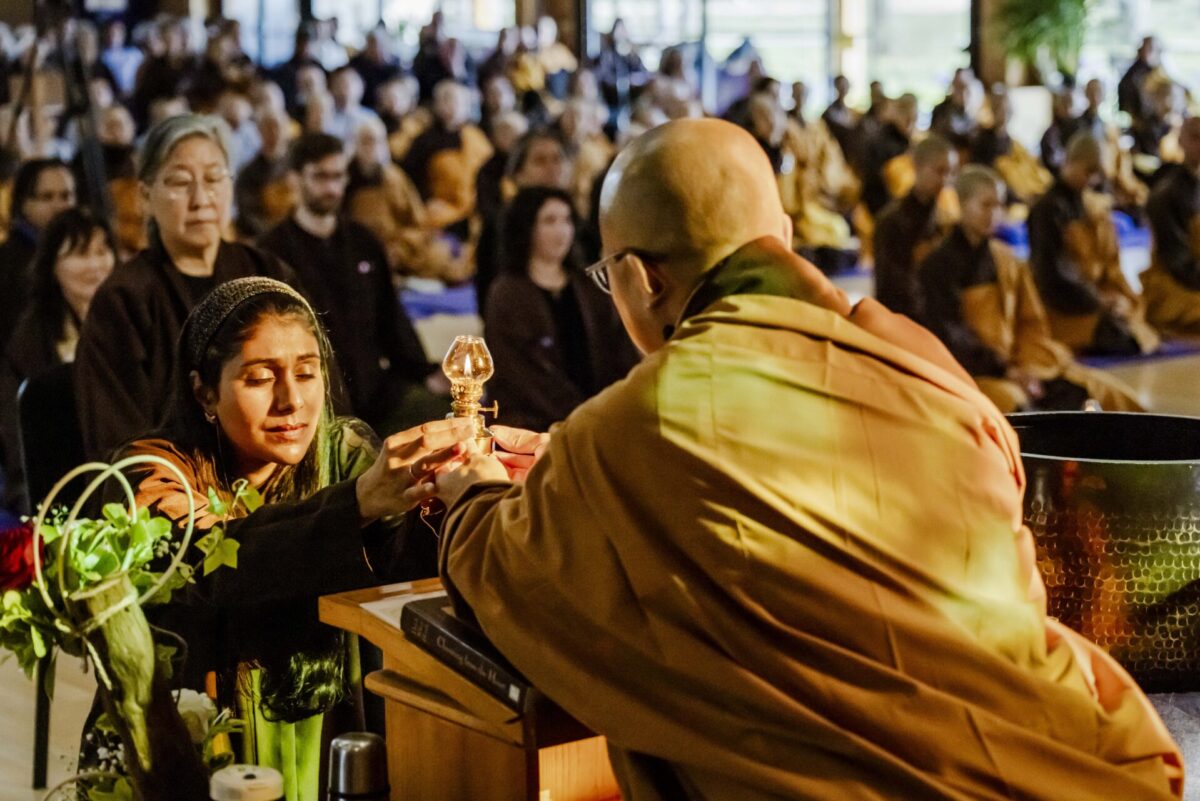
Afterward I wept surrenderful tears of gratitude as I prostrated before Thầy’s picture. I’ve never really made big decisions; they’ve made me. India called me at twenty-six. Now, at forty-five, Deer Park is calling with the same clarity. There is no deliberation, only surrender.
Meetings that made the path visible
Over several months, and many cups of tea, in early 2025, Chihiro and I sat with Thầy Pháp Dung and Thầy Pháp Lưu to make our family’s move concrete: listening for their vision of Simplicity Hamlet and reflecting on how we might serve the sangha. I wrote after one of our many meetings, “Dearest Brothers, there are no words to express what I feel.” I thanked them for seeing me—my spirit, gifts, and challenges—with such tenderness, and I shared our longing to live differently: not inside the isolating grind of nuclear-family striving, but inside a village shaped by practice.
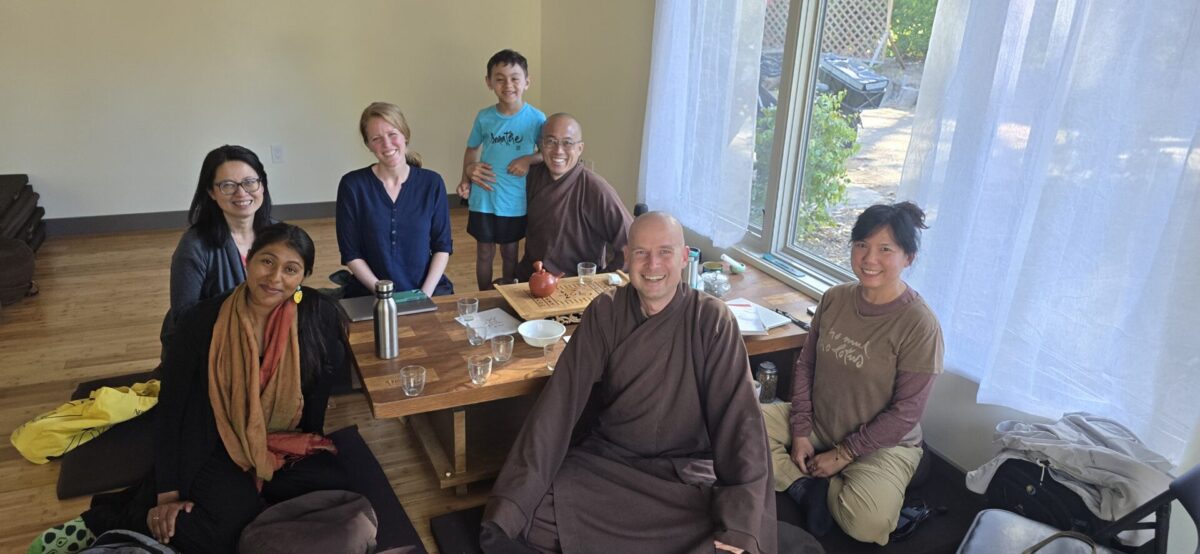
In one meeting, tears came, not from fear, but recognition. I said I knew this move was also about my own evolution and the polishing of my practice and path as a lay leader in the mahasangha. I confessed the quiet question that sometimes visits me: Am I worthy of this? Thầy Pháp Dung smiled and, with so much love, shut that story down: You are worthy by nature of who you are. Come back to the wisdom of your ancestors. Don’t get caught in the American paradigm of feeling you need to prove your worth. Ground returned beneath my feet along with a deep sense of belonging.
Together we named our family’s role as an anchor family for Simplicity Hamlet, here to do whatever is necessary to help the Thích Nhất Hạnh School of Interbeing manifest and to midwife a healthy lay community of families and children in harmony with the monastic rhythm. In my Hindu ancestral tradition, there is a word for how we hold this: seva, selfless service given from the heart, measured not by logged hours but by love and presence. Underneath is another word I cherish: svadharma, one’s sacred calling. My mentor Linda Lantieri’s teaching echoes here: “Talents are things others can do. Gifts are assignments from the universe. If you don’t say yes, they may not happen in the world.”
When our family offered a firm yes, something in the field shifted. Momentum gathered like a tide, as if the school project had been waiting for a family to jump in with both feet. In any beginning, someone often has to go first, not for credit, but to spark the catalyst energy that helps the unseen organize into form.

A small revolution in the laundry room
After packing up our home, we camped at Deer Park for a few days before summer travel and our official move. When we ran out of clean clothes, we asked Brother Aaron (a former monk, now a guiding lay Dharma teacher who lives here with his wonderful mother, an elder and former special-ed teacher who zips around joyfully on her scooter) where to get change for the machines.
He smiled and said, “It’s all free.” The machines came from a laundromat, he explained, but they’d been rigged to be free. “We just keep using the same quarters.”
We looked at our bag of coins and laughed—of course the quarters would circle back. It was a living illustration of what Thầy Pháp Dung means when he talks about circular economics: resources moving to meet real needs, always returning to the whole. A tiny decolonizing of habit in the most ordinary corner of daily life: laundry! In that moment, I felt how much unlearning lies ahead for our family, how much we will need to loosen our transaction-as-default conditioning, soften scarcity, and shift from “mine” to “ours.” In the hum of those machines, I caught a glimpse of what a community economy feels like: the clothes get clean, the quarters keep moving, and nobody is counting.
A summer of contrast: why deep community matters
The summer before our move, we joined an overseas program hoping for spaciousness, rest, and reflection as a family, so we could arrive more attuned to the monastery’s frequency. The people were warm and sincerely aiming to give their children a cross-cultural experience. The cohort leaned largely US-based tech founders, thoughtful parents comparing notes on screen time, networking, and “scaling impact.” I noticed I was the only dark-skinned person, and we were the only vegetarian family; seemingly small details, but they revealed the center of gravity. With our son in a Waldorf school (until the School of Interbeing opens) and our family’s device values already clear, we realized we’d arrived with a different baseline. No one was unkind; the frequency was simply tuned to a channel our hearts no longer recognized.
The experience became a mirror: while the wider current moved toward “wellness” and “optimization,” we longed for deeper waters, conversations about power and privilege, the unseen labor that sustains certain lifestyles, and the Earth that holds it all. What we touched was a friendly togetherness organized around individual families maximizing opportunities, beautiful in many ways, and less oriented toward examining dominant-culture patterns and equity. It’s a version of surface community many of us know, carried by a broader current of individualized striving.
What our spirits were craving, and what Deer Park embodies, is deep community: not just proximity or affinity, but values alignment held by explicit vows. In our tradition, those vows are The Five (and for many, The Fourteen) Mindfulness Trainings. They aren’t rules to perform; they’re living commitments that shape how we spend money and time, what we eat and consume, how we speak and listen, how we relate to power, and how we care for the Earth. In deep community, the unspoken questions shift from “Are you worth my time?” or “What can I get from this?” to “How can I be of service?” “What can we steward together?” “Who is missing, and how do we make room?”
Enough, together
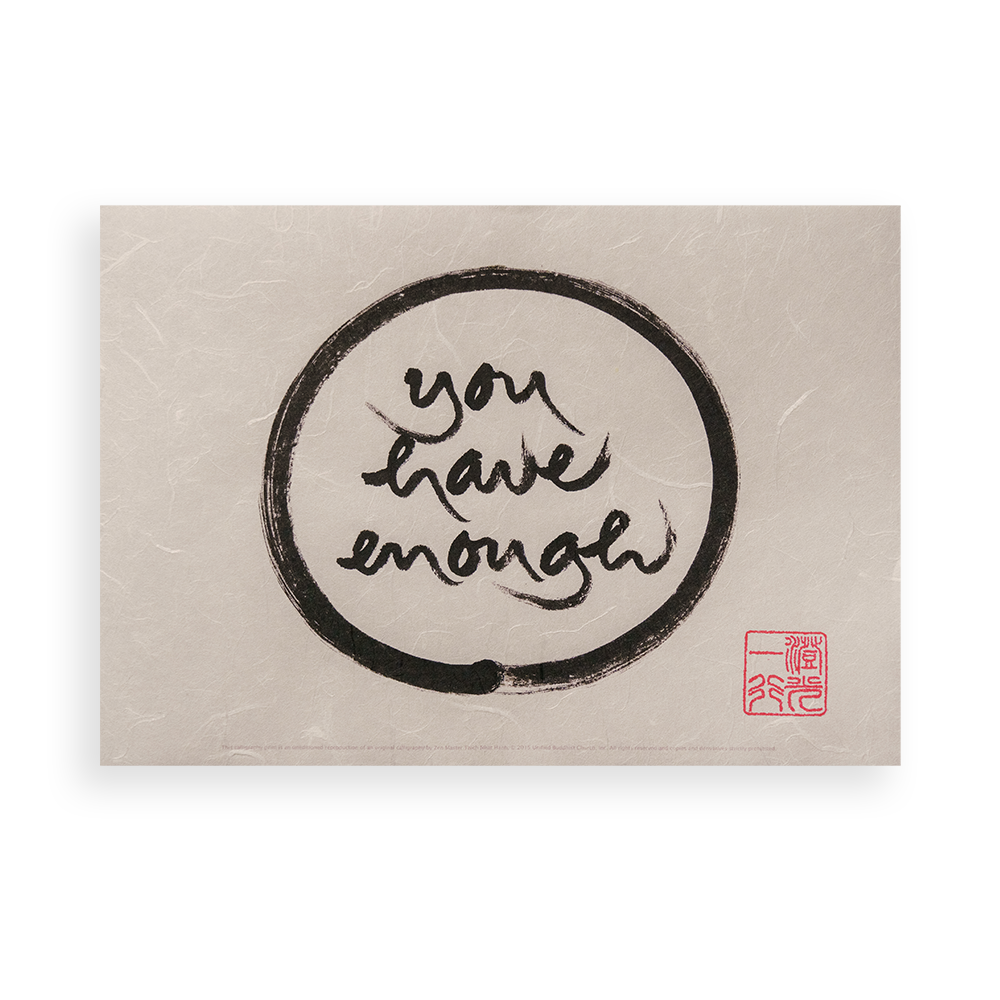
Sixteen years ago, on my first visit to Plum Village, I bought the only piece of Thầy’s calligraphy I have: Samtusta, You have enough. My friend, psychologist Daniel Cordaro, calls contentment “the knowledge of enough,” and Lynne Twist speaks of sufficiency as releasing the drive for more of what we don’t need so our energy can serve life. This move, this school, and this community are not about chasing happiness; they’re about listening to what is quietly, clearly true, becoming a small island of coherence together, a sangha for children and adults in a burning world.
I see it already. When I watch Kailash play ping-pong with the monks and basketball with lay friends, I see a boy learning to listen to the land, to people, to himself. I think of monastics whose footsteps serve as mindfulness bells. I think of lay friends choosing this with us, imperfect and practicing, all wanting something deeper than what we left behind.
Community isn’t the absence of friction. It’s the willingness to be present through the small rubs and big storms, to stay, repair, and recommit. TEL taught me that leaders need communities of practice to sustain courage. Deer Park is teaching me that families do, too. The school reminds me that the seeds of community live in all of us, waiting to be nurtured. And the Lamp keeps whispering that a life’s message is written in ordinary hours: the point isn’t to shine endlessly, but to tend the flame, noticing when it flares too hot or dims too low, asking for help, and sheltering it so it can keep giving light. In the end, we are the ones we’ve been waiting for.
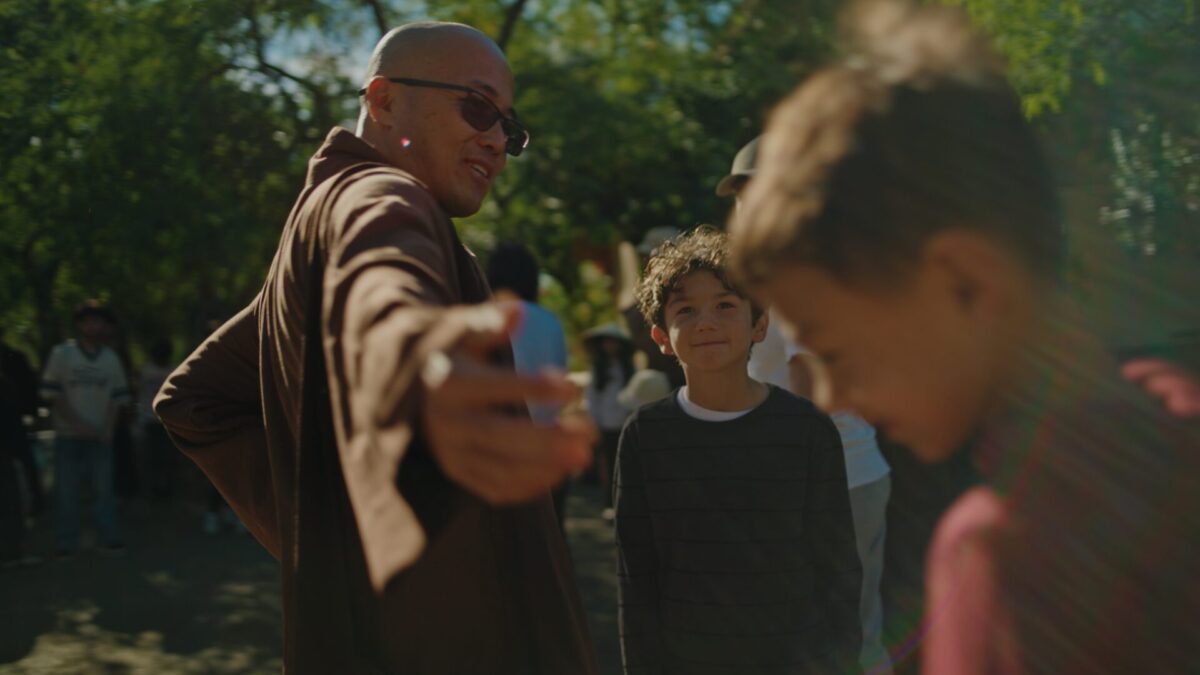
The Thích Nhất Hạnh School of Interbeing is launching a one-million-dollar Planting Seeds campaign to support the school’s founding (giving.tnhf.org/page/schoolofinterbeing). Whether you offer $50, $500, or more, every gift matters. Money, given to make a difference, does. It is blessed money. Your generosity will help build classrooms that feel like living rooms, gardens that feel like teachers, and a daily schedule that flows like a song we love to keep singing together. It will honor the labor that makes a village possible.

Thank you for walking with us, for believing in slowness, simplicity, and shared belonging, and for holding the truth that we have enough: enough to tend a flame, to be an island of coherence, to begin again. May we keep choosing community and tenderness, letting our lives be our message, and trust that the lamp we carry, lit by many hands, will shine brighter with your support.