An interview with Brother Pháp Lưu by Sister Tại Nghiêm on the spirit of the Order of Interbeing and Engaged Buddhism
By Brother Pháp Lưu, Sister Tại Nghiêm on

Sister Tại Nghiêm: What first inspired you to connect deeply with the spirit of the Order of Interbeing?
An interview with Brother Pháp Lưu by Sister Tại Nghiêm on the spirit of the Order of Interbeing and Engaged Buddhism
By Brother Pháp Lưu, Sister Tại Nghiêm on
Sister Tại Nghiêm: What first inspired you to connect deeply with the spirit of the Order of Interbeing? How did your understanding of the Order of Interbeing evolve after you became a monk?
Brother Pháp Lưu: I got invited to an Order of Interbeing (OI) retreat at Green Mountain Dharma Center in the spring of 2003. I wasn’t an OI member or even an OI aspirant, but I was very enthusiastic about the practice. The retreat was very peaceful. Some of the most senior members of the community on the East Coast, including Joanne Friday, Sue Bridge, as well as Sister Chân Đức, the Abbess, were there, which gave me a feeling of the gravitas of the OI and of how particular it is to our tradition.
I was especially impressed by Joanne Friday as a Dharma teacher. She had gone through so much suffering, and yet she radiated joy and spontaneity. She never complained. She has been a kind of underground mentor for me. Even since becoming a monastic, I still consider her my teacher. My associations with The Fourteen Mindfulness Trainings are very much connected to her spirit.
These Fourteen Mindfulness Trainings, more than anything, define the Plum Village tradition of Engaged Buddhism. The First and the Second Mindfulness Trainings especially struck me.
In the Buddhist tradition, we are reminded not to get caught in dogmatic thinking and ideology. The First Mindfulness Training of the Order of Interbeing includes this kind of self-reflection—a lion’s roar, really—on the Buddhist tradition. It helps us remember that we don’t need to carry the raft around after we cross the river.
TN: The Order of Interbeing has often been described as integrating Buddhist ethics into daily life through mindful social engagement, community care, and sustainable projects. From your own practice and community life, what is your perspective on contemplative practice and social action?
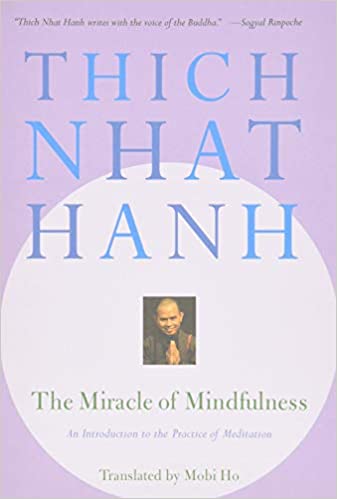
PL: Thầy created The Fourteen Mindfulness Trainings to help people train their mind to speak and act free from dogmas. Then Thầy wrote The Miracle of Mindfulness as a letter to his students, so they can train themselves with mindful breathing, mindful walking, mindful washing…. I hadn’t learned of any of this yet when I went to Madrid, Spain to teach English after university in 1997. I immersed myself in a movement—the Okupa Movement—with other young people who were trying to challenge the status quo of society with their own bodies. They were living in abandoned buildings in the city and trying to engage in social action in the streets to address the situation of undocumented immigrants; other communities were doing resistance work. Within those communities, I was close to a lot of anger and blame toward authority. In those movements for almost two years, I didn’t understand why I kept getting more and more angry. I didn’t have any way to take care of my mind.
Now I understand that I was in an environment that did not help me take care of this anger. It got overwhelming for me. When I came back to the US in 2000, I went into a depression. That’s when I discovered mindfulness meditation.
I said, “Okay, at least I can sit here on this cushion and embrace this anger inside of me.” So I trained myself in meditation, which gave me relief; I was able to touch joy again.
When I read Thầy’s story—the journal being shut down when he lost funding in the late ’50s, feeling undermined by elders in the Buddhist community—I asked myself, “What must have been going through Thầy’s body and mind?” He was in New York City, at Union Theological Seminary, hearing about protests at home against the banning of flags for Vesak, the collapse of the Ngô Đình Diệm regime, and eventually Diệm’s assassination. What could Thầy do? He fasted, sought connection with the United Nations, and then returned to Vietnam, knowing he might be betrayed again. He wrote a heartbreaking but beautiful poem about his two hands being crushed.1
When I have challenges in my practice, I imagine myself as Thầy in New York. Getting in touch with what Thầy went through makes it easier for me to deal with my own anger. I think of Thầy rolling up his sleeves, starting experimental villages, learning how to raise chickens, and working with Cô Phương Thảo and other medical students to bring basic hygiene to villages. He didn’t sit on the sidelines; he went out and helped people.
If you succeed at something, you may not learn much. But when you fail, you learn a lot. I fail a lot in the sangha. I have learned to enjoy failing. If you see failure as a joyful thing, you don’t get stressed.
Taking care of our minds while doing this work takes discipline and training. Having studied, gained knowledge, gone out to do activist work, and seen the dangers of not taking care of my mind, I felt deeply drawn to The Fourteen Mindfulness Trainings.
In 2006, Brother Pháp Hộ and I were asked to come to Deer Park to train and help build the sangha. We went to the hermitage to meet with Thầy before we left Plum Village. One thing Thầy shared with us that I always remember is to avoid getting caught thinking that there is a separation between the contemplative life and the engaged life. “Don’t see them as two separate things,” he said. “They’re not two, they’re one.”
Dualistic thinking makes us go back and forth between extremes—first you think you’re too contemplative, you have to be more engaged, but then you change to be more engaged, and then you’re too engaged, and you need to be more contemplative. It can go on and on.
TN: That is Thầy’s vision for us. How do you apply that in your daily life? How do you keep from being burned out?
PL: I don’t have trouble being burned out, because I always return to the sangha. With the sangha, you can do so many things. But if you try to do it all by yourself, then you burn out and you get stressed. Even if it looks like I’m doing a lot, it’s actually the sangha. If the conditions are there in the sangha, then boom—it becomes very easy to do things.
That’s how Thầy was able to write so many books. I just observed how Thầy did it. When I was a novice in Hanoi on Thầy’s return trip to Vietnam in 2005, people were getting sick, it was cold and wet. We didn’t know every day what was going to happen next and one of my elder brothers, Brother Pháp Trú, told me: “Just focus on Thầy. Look at Thầy. Do what Thầy is doing.” The whole tour, I did that. I didn’t get distracted by what my brothers and sisters were doing. I just looked at Thầy. What is Thầy doing? How is Thầy guarding his energy? When is Thầy resting? When is Thầy teaching?
One good thing as a monk is it’s very difficult to fire you. If you make a mistake or you don’t do something so well, it’s okay. If you succeed at something, you may not learn much. But when you fail, you learn a lot. I fail a lot in the sangha. I have learned to enjoy failing. If you see failure as a joyful thing, you don’t get stressed.
TN: The Order of Interbeing was born in a time of war in Vietnam. Sixty years later, what challenge does the Order of Interbeing need to respond to most urgently?
PL: I think we need to learn to be nimble and flexible, to respond dynamically to ever-changing situations. The biggest difficulty OI has now is that, like any institution, as it becomes larger it starts to take on unwieldy structures—structures that are there for good reasons, but that sacrifice nimbleness and responsiveness.
You can see this with the horrors going on in Gaza right now, or the rise of fascism in the United States: we struggle, as such a large organization, to respond effectively. It’s not because of any one person; it’s just difficult to work at scale with the structures we’ve put in place.
When Thầy started the OI, there were only six members and he was very clearly the one leading the way. The Six Cedars—the first six members of the Order—were very happy to follow Thầy’s direction. Now, we don’t have one leader everybody follows. So, we have to work together. We have to have good communication.
For me, the teaching on keeping communication open is critical. I see we are siblings, lay and monastic. Where we fail is where we cut off communication. All my monastic brothers know: whoever reaches out to me, I always respond. I really admire my elder and younger brothers and sisters who do that, who have that spirit. Thầy did that, too; he always kept communication open.
I remember one brother who, in 2004 at Deer Park, declared that he no longer needed to go to Thầy’s Dharma talk because he already understood everything Thầy had to teach. He said he would enjoy his practice and not attend the talk. Most of us felt incredulous and angry when we heard him say such things—that’s where we were in our practice.
Later, during a monastic day, Thầy invited that very brother to sit right next to him. I was upset—how could someone say such things about Thầy? But Thầy embraced him. That was a great teaching. I will never forget how Thầy embraced him right there, inviting him to sit beside him, and spoke with the sangha as one.
That spirit—always keeping communication open—was transmitted to me by Thầy.
You practice like Thầy to walk without conflict. That way you can bridge East and West. That was how Thầy did it. He didn’t criticize or judge others. He just walked his path.
TN: When you think of how the Order of Interbeing has grown across so many countries and cultures, what do you feel are the most precious strands?
PL: I think the ethical response to violence is fundamental. If we lose our ethical integrity, then we lose everything, and it just becomes tit for tat—them against us. Right now, international politics have descended into that kind of zero-sum thinking. What The Fourteen Mindfulness Trainings offer is this ethical core. It is not an ethics that sits on a shelf; it must be applied. How do you live your daily life? How do you respond, how do you practice listening deeply, responding with loving speech, acting with nonviolence—not only in bodily action, but also in speech and thought?
You need mindfulness to do this. You need to practice being mindful of your thinking, your speech, and your actions if you want to transform them. The teaching of Plum Village is that the means and the end are not separate: there is no way to Nirvana, Nirvana is the way. That is what we have to offer—in politics, economics, or spirituality.
TN: When you think of the sixtieth anniversary of the Order of Interbeing, what brings you the most gratitude?
PL: The brotherhood and sisterhood, the siblinghood. Everywhere we go on the Earth, we have family, created by our practice of the trainings. That fills me with gratitude, to know we have the sangha everywhere.
I see it concretely with projects we are starting here at Deer Park: the Thích Nhất Hạnh School of Interbeing, the new Deer Park Happy Farm, and the Thích Nhất Hạnh Museum in Los Angeles. None of these can be done alone; they depend on the Sangha in the Ten Directions. We look deeply to see what nourishes the sangha best in this moment.
At Deer Park, we keep nimbleness and the ability to respond as a monastery. This is thanks to the decision-making structure Thầy transmitted—the sanghakarman procedure, the bhikṣu and bhikṣuṇī councils as the priority. I hope we never lose that. In any organization, there is a danger of becoming more hierarchical, with an elite making decisions. Thầy taught consensus-based decision-making, democracy and seniority. He trained us well in this, and it allows Deer Park to be nimble in responding to situations.
Consensus decision-making has no merit without brotherhood and sisterhood. What allows our bhikṣu meetings to be harmonious is the brotherhood. I am grateful for the international siblinghood The Fourteen Mindfulness Trainings create—not only in the monastic sangha, but also among lay sangha members. We flow together like milk and water, very harmoniously.
TN: What is your deepest aspiration for the future of the Order of Interbeing?
PL: My aspiration is that The Fourteen Mindfulness Trainings can come to the UN and the International Criminal Court and actually help those bodies to be really effective moral forces for the world. I personally feel these two bodies really try to represent a universal kind of justice, a universal kind of democracy on our planet. But because the main powers in the world don’t respect these bodies or give them authority, they are not yet as effective as they could be, for example in responding to the climate crisis or increasing lawlessness and violence on the planet. The Fourteen Mindfulness Trainings have something to offer to those bodies and others who are doing great work, like Greenpeace, Human Rights Watch, Extinction Rebellion, and groups which at their core really uphold a profound humanity.
I remember being on a call six or seven years ago with a member of Extinction Rebellion. They were struggling with how to relate to each other within the organization, because it’s a decentralized organization. How do you make decisions? I shared a lot of what I’m sharing right now: you have to train yourself. You can’t start with the action and then work backward to the training. You have to train yourself to be able to act in a way which is truly humane and ethical.
TN: If you could transmit one insight from your journey to the younger generation of the Order of Interbeing aspirants, what would it be?
PL: Live your dreams. It’s not enough just to have a dream; you have to live it. That’s how you learn. And you have to have patience, a lot of patience—lifetime after lifetime of patience. When you practice to live your dream, you’ll get criticized, you’ll get judged, people will blame you, they’ll make you into the enemy. You practice like Thầy to walk without conflict. That way you can bridge East and West. That was how Thầy did it. He didn’t criticize or judge others. He just walked his path.
This is the translation I like of Thầy’s transmission gatha, which he received from our grandfather teacher. Thầy wholeheartedly put it into practice throughout his life:
Going to meet the spring one finds the strength to walk,
Walk without thought or contention,
When the lamp of the mind shines on the original nature,
The wondrous Dharma of East and West will naturally manifest.
TN: It’s very beautiful. If Thầy were here with us to celebrate sixty years of the Order of Interbeing, what do you think he would most want us to remember?
PL: Thầy would just want us to be able to come together as brothers and sisters, as siblings. Thầy loved when the sangha would come together and play! I see the upcoming OI retreat in June in that spirit. I remember in 2014, Thầy called all the Dharma teachers and said, “Mindfulness is a path, not a tool.” Maybe Thầy already had that idea, but I feel you don’t know until the sangha gets together.
Nowadays, we really have to physically come together more often; we see that virtual is not enough. When you recite the precepts, you have to be able to reach and touch the monk or the nun next to you. In that spirit, the Buddha already had that wisdom. Now we say, “Science says oxytocin is released when you are physically together with people and you feel happier.” The Buddha didn’t have that language, but he knew you have to be within arm’s reach of your sangha.
So I think what Thầy would wish for the sangha is that the sangha comes together as one big family.
TN: Is it the inspiration for the idea of fire building? Can you share more about that?
PL: We have these sessions of visioning about the OI charter and council. We will be reading the charter with some elders, both monastic and lay. We remember that Thầy always wished for us to learn to come together, drink tea, and share our ideas before we come to the meeting where we have to make a decision.
Thầy’s niece Anh Hương suggested the image of building a fire to prepare for the gathering in June 2026. That image really resonated with all of us. We knew it would be difficult for every OI member around the world to come to Plum Village. How do we host everybody? So we thought, let’s gather people whether or not they are coming to Plum Village. Let’s get them to come together in person in their local regional groups so they can play together, have a chance to practice together as OI members and aspirants, and then share about it, so that in the build-up to the larger gathering in Plum Village we can have these smaller regional sessions.
These regional sessions are also a chance to come together in that spirit of one family—brothers, sisters, siblings on one path. Through the organism of the sangha body, we can start to hear what is coming up for people in different areas so when we come together in June, we can do our best to address what is arising and look deeply.
TN: Thank you, brother, for what you shared. For me, it is really inspiring. It refreshed my bodhicitta. Listening to your sharing, I can really feel the fire is still alive in your heart, and this nourishes me.
1 Thích Nhất Hạnh, “Here Are My Hands,” Call Me By My True Names: The Collected Poems of Thích Nhất Hạnh (Berkeley, CA: Parallax Press, 1999), 59-61.