How a weekend retreat launched an OI journey
By Stephen Pradarelli on
People embark on the Buddhist path for many reasons: the desire to learn practices to calm the monkey mind, inspiration from a book, curiosity about Eastern wisdom traditions.
Heartbreak led me to the trailhead a decade ago, and I took my first tentative steps on the path at an autumn retreat in the Driftless region of Wisconsin,
How a weekend retreat launched an OI journey
By Stephen Pradarelli on
People embark on the Buddhist path for many reasons: the desire to learn practices to calm the monkey mind, inspiration from a book, curiosity about Eastern wisdom traditions.
Heartbreak led me to the trailhead a decade ago, and I took my first tentative steps on the path at an autumn retreat in the Driftless region of Wisconsin, US.
I was still mourning the end of a long-term relationship two years earlier and feeling considerable tenderness around challenges my son was navigating at the time. I had read a few books by Thầy, but I needed more—something embodied. The retreat, organized by the Snowflower Sangha of Madison on the edge of Governor Dodge State Park, seemed promising.
Driving up the winding road to Bethel Horizons retreat center, I encountered my first Dharma talk in the form of hundreds of acres of sprawling woodland, rolling hills, and sandstone bluffs. The late afternoon sun ignited the sourwood, sugar maples, and ginkgo, their canopies a shimmer of crimson, apricot, and saffron.
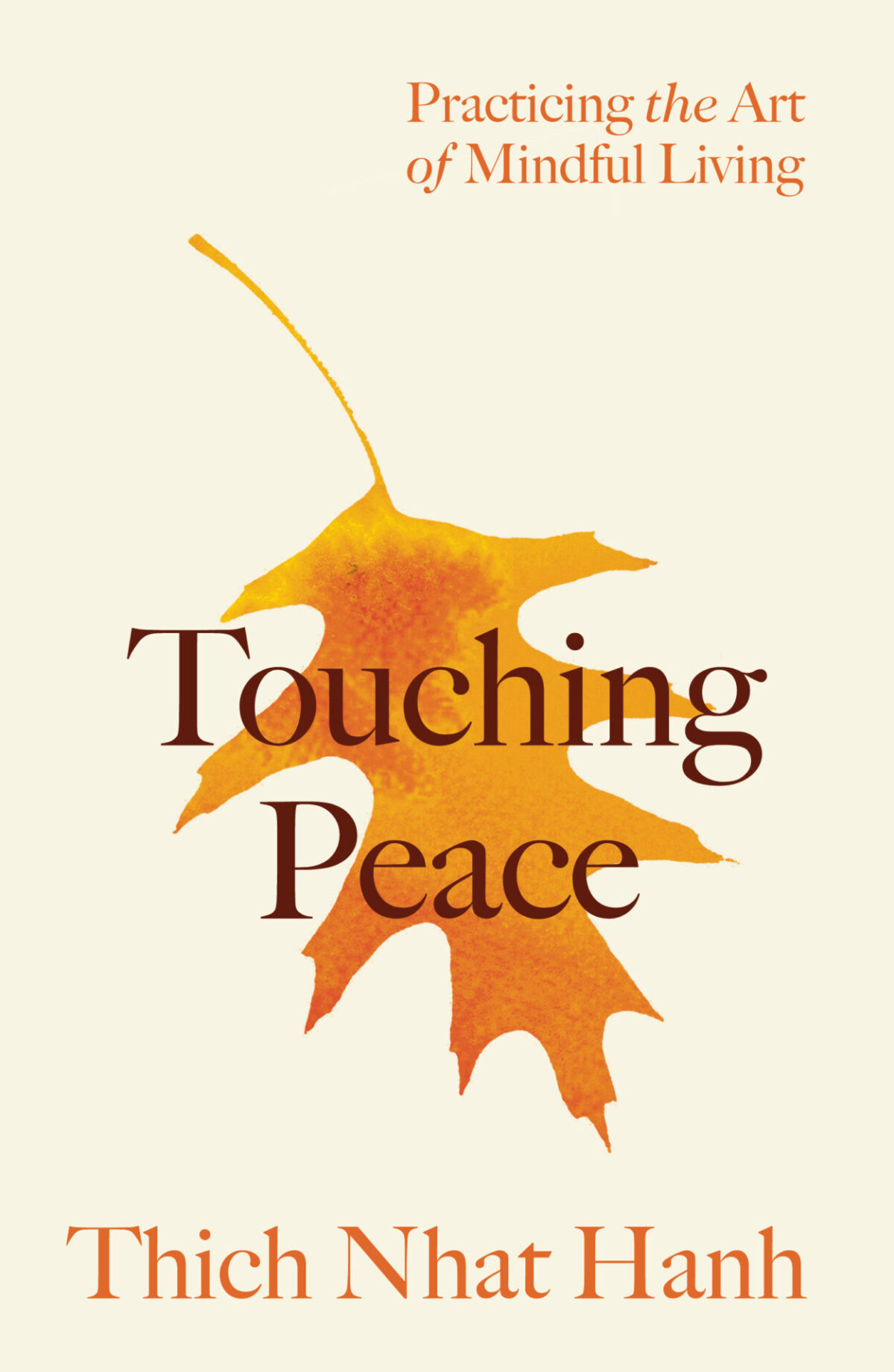
“To live in the present moment is a miracle,” Thầy writes in Touching Peace: Practicing the Art of Mindful Living. “The miracle is to walk on the green Earth in the present moment, to appreciate the peace and beauty that are available now.”
Walking into the main building to register and get my room assignment, I was self-conscious and shy. As a newcomer, I knew virtually nothing about the practices and protocols of Buddhism in general and the Plum Village tradition specifically. What if I got something wrong—didn’t bow at the right times, didn’t sit properly, didn’t know where to look or where to place my hands in meditation?
But I was immediately put at ease by how casual, welcoming, and familiar everyone seemed to me. The other retreatants—Midwesterners like myself—reminded me of aunts, uncles, and cousins back in Milwaukee where I grew up: plain-dressed (there were lots of blue jeans and flannel shirts), soft-spoken, sincere to a fault.
Whatever I pictured Buddhism to look like, this wasn’t it. This looked more like the crowd at a Catholic church potluck, which made me feel entirely at home.
After a light snack and some social time, we gathered for orientation in the large room that would serve as our zendo for the weekend. It had a vaulted timber ceiling, vintage 1970s macrame art, and large windows that looked out onto forested hills, now dark as plums against the night sky.
The retreat was co-taught by lay Dharma teachers Jack Lawlor, a Chicago attorney from a family of firefighters, and Cheri Maples. Cheri was a diminutive woman with a close-shaved head and monastic demeanor who, I was surprised to learn later, was a police officer in Madison.
Jack, in a brown fleece jacket and brown pants, shared his thoughts on the weekend’s topic, “Social Engagement, Transformation and Healing.” He spoke about Thầy’s development of Engaged Buddhism and said that in the Mahayana tradition, of which Plum Village is a part, meditation and mindfulness practices aren’t solely for our own benefit, but are for the benefit of all beings.
Whatever we gain from our time in meditation, that’s only the beginning of a committed practice; the next step is to take our mindfulness out into the world to help ease the suffering of others. Simply by walking mindfully, speaking thoughtfully, and listening deeply, we can heal the people around us.
Then Jack said that those who were interested in receiving The Five Mindfulness Trainings that weekend should come forward after the welcome session. I had only a vague understanding of the precepts, but I was among the first in line after most everyone else stood and headed to bed in noble silence.
“You need to write a letter to Cheri and me expressing your aspiration to receive the trainings,” Jack instructed our small group. “On Sunday, we’ll have a short ceremony and present you with a booklet and a Dharma named based on that aspiration.”
I didn’t keep a copy of the letter, but I remember writing about my longtime wish to live a life of integration and integrity. Growing up the eldest son in an alcoholic single-parent home, I’d learned how to be a chimera, always adapting who I was to suit the ever-shifting circumstances of home life. This meant knowing to be quiet and invisible when things became volatile, or funny and irreverent when my mother was “happy drunk” so I could garner rare positive attention from her.
As a result, it’s taken me years to figure out who Stephen actually is apart from my performances and longing for approval. After the failure of my own long marriage—the only intact family life I’d experienced up to that point—I questioned everything: who I was, how I was living my life, what came next.
There wasn’t a road map for where I found myself at that moment. All I knew was that I wanted to be a good person, certainly, but also a true person: to know, embrace, and weave fully together all my messy and beautiful parts. I wanted writer Walt Whitman’s courage to embrace all my contradictions. (“I am large,” Whitman writes, “I contain multitudes.”)
Buddhism, as I was learning that weekend, is a big tent, both as a philosophy and as a community. People are still people, with all their wild inconsistencies and quirks. But during our sunrise sits, or walking meditation to a bluff overlooking a quilted rainbow valley, or Dharma sharing, I noticed something: what really matters is showing up.
If you can be fully present to each moment, everything else will take care of itself. “There is only one moment for you to be alive, and that is the present moment,” Thầy said in a Lion’s Roar article in 2021. “Go back to the present moment and live this moment deeply, and you’ll be free.”
At the ceremony Sunday morning, I received The Five Mindfulness Trainings and my little booklet with the Dharma name Deep Integration of the Source. A sense of being deeply seen, heard, and known washed over me for the first time in my life.
I left the retreat nearly levitating in my car on the drive back to Iowa City, Iowa, fired up with the zeal of the newly converted. I wanted to keep the momentum of this transformative weekend going. Within weeks, I started Winding Path Sangha in Iowa City, hoping to share the “good news” of mindfulness with whoever came to the small room I’d reserved at the public library: three people the first week, eleven the next, and to my astonishment twenty-five soon after.
I signed up for more retreats, including the next summer retreat at Plum Village Monastery. I bought lots of books. And just four months after the Wisconsin retreat, I emailed Cheri asking how I might join the Order of Interbeing.
In my hunger for the Dharma, I was falling into the trap of thinking more was necessarily better (the notions of grasping and aversion were still too subtle for my baby Buddha brain to grasp).
Cheri was kind but clear in her response. “I think if you read the entire application carefully, you will see that you are not eligible yet to become a member of the Order of Interbeing,” she wrote back. “It requires practicing for a couple years after receiving The Five Mindfulness Trainings. It’s important not to be in too much of a hurry and I think you should practice for a while before deciding.”
I took a breath. I was disappointed but also grateful for the invitation to slow down and savor the journey. A year later, I submitted my OI aspirancy application, and Jack agreed to serve as my mentor.
“Mindfulness has helped me recognize the importance of living a life that permeates the boundaries and breaks out of the boxes I had previously used to define different aspects of my life: work, home, community, etc.,” I wrote in my OI application. “And it’s helped tremendously with past issues around anger and reactivity, calming and cooling and creating space for me to reflect before responding.”
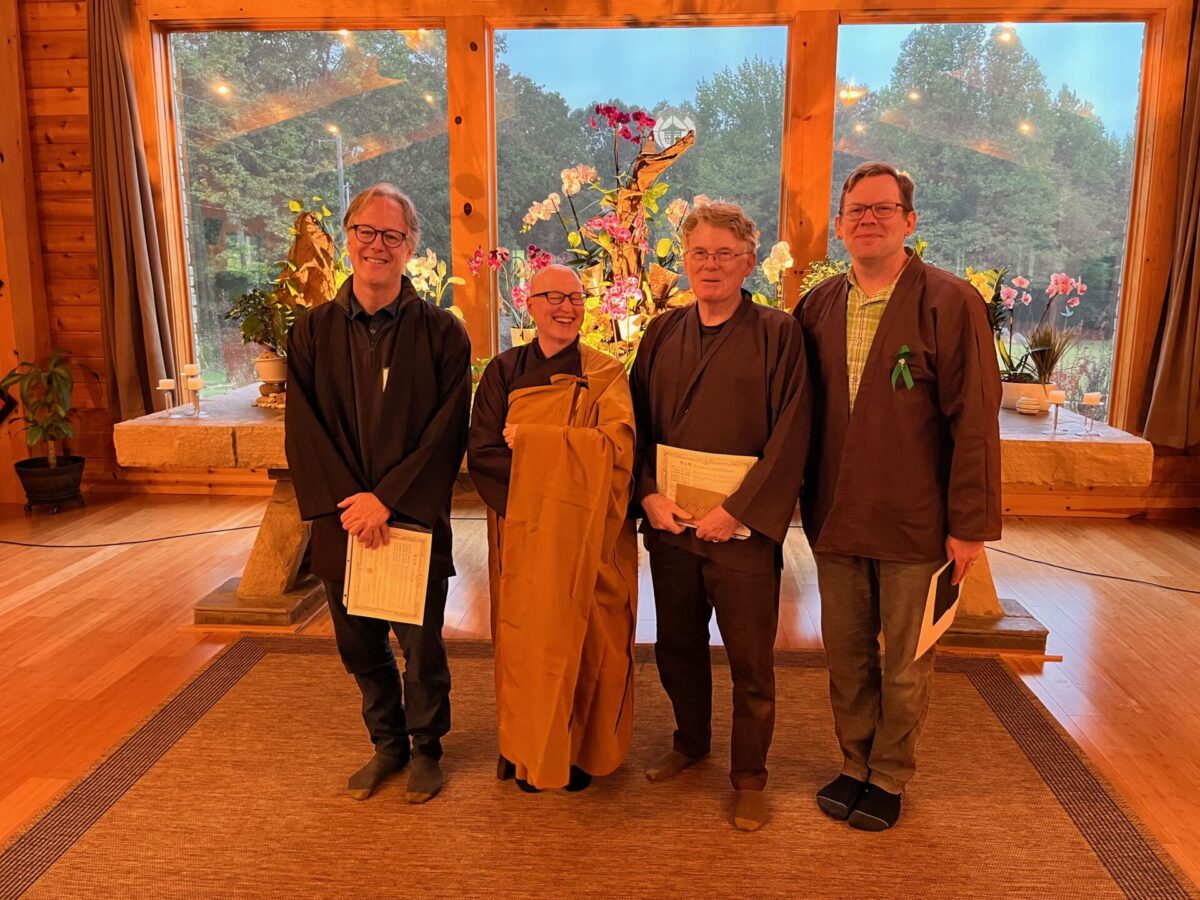
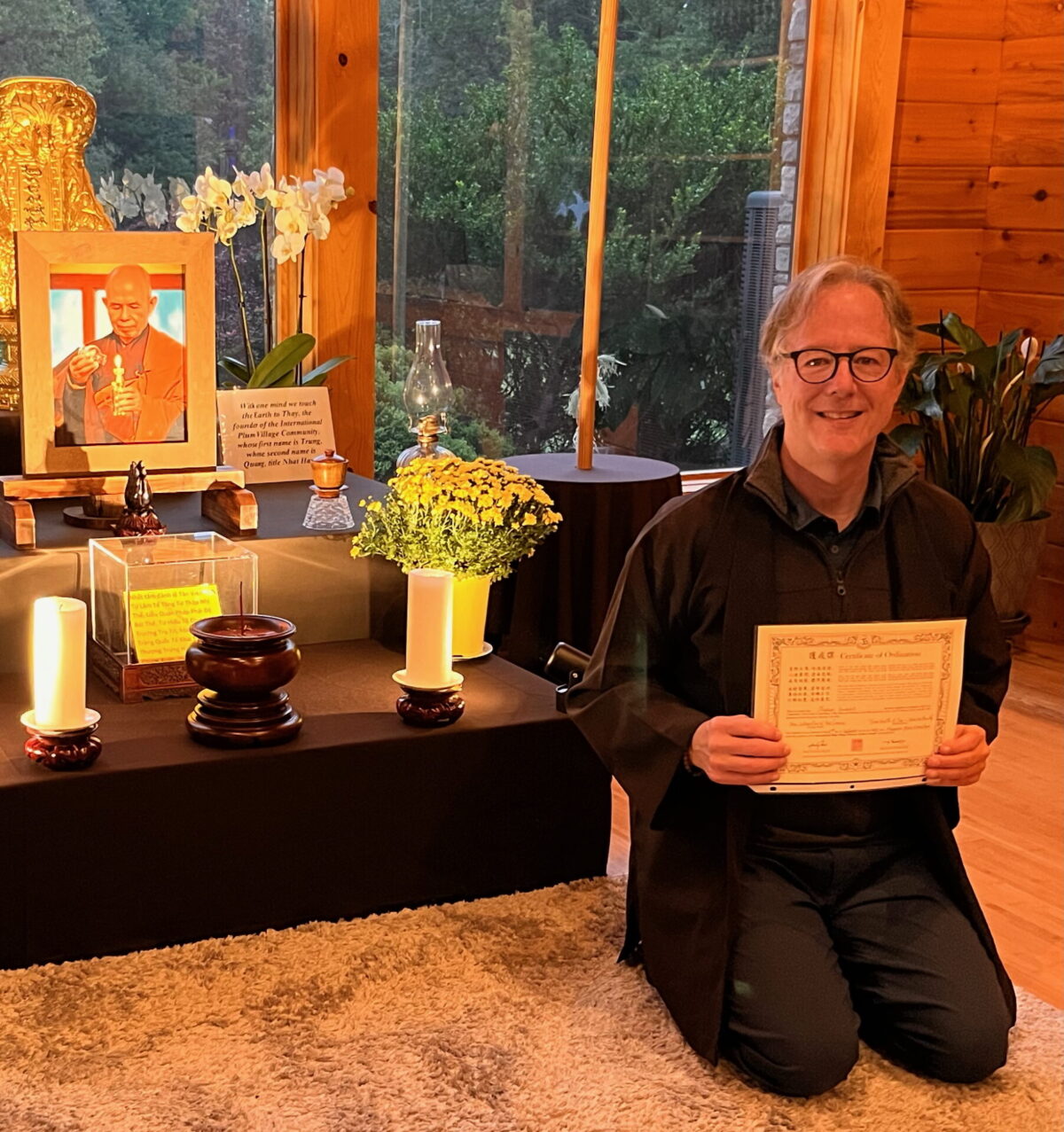
This time, as I began the OI journey in earnest, there was no hurrying; in fact, there were times over the next six years when I almost forgot I was an aspirant with an objective. Instead, I just showed up: with my mentor, with my sangha, in my home practice, for myself, and in my relationships.
In 2023, I received The Fourteen Mindfulness Trainings at an OI retreat at Magnolia Grove Monastery, along with my OI Dharma name: True Earth of Joy.
First integration, then joy. Both because I took a chance ten years ago and walked into a retreat with a broken heart and beginner’s mind.
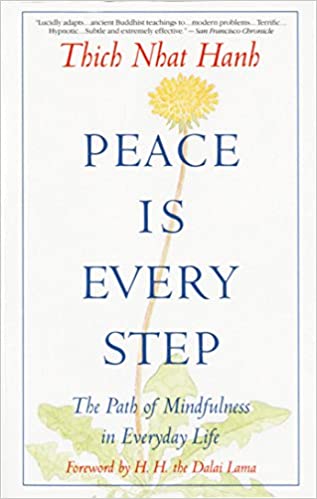
“The present moment is filled with joy and happiness,” Thầy reminds us in Peace Is Every Step: The Path of Mindfulness in Everyday Life. “If you are attentive, you will see it.”