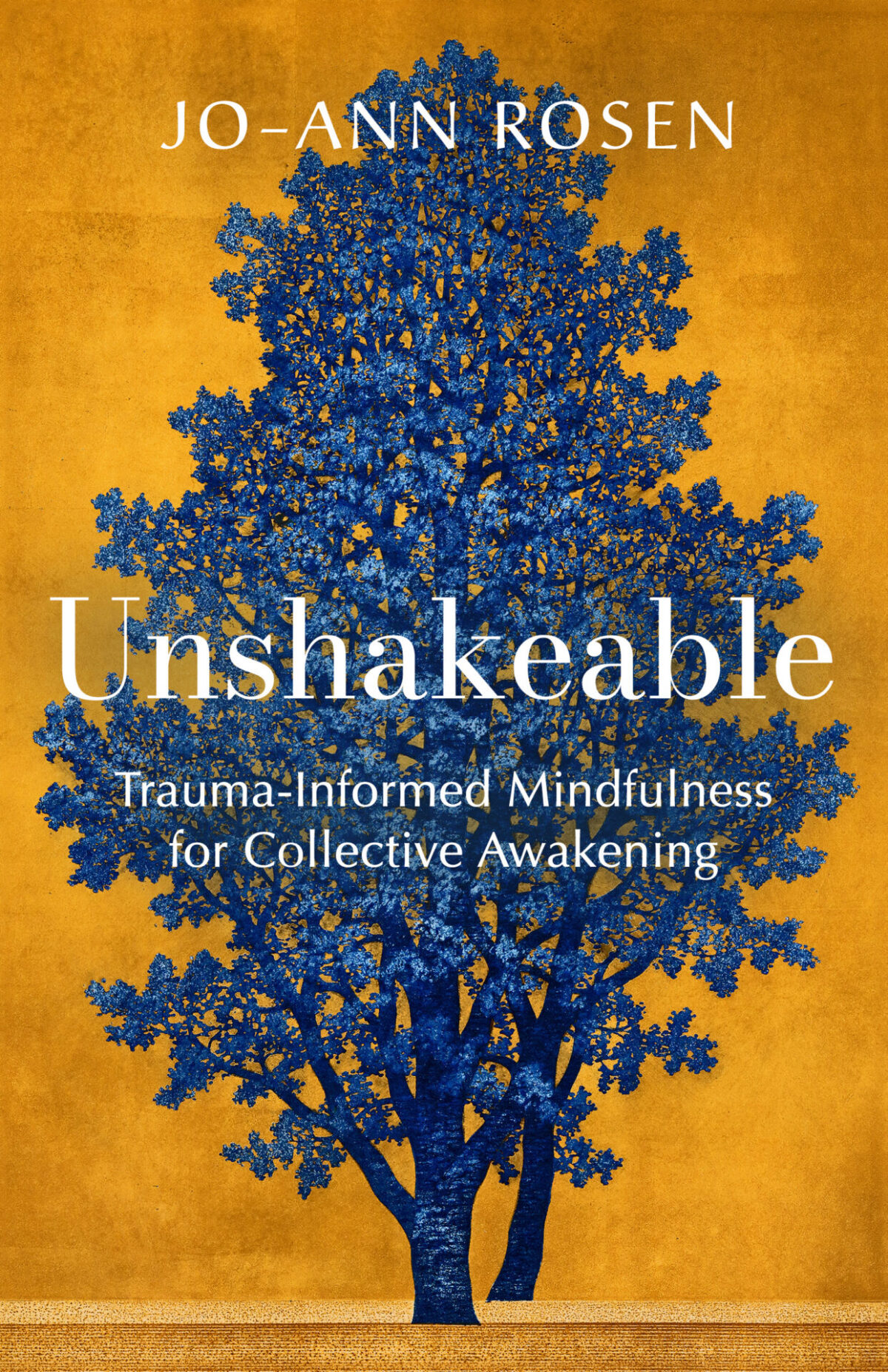
Dharma teacher Jo-ann Rosen guides us through exercises to help us regulate through unrelenting stresses and shares teachings from her engaging book, Unshakeable: Trauma-Informed Mindfulness for Collective Awakening
By Jo-ann Rosen on
I’d like to begin with the EMBRACE Land Acknowledgment:
In acknowledgment of the land and the land ancestors. I welcome each of us to bring our awareness to the storiedness of the earth under our bodies.
Dharma teacher Jo-ann Rosen guides us through exercises to help us regulate through unrelenting stresses and shares teachings from her engaging book, Unshakeable: Trauma-Informed Mindfulness for Collective Awakening
By Jo-ann Rosen on
I’d like to begin with the EMBRACE Land Acknowledgment:
In acknowledgment of the land and the land ancestors. I welcome each of us to bring our awareness to the storiedness of the earth under our bodies. May we listen deeply to understand the stories, the causes, and the conditions that got us here.

In reverence and with wholehearted gratitude, we honor the ancestral stream, our known and unknown land ancestors, our spiritual and familial ancestors. May we contemplate the challenges, the gifts, and the responsibilities that have been transmitted to us by all the land ancestors, the spiritual and the familial. May our learnings together on this path grow our ability to be mindfully present, to support our curiosity, and to feel truth so that we may transform what needs to be transformed for a just and equitable future.
I come to you with my own roots, my own biases, my own identities—I identify as a working-class woman with Jewish roots, who has lived rurally for many decades.
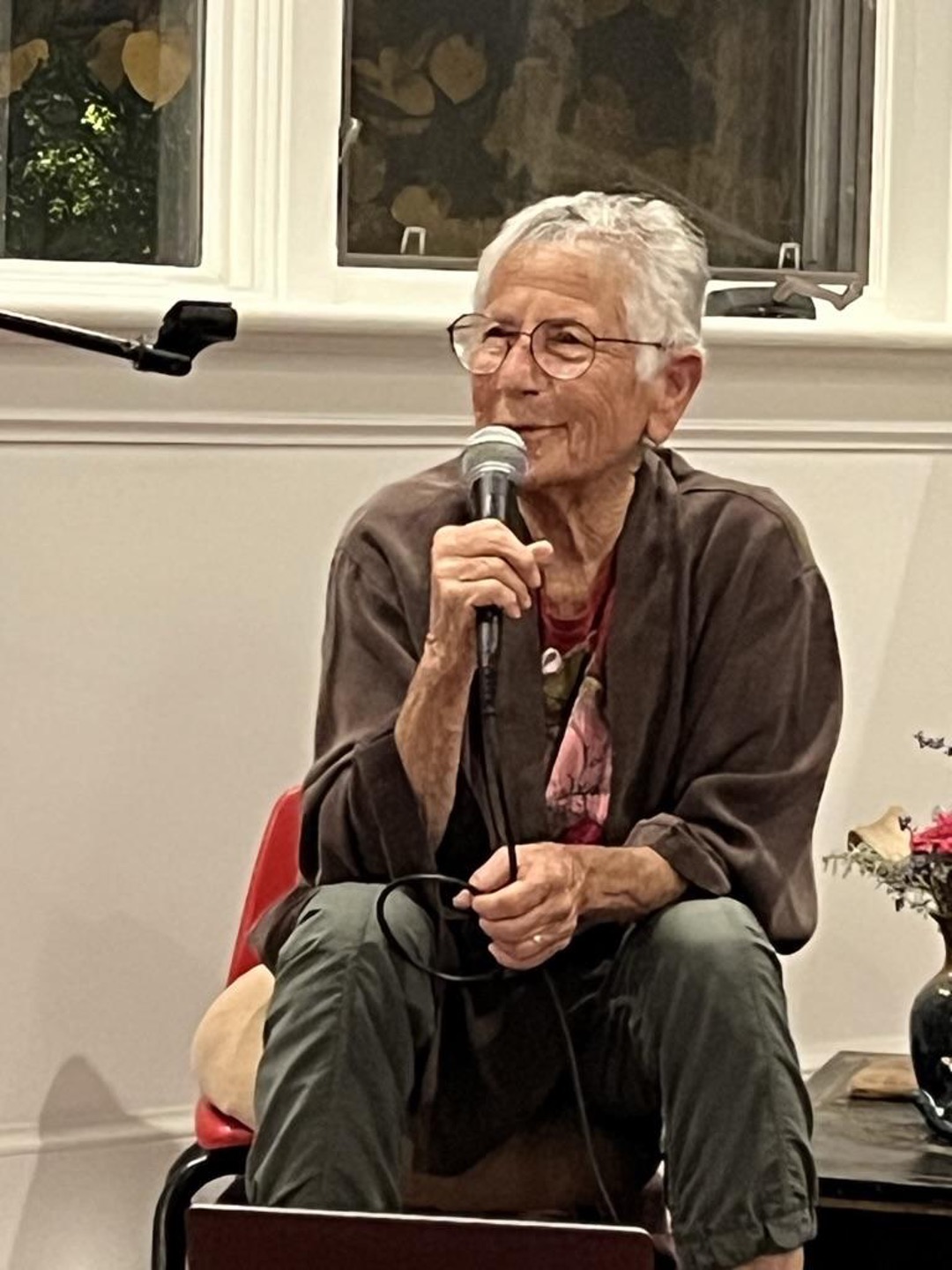
I didn’t have the ability myself today to do the exercise we’re about to explore together—I felt way too dysregulated by an ongoing heat wave, an upcoming election, and the humanitarian crises of Israel, Gaza, and the West Bank. I’ve been having trouble sitting; even in our lovely morning sangha, I can’t stand sitting meditation. I feel like I need to be yelling or running or breaking things. Today, I had to stick to very, very simple mindfulness practices: watching my steps; feeling the texture under my feet; going outside and feeling the sun scorching my skin; drinking a whole bunch of water. Those were the kinds of very simple regulating systems for this body.
I haven’t been able to adapt to unrelenting stress and perhaps neither have you; in fact, we don’t have a nervous system that deals with unrelenting stress. It takes tens of thousands of years for our hunter-gathererer nervous system to even do a little adapting, so we’re walking around with a nervous system meant for a lifestyle that doesn’t match with what we’re living.
If anything we do together doesn’t feel right to you, know that you are in choice—being in choice in and of itself can help regulate your nervous system. If you need to lie down, lie down. If you need to stand and move around, do. If you need to sit still or rock, try it out. You might want to look around and make sure your surroundings are good enough so if you feel like closing your eyes at any point, you’ll feel safe.
Our challenge is to figure out how to regulate our nervous system. When our nervous system is dysregulated, we’re in automatic threat mode—our life feels threatened, even when it’s not. In this mode, even getting stopped by a red light at the wrong moment can feel life-threatening in our bodies, which respond as if we’re in existential danger. And when we’re in danger, our brilliantly evolved nervous system immediately tells us to either go really fast, to fight, or to run away. You can feel that urge to fight or run away in your body as your arms and legs get more charged, your heart beats fast, and your breath speeds up.
Where we put our attention becomes our reality, so if we learn how to put our attention on the wholesome, safe islands all around us, we can calm our body and fool our nervous system into thinking everything is fine so we’re no longer in a fight-or-flight mode. When that happens, the cognitive, the receptive, the creative, the problem solving, and the interpersonal, social self can come online.
So as activists, how do we see a big picture?
How do we see the interbeing nature of what we’re doing?
I’m guessing many of you have a concern for the state of our Earth and our human civilization and want to help heal the world. That has certainly been a strong call in my life, but following it hasn’t always been an intelligent way for me to show up. When I was in my early thirties, I got smitten with the idea of getting arrested trying to stop nuclear power plants. I have to say, there was a part of me that was truly worried, but there was also a part of me that found it kind of romantic to get arrested and go to jail with a bunch of people. It seemed like we were being very effective, but I also noticed that there was a lot of ego showing up in the variety of leaders—I wouldn’t call everything that happened during those days skillful.
I might not want to participate in those activities anymore, even though what drew me to them still feels alive in me, but I notice that when we’re all riled up, we don’t use our wisdom to create wise action. We’re easily manipulated by chaos, by other people yelling or things going too fast, by someone taking over a meeting, and we don’t know how to stop when we get nervous. The very first thing we need to know if we want to be activists is that our action comes from a wise, broad view.
When human beings first roamed the Earth as hunter-gatherers, we were able to hunt our food supply almost to extinction. We were so clever, though, that when our animal food supply began to dwindle, we figured out how to make plants more productive. We were clever in the short run, but we didn’t see the big picture of what we were doing. This applies to much of what human beings have done: our shortsightedness helps us survive because we can mobilize to danger very quickly, but it also clouds our ability to see the big picture. When we’re dysregulated and highly activated, we’re focused very much on whatever that dysregulator is.
So as activists, how do we see a big picture? How do we see the interbeing nature of what we’re doing? We must have this cognitive perspective rather than acting out of being all riled up. Our cognitive part allows us to be mindful, to be curious, to see things as they are. We need to know when we’re dysregulated and feel that in our bodies. This is challenging because it’s so embedded in our lifestyle and culture not to be in touch with our bodies and the subtle and not-so-subtle signals that tell us, “Hey, hold on a minute, you need to settle yourself down.” So the first step toward mindfulness and seeing the big picture is to regulate ourselves.
An exercise to inhabit a sense of well-being
I’d like to pause to take a sip of water, because that helps me regulate. I’d like us to all have an experience of regulation, so you might want to try a drink of water yourself—be present for it; notice what happens before you drink and as you’re drinking.
Now we’ll explore a mindfulness practice together. Get comfortable; we’re going for the optimal balance between alertness and relaxation. There’s no right or wrong way to do this; we’re just going to spend time noticing. We’re going for a sense of well-being or good-enoughness: good enough not to be on high alert. You can say hello to your body—you might not have said hello yet today. You might enjoy taking a deep breath. If you feel a little drowsy, you might hold a big breath in; if you feel like you need to regulate down, you might want to focus your attention on a long, slow out-breath. Just notice the impact of the breath on your body.
Just notice, just scan your body for some part that feels good enough, relaxed enough, or maybe even pleasant. It might just be a slight breeze going across your cheek, or it might be that your knee doesn’t hurt quite as much as it did this morning. See if you notice a place where you can rest your attention at ease.
When your mind wanders—because that’s the nature of the mind, it’s always on alert for safety—just bring it back to curiosity about anywhere inside that’s good enough right now. Maybe it’s the sensation of weight or solidness where your bottom is being supported, or your feet, or your knees, or your hands. Weight can feel really good. Maybe you can feel your heartbeat in various parts of your body: in your throat, your chest, or even your arms or your fingers. Notice how observing our bodies affects how we feel inside.
If you feel like venturing into a different kind of well-being, bring to mind something that is almost always guaranteed to feel good—it might be the image of a dear one, a place you enjoy, an animal companion, or a piece of music. Well-being comes in so many different shapes and sizes, so bring to mind just one thing that has the quality of well-being without any bittersweetness. Bring it to mind in detail. What sounds might be there? What thoughts? What are the very best parts? Notice your body: is there anywhere you feel a sense of well-being, even just a little bit, just one breath’s worth?
Rising from this sense of remembering, you might consider putting a hand on the part of you that is responding to your images and holding your attention there as you water these seeds of well-being. This strengthens the neural pathway to this particular flavor of well-being; the longer and more frequently you visit this very place inside, the easier it will be to access this sense of well-being to help regulate your nervous system when you need it. Maybe as you do this, you notice a word or a body movement that feels like it encapsulates the feeling, or maybe it’s just one little image that helps you remember it. Perhaps taking a deep breath in and knowing that remembering this can remind you to revisit it at another time.
Just as you have savored this experience, so too can you create a lifestyle where you watch for these moments and slow down enough to savor them when they happen, knowing you can continue to savor them even when that time has passed. Watering wholesome seeds in this way is foundational to our practice of Right Effort.
Take one or two more breaths to accompany a sense of well-being.
Our impact on others
I would encourage you to share your experience doing this exercise with someone, because chances are that when you share your story of well-being, the person who is listening will light up as well. It’s important to realize that we are built to mimic each other’s emotional states. When somebody in our company is agitated, we can either become agitated ourselves (if we’re not aware that they are bringing us into their emotional state) or we can do things to self-regulate, which helps them to come into our sense of well-being.
Sister Chân Không has shared her insight that when she was rescuing Vietnamese refugees by boat and could hold a calm presence for them, the whole boat began to co-regulate with her solidity, her calm. This is something you can take into a meeting. When things get stirred up, you can be aware: “Ah, my body is being stirred up.” This is the practice of knowing your body and staying in touch with it so well that when you become dysregulated, you recognize it. We can make a big difference in a meeting—whether we speak or not, how regulated we are will impact others. This is already activism: to be in community, to be at work, to be in a movement, and to be solid, kind, and compassionate.
Each of our states of well-being can be developed by sitting with them, watching for them, practicing them when we go to sleep, when we wake up, and when we sit on the cushion. Metta is bringing up these wholesome states of well-being and sending them out to others. We can do this in our meetings and with our families. Sometimes, we care so much and things around us are so painful, ugly, or disruptive that we can’t handle our feelings.
Handling our pain
After the foundation of watering wholesome seeds and inhabiting a sense of well-being, the next step is handling our pain for our world. We learn to be skillful in bringing up difficulties and wrapping our mindfulness around them. It’s important for us to practice knowing when we are grounded and when we are not, when it is time to begin handling difficult feelings and to put ourselves in difficult situations, and when we have the capacity not to be carried away. This comes and goes. We need to guard our senses so we’re not overworked, not overwrought, and then we will have the resilience to take on and work with the right amount of pain.
I liken it to roasting a marshmallow: sometimes, you put the marshmallow on a stick, put it in the fire, and it turns to flame. What you have left is a yucky, black, ashy mess that nobody wants to eat. But if you take the marshmallow, hold it close to the fire so it just begins to brown a little bit, then pull it away, maybe turn it over before reaching it back toward the flames, the marshmallow will melt more gently and become something delicious.
It is the same with difficult feelings: if we notice that there’s a difficult feeling arising, we don’t have to just focus on the whole thing and become overwhelmed. We can take a little bit of it at a time. We can notice where it affects our body and then pull back if, for example, our heart starts to beat even harder. We don’t have to do it all at once. We can take a difficult body sensation, thought, or image in mind and just stay with it with curiosity for long enough to learn something. As soon as we notice we can’t maintain that curiosity, we go back to that sense of well-being, whatever it is. We need to practice this when we know we have the capacity not to be carried away.
An exercise to be with a concern
Now I want to invite you, if you feel like you have the capacity, to bring to mind something or someone that you have a sense of concern about. Start by remembering the exercise we did a few minutes ago where you had a sense of well-being. Get comfortable and start with a sense of well-being in your body and/or mind.
Allowing your sense of concern to arise now, tell yourself what you’re concerned about. Bring it to mind in much the same way as the sense of well-being: see it in your mind’s eye. Bring it to life in as much detail as possible, noticing what you tell yourself and what’s happening in your mind and body. Give it some time to become alive.
Notice if something happens in your body when you bring this concern to mind. Just be curious: when you’re in touch with your concern, what happens in your body? Then go back to that sense of well-being you played with in the first exercise, and just be curious: maybe nothing happens, or maybe something surprising happens. Then go back to your original sense of concern, again noticing what happens in your body.
Do this in your own rhythm, going back and forth, stretching yourself a little bit to notice what your concern is made of and what it is like to experience it. You might notice anger or fear or grief. Continue to come back to the refuge of your sense of well-being as you increase your ability to be with your concern, to be with your fear, to be with your grief, to really see what it’s made of. This is developing fearlessness and courage, little by little, depending upon your own capacity.
Always end by sitting with a sense of well-being: take some cleansing breaths, let out whatever needs to be let out, maybe hug yourself or put a hand on your heart and take two more breaths.
You may choose to take several visits to this difficulty, each time finding that new bits of insight might reveal themselves. Go at the speed of maintaining curiosity.
Creating wise action
In order to see clearly and accurately, we need to be able to handle difficult feelings. We need to become intimate with the things we care about. Often we run away, distance ourselves, or jump to action because it’s so painful, but none of this actually produces the kinds of results we hope for. We need to be able to look at a situation and feel fear or sadness or anger in a way that does not carry us away so we do not act impulsively out of fear, anger, or grief. Instead, we will be able to collaborate with each other and share our knowledge in a way that creates wise action.
The first step is being in tune with our body and knowing how to regulate it. The second step is knowing how to handle pain so we can see what it is made of and move toward intelligent action.
Once we’re ready for intelligent action, we need to have some guidance—not only collective wisdom, but an ethical compass. In our tradition, we’re incredibly blessed to have The Five Mindfulness Trainings and The Fourteen Mindfulness Trainings as real guidance for how to incorporate the biggest perspective possible in our actions. We train ourselves to have the insight of interbeing, which means incorporating many, many perspectives. Perhaps we can’t get all the perspectives, but we can certainly get more if we can come from a place of curiosity and mindfulness rather than reactivity. Sangha is a living laboratory for how to practice with kindred spirits to get the kinds of skills that we need, and then we can go out into the world and be in relation to others perhaps who are not on this path but who have similar concerns, similar commitments to the environment, to social justice, and to supporting others. It is important for us to be able to relax, to not be swept away by our difficult feelings, but to be motivated by our caring. Being able to handle our caring in a regulated, mindful way is a gift that, along with the Mindfulness Trainings, will guide us into wise action.
This is an excerpt from “Activism as a Vehicle for Awakening,” a Dharma talk given by Jo-Ann Rosen on July 19, 2024. It has been edited for length and clarity.