Order of Interbeing member Jessica Li-Winkler follows a school day of a future student, highlighting curriculum aspirations at the heart of the school’s mission: interdependence.
A young student holds an apricot in the palm of her hand, and she is invited to see the world within it. She is joined by classmates, who, too, are looking into the wisdom of this fruit, and by schoolteachers who are guiding a deeper understanding. This apricot is not only an invitation into the ultimate—a teacher of interbeing—but also a historic gift of the land in the ancestral home of the Kumeyaay,
Order of Interbeing member Jessica Li-Winkler follows a school day of a future student, highlighting curriculum aspirations at the heart of the school’s mission: interdependence.
A young student holds an apricot in the palm of her hand, and she is invited to see the world within it. She is joined by classmates, who, too, are looking into the wisdom of this fruit, and by schoolteachers who are guiding a deeper understanding. This apricot is not only an invitation into the ultimate—a teacher of interbeing—but also a historic gift of the land in the ancestral home of the Kumeyaay, where Deer Park Monastery sits. This is the literal and pedagogical ground beneath the Thích Nhất Hạnh School of Interbeing, a learning village whose doors are set to open for K-4 in fall 2026 for its inaugural year.
A child begins his school day by gently transitioning into the classroom. He joins the Opening Circle with other children for mindful movement, settling breaths, and a connection practice. Afterwards, transitions between activities are accompanied by song, setting a rhythm of musical joy and steady consistency. Lay Dharma teacher and Founding Board Member Meena Srinivasan believes that offering these somatic practices creates “an environment where [students] can know how to attend to their inner life.” Mindfulness is not only a tool for self-awareness at the School of Interbeing. Co-founder Alicia LeClair shares that “it is also about giving [students] the skills they need to be able to cultivate joy from all the conditions of happiness that are already present.” It is from this place of joyful awareness that students segue into their educational blocks for the day.
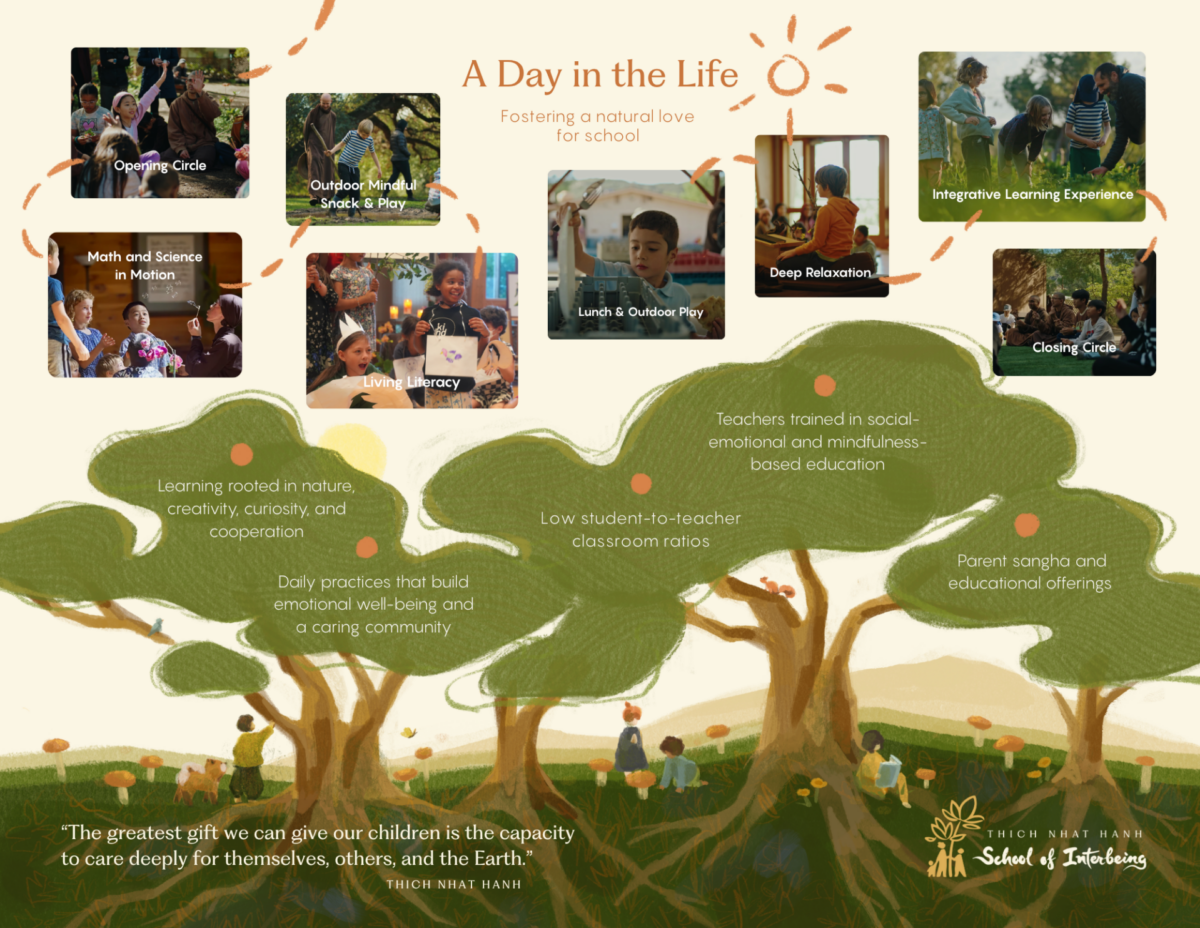
Math and science learning occur in motion. Children explore mathematical concepts through interactive and hands-on experiences, including live games and experimentation. But what happens when a student is caught in the challenges or anxieties of learning math? Director of School Operations Karman Mak shares an example of how mindfulness skills are embedded in academic lessons:
At the start of our math lesson, we all take a few breaths together, coming back to the present moment. With those in and out breaths, we notice feelings or thoughts we may have about the upcoming math lesson. Some of us may be excited, some of us may be nervous, and some of us may be thinking about play time. Whatever arises, we see it with compassion and care for it. In this way, we integrate Plum Village practices into all parts of the school day so that students build habits and resources to move through challenges.
Whether it’s mathematics or mindfulness, the holistic skills students develop during morning blocks offer the foundational support for integrative learning practices in the afternoon.
After lunch and a practice of deep relaxation, students participate in experiential, project-based learning. Skills developed during morning academic blocks, like literacy and science, are applied in real-world contexts. Children extend their learning in nature, at an elder care center, with a monastic on a hiking trail, or under the guidance of an artist-in-residence. It is during the integrative learning block that children explore the heart of Plum Village practice: interdependence.
During this time, a child meets the world around him and notices the ways in which that world lives inside of him. This is when a child encounters their contemplative life and understands their interdependence in community. This is when a child notices that the life of an apricot is not unlike her own.
“When you're eating an apricot that's been grown right nearby Plum Village by a farmer that we know,” Thầy Pháp Lưu of Deer Park shares, “the kids hold the apricot and they look at it and they're invited to see the earth in it, the sun, the rain. And then they see the farmer. They see the ancient apricots, which were not quite as sweet, that had been cultivated through hundreds of years to the sweet apricot that we have in our hand.”
“And they do that together with other students,” he continues, “so that there's a collective experience of interbeing.”
Thích Nhất Hạnh’s vision of education was not only grounded in interbeing; it was also informed by a history that intersected social responsibility and the alleviation of suffering. Thầy’s early work in education began in 1950s Vietnam, where he helped establish Buddhist education programs, most notably Saigon’s Van Hanh Buddhist University in 1964.1 Program curricula intertwined Buddhist philosophy with contemporary social concerns so that its students, including laypeople and monastics, would be equipped to aid their communities during and beyond the ongoing war that had plunged Vietnam into struggle. Thầy’s concern was that traditional models of education were heavily focused on accumulating intellectual knowledge, as opposed to cultivating the compassion and social engagement needed to halt war and heal communities.
“As Thích Nhất Hạnh reminds us, healing asks us to ‘wake up to the illusion of our separateness’ [...], to touch our shared humanity, while also not turning away from the lived realities that shape our experiences,” Srinivasan reflects. “It is in this deep and honest holding that the conditions for true, beloved community can begin to emerge.”
These are the storied taproots from which the School of Interbeing has arisen. When children are given the tools to access their inner awareness, tend to suffering, connect with the earth, and see themselves as a part of a greater community, a kind of hope begins to fruit. Thầy’s vision of education, from his early projects to later Wake Up Schools, empowered the next generation of community builders to look deeply into themselves. A transformative education is one in which students observe the dependent co-arising of suffering within us and around us. It is one that cultivates peace in the child, which, in turn, manifests peace in our shared future.
“When students experience their connection to the natural world—not as an abstract idea, but as a felt reality—they are more likely to act from love rather than fear,” Board Member May Duong says. “They can study real challenges, engage in service and stewardship, and practice ethical discernment through the lens of ‘this is, because that is.’ In this way, the School of Interbeing helps young people grow into connected, resilient, and compassionate community builders who can meet our times with clarity and hope.”
Around the School of Interbeing, the proverbial village grows. Through the guidance of Thầy Pháp Dung and Thầy Pháp Lưu, educators and families have come together to co-create a space at the base of Deer Park where they live and work in mindful harmony. Teachers and parents are especially called to nurture their mindfulness practices, as their influence at home or in the classroom rests on that bedrock. Now called “Simplicity Hamlet,” Thầy Pháp Dung describes this communal endeavor as “a culmination, a kind of flower, a blooming of the aspiration and the deep longing that many families and teachers have after Thầy initiated the Wake Up Schools movement to help bring mindfulness practice into education.”
“So raising your child, raising your family, educating your children is not like the responsibility of the teacher or the parent.” The effort, he says, is carried “throughout the village.”
A school day closes in the same way it begins—in a collective embrace. Children gather in a Closing Circle to reflect on their afternoon of experiential learning. With their teachers’ guidance, students revisit the day’s contemplative lesson, internalizing it in new and embodied ways. They “water flowers” for each other, offering words of appreciation and acknowledgement to their peers, which nurtures kindness, insight, and belonging.
Children return home knowing they are already whole and complete as they are. This energy of non-striving does not turn away from a child’s potential—it is rather a gentler mode in which students discover their strengths and true nature. This is the hope in building a village, after all—to return to a truer nature in which all beings are enough, all beings are loved.
1 Order of Interbeing | Tiep Hien, “Timeline of Community.” Accessed March 12, 2026, https://orderofinterbeing.org/about/timeline-of-community/.