A Journey From Rushing to Smiling
For several years, I knew the Plum Village community only through the pages of Thích Nhất Hạnh’s books and the envelopes that arrived via the sangha’s mailing list. I had attempted to attend a retreat years earlier, but my family felt I was too young to travel alone to an unfamiliar place and community.
But in September 1999, at nineteen years old, the conditions finally ripened.
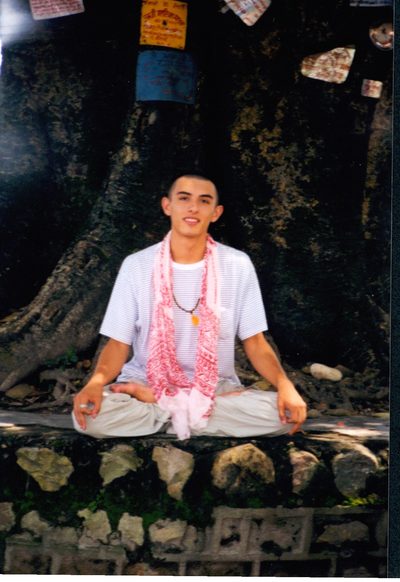
It was the summer before I was set to attend Western Washington University in Bellingham, Washington, US. When the opportunity arose to attend a retreat with Thầy at the UC Santa Barbara campus, I jumped at it. I boarded a Greyhound bus in Bellingham and rode the whole way down the west coast, eventually catching a taxi from the downtown station to the campus.
I was one of the first to arrive on that misty weekday morning. A thick, cool ocean layer blanketed the entire campus. I found my way to the dorms, checked in early, and settled into my room. Exhausted from the long journey but vibrating with the excitement of finally seeing my teacher, I lay down after lunch to take a nap.
When I woke up, I realized with a jolt that it was almost time for the retreat’s first evening Dharma talk. My dorm was all the way across the sprawling campus. Any peacefulness I felt during the misty morning vanished, replaced by the frantic energy of a nineteen-year-old terrified of missing out.
I was rushing. In fact, I was running.
I sprinted across the campus until I reached the cutoff path leading to the gymnasium. And there, up ahead, I saw a figure. A monk in brown robes, walking slowly, with two attendants just steps behind him.
I stopped for a moment, chest heaving, not wanting to intrude. Whatever thoughts I had of getting to the talk fast ceased. The frantic energy of getting somewhere quickly and any associated tension drained from my body. I began to walk slowly, aligning my footsteps with the monk's, trying to be as slow and present as I could.
It was Thầy.
Had I arrived at that path even a few minutes sooner, meeting Thầy might not have been so immediate. Instead, my teacher forced me to stop by blocking the way and opening a new path for me. For a few precious moments, our paths merged. I walked slowly behind him, feeling the profound stillness of his steps, until we reached the building and our paths diverged—me through the front doors, and Thầy and his attendants through the door nearest the dais. It was an awe-inspiring moment, a somatic transmission of peace that would continue to deepen within me throughout my life.
During that retreat, my practice took root in the fertile soil of my Dharma sharing family. I was placed in a group alongside other survivors of abuse, beautifully facilitated by Sister Susan and Patrecia Lenore. In the safety of that circle, I began to process the heavy narratives I carried.
I decided to write Thầy a letter. I wanted him to know the depth of what his teachings meant to me. In the letter, I wrote about my maternal grandparents' lives as civilian prisoners of war during Japan's occupation of the Dutch East Indies (Indonesia) during World War II, and our family's subsequent journey toward intergenerational healing. I also shared my own experience as a childhood survivor of sexual abuse, and how the trauma of testifying as a child witness had shaped my life. I told him that I had sought out his teachings as a way to liberate myself from the immense suffering I was experiencing, and as a method to help my family heal.
Along with my aspirations as a young practitioner, I included the lyrics to a song I had written for the sangha titled “Soldier.” It was a song about ending the war within, and letting go of the armor we inherit:
I don’t want to be a prisoner
And lock these worries in my womb
I don’t want to be a savior…

I want to tell my sister
My mother, father too
The gifts in life are plenty
The choice to grow and change

I want our generation
To heal the bleeding wounds of war…
Sister Susan offered to deliver the letter to Thầy for me. The next day, during our Dharma sharing circle, she told me that Thầy had received it with a smile.
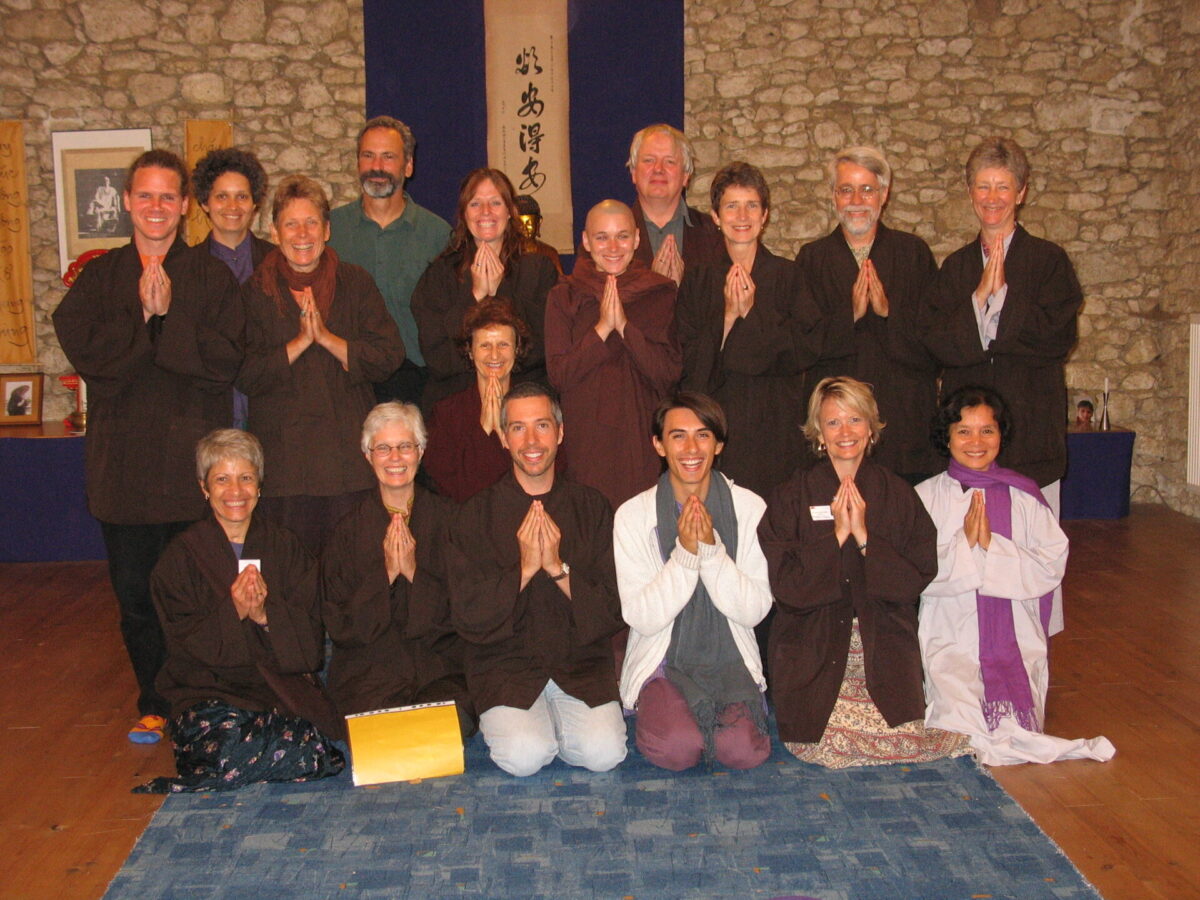
From that first retreat in 1999, I would spend the next two-and-a-half decades traveling, sitting, and walking with Thầy and our beloved community. There were many chance encounters over those years, many moments of quiet transmission with Thầy. In 2006, after I was ordained into the Order of Interbeing in Plum Village by Thầy and the community, Thầy posed for individual photos with each of the ordinees. He approached, standing next to me at the table for the West Coast United States sanghas, and said, “Smile.” The cameras clicked as we looked in the same direction and others looked toward him.
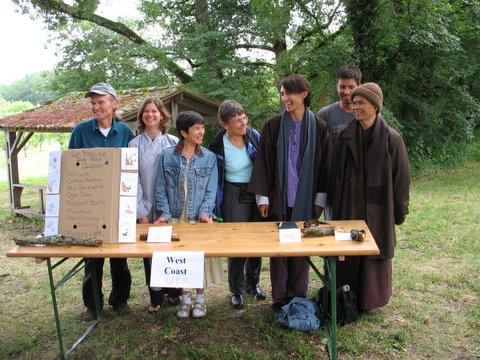
Decades later, as a clinician and dharmācarya, the memories of that first misty morning in Santa Barbara, of smiling and walking with Thầy over the years, remain strong and clear. I don’t have to rush to catch the Dharma. Instead, I can be present where I am and smile, because the Dharma is present in me and around me too. The transmission continues from that first time falling into step behind Thầy, breathing in, breathing out, and in allowing his single word, “Smile,” to guide me. It’s not always easy to smile, but a smile can heal many wounds of the past and in the present. That is the practice.