by Renewing the Great Precepts Transmission Ceremony Process
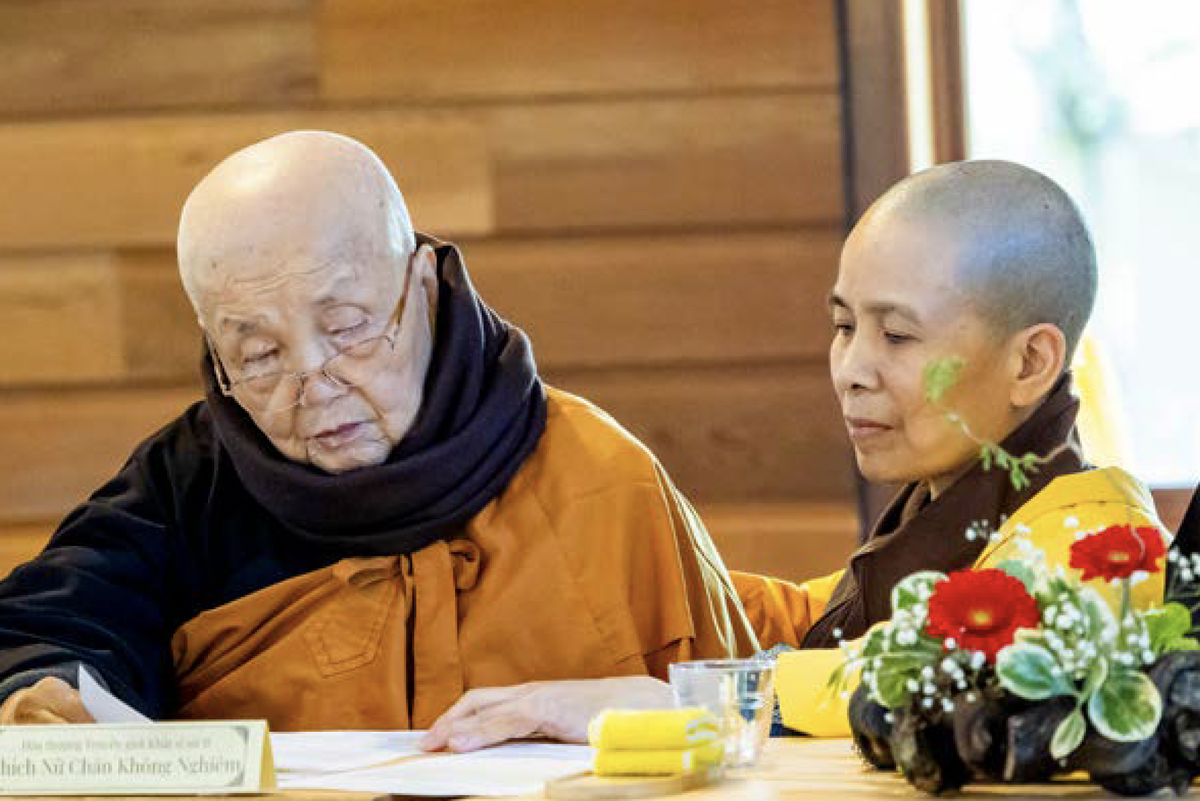
At the 2026 Great Precepts Transmission Ceremony “Still Water,” during the ceremony to transmit the bhikṣuṇī precepts, I couldn’t hold back my tears when I heard the very clear and calm voices of two transmission Venerable nuns, Sister Chân Không and Sister Trung Chính, as they transmitted the precepts to the nuns. These two elders, who were seemingly not very long ago two young nuns,
by Renewing the Great Precepts Transmission Ceremony Process
At the 2026 Great Precepts Transmission Ceremony “Still Water,” during the ceremony to transmit the bhikṣuṇī precepts, I couldn’t hold back my tears when I heard the very clear and calm voices of two transmission Venerable nuns, Sister Chân Không and Sister Trung Chính, as they transmitted the precepts to the nuns. These two elders, who were seemingly not very long ago two young nuns, now have become the precept transmission Venerables to transmit the precepts to their young siblings and the generation after. Their reading was not just about transmitting the precepts, but it was as if it carried the whole length of the transmission history.
Right after becoming a nun, I had a chance to attend the 1994 Great Precepts Transmission Ceremony “Fragrant Mountain,” which was conducted during the summer opening. It was the second of this kind organized in Plum Village (back then, it was still called Persimmon Village). As a novice nun, I was fortunate enough to attend the High Venerable nuns such as Venerables Đức Viên and Phổ Đà. Both Sister Chân Không and Sister Trung Chính were still very young bhikṣuṇīs. Thầy Pháp Hòa, still a novice monk, was accompanied by his master to the Great Precepts Transmission Ceremony to receive the bhikṣu precepts. He was also part of the attendant team, including Sister Tuệ Nghiêm and myself (he attended the Venerable monks). As I was still very young in the Dharma, I just took into my store consciousness whatever sounds and images without any questions.
Time goes by. Every time I recall those moments, I gain a little more understanding of what has happened, which has now become part of Plum Village history.
The connection between a Great Precepts Transmission Ceremony and the renovation of Buddhism
To prepare for a great precepts ordination transmission ceremony, Thầy arranged everything from A to Z, from inside out. First of all, Thầy decided when to hold it, gave it a name, then personally wrote letters to invite high Venerable monastics to form a transmission council.
Thầy handwrote the opening ceremony in a very concise manner; prepared various steps of the transmission ceremony, all in Vietnamese (traditionally it is in Sino-Vietnamese); designed the certificate; mapped out the schedule; selected a venue for the assembly; and drafted out how the hall should be set up for the whole ceremony. Each detail carried a meaning and Thầy’s intention within.
Until that year, Plum Village had not played the Prajñā drum and bell (chuông trống Bát Nhã). Thầy gave a novice monk (back then, the majority of Thầy’s male disciples were still novices) a cassette tape of the playing of the Prajñā drum and bell, told him where to start and end the walking meditation and how to match the three sets of drum and bell with the procession accompanying the precept books. He coordinated and attended to details, to the point that nothing was missed. And he delegated tasks very clearly and precisely to each student.
It all started in 1992. Seeing that his first batch of monastic students were ready to receive the great precepts, Thầy invited high Venerable monastics from many places such as the US, Canada, Australia, and Denmark to Plum Village to form precept transmission councils in the Dharma Nectar Great Precepts Transmission Ceremony. Therefore, the precept transmission happened with proper sanghakarman procedure, with four times of asking, with three Dharmacharyas and seven witnesses as set out in the Vinaya, although Plum Village could be considered as located in a remote area, and in the West, where Buddhist monastics were very rare.
After that, every two years, and then later on, every year, Thầy personally took on the role of organizing transmission ceremonies continuously until 2008. When Brother Pháp Ấn left Plum Village to take care and become the dean of the European Institute of Applied Buddhism, Plum Village started to form the precept transmission ceremony organizing team to replace Thầy in organizing the later ceremonies.
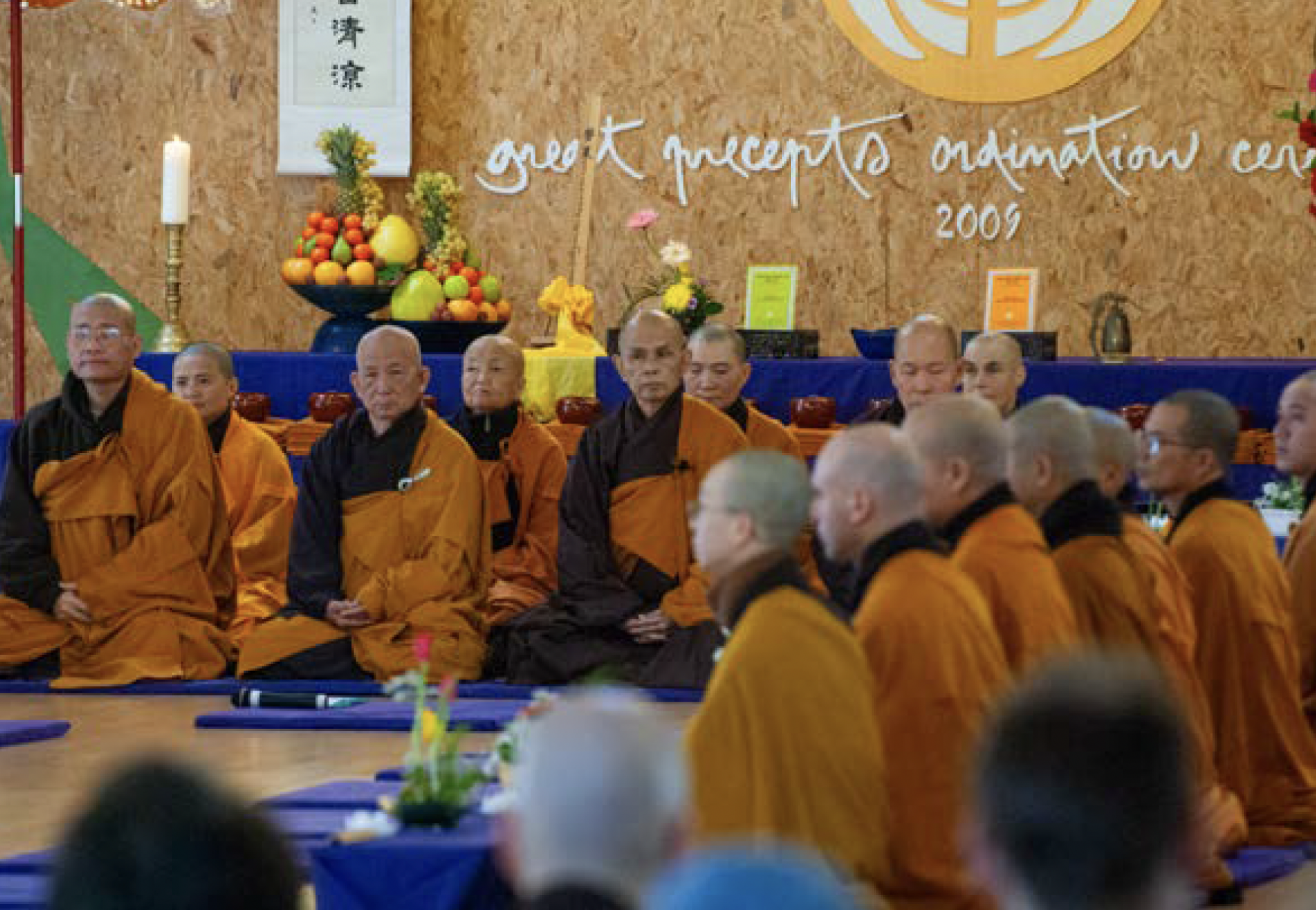
The energy of mindfulness and concentration—the heart of Great Precepts Transmission Ceremony
While I was attending the Venerables with other attendants, I saw that even high monks and nuns sometimes still got nervous or perplexed when they offered incense or transmitted the precepts. And I was often surprised. Later, I learned from their sharing that the energy of mindfulness and concentration in the ceremony was so powerful that they felt deeply touched and moved.
Every time a venerable nun who was attending the Great Precepts Transmission Ceremony for the first time and was not yet familiar with the procedure turned the pages and made some sound, Thầy would stop what he was conducting, look at the venerable nun, and wait until she was done with it before continuing. The noble silence and serenity no doubt contributed greatly to the energy of mindfulness and concentration during the ceremony. What made the venerables happy the most was that the ceremony was very concise; its focus was not on the form, yet the energy was so serene and powerful.
Thầy’s secretaries in various ceremonies were chị Ấu Hà (later Sister Hương Nghiêm), Sister Đoan Nghiêm, and Brother Pháp Ấn.
When designing the certificate, Thầy sat next to chị Ấu Hà or Brother Pháp Ấn in front of a computer to select the font, correct each word, each mark, attending to every small detail. We can say that from the precepts themselves to the font and the signature, it all carried the mark of Thầy’s deep looking and attentiveness. Thus, each certificate is not just paper and ink, but the coming together of Thầy’s love, care, respect, and responsibility toward the Vinaya.
After each Great Ceremony, from time to time, there would be a venerable who would like to have access to a copy of the precept transmission procedure. But usually Sister Hương Nghiêm would be in joint palms and said that it was not yet concluded because Thầy still continued to modify it. So it was the case: not only did Thầy renew The Five Mindfulness Trainings, The Fourteen Mindfulness Trainings, and the Bhikṣu and Bhikṣuṇī Precepts (often referred to as great precepts), but Thầy also modified the great precept transmission procedure. Even up to 2013, Thầy still continued modifying the questioning of the ordinees ritual before they received the great precepts.
What we have in our hands today, indeed, has been through years of contemplation and revision by Thầy.
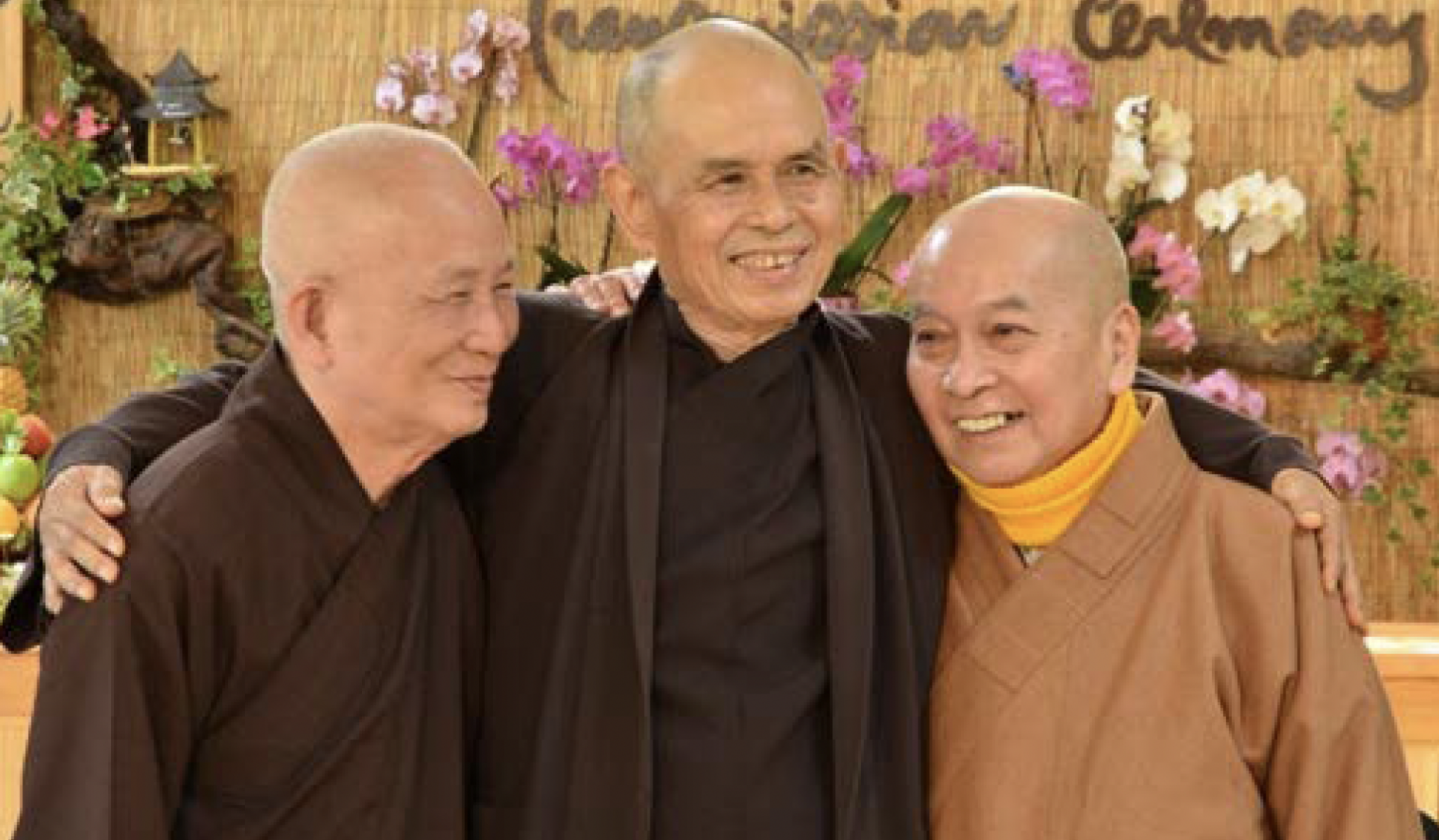
Transmission of love between teacher and student, of siblinghood
What we, the attendants, treasured most while attending the Venerables was getting to listen to their stories about when they were young novices. Some of them used to be Thầy’s students in Ấn Quang’s temple. Now, they were advanced in age, their health was frail, yet they still courageously flew such a long distance to visit Thầy and help transmit the precepts for younger generations, although sometimes this went against doctors’ advice.
We were so moved to witness and bathe in that love between teacher and students, in that siblinghood—a kind that is so beautiful, deep, and long-lasting; it can be sensed very clearly not through words but also through each glance, each gesture.
Supporting bhikṣuṇī community
From the 1994 Great Precepts Transmission Ceremony “Fragrant Mountain” to later Great Precepts Transmission Ceremonies, some nuns from the Tibetan tradition, with their Guru’s permission, went to Plum Village in order to learn the precepts with Sister Chân Đức and later receive the transmission with Thầy. This was an effort to restore the bhikṣuṇī community in the Tibetan tradition. Later, those nuns became solid, highly venerable nuns in their tradition.
I wonder if this has fostered such a deep connection between Plum Village and some Tibetan centers. Perhaps that is why when Thầy passed away, many Tibetan centers set up an altar for Thầy and conducted ceremonies to send energy to him in support.
Starting in 1996, when it was more possible to obtain a French visa for Vietnamese people, Thầy also invited venerable nuns from Việt Nam to Plum Village to conduct the bhikṣuṇī transmission ceremony. The first one was a venerable nun from Phụng Thánh temple. She was in tears when Thầy placed some food in her bowl (no Zen master ever does this for a nun in the Vietnamese tradition). She was so moved to be able to attend the whole Great Precepts Transmission Ceremony, which included the bhikṣu precept transmission ceremony, and sit in the opposite position of Thầy.
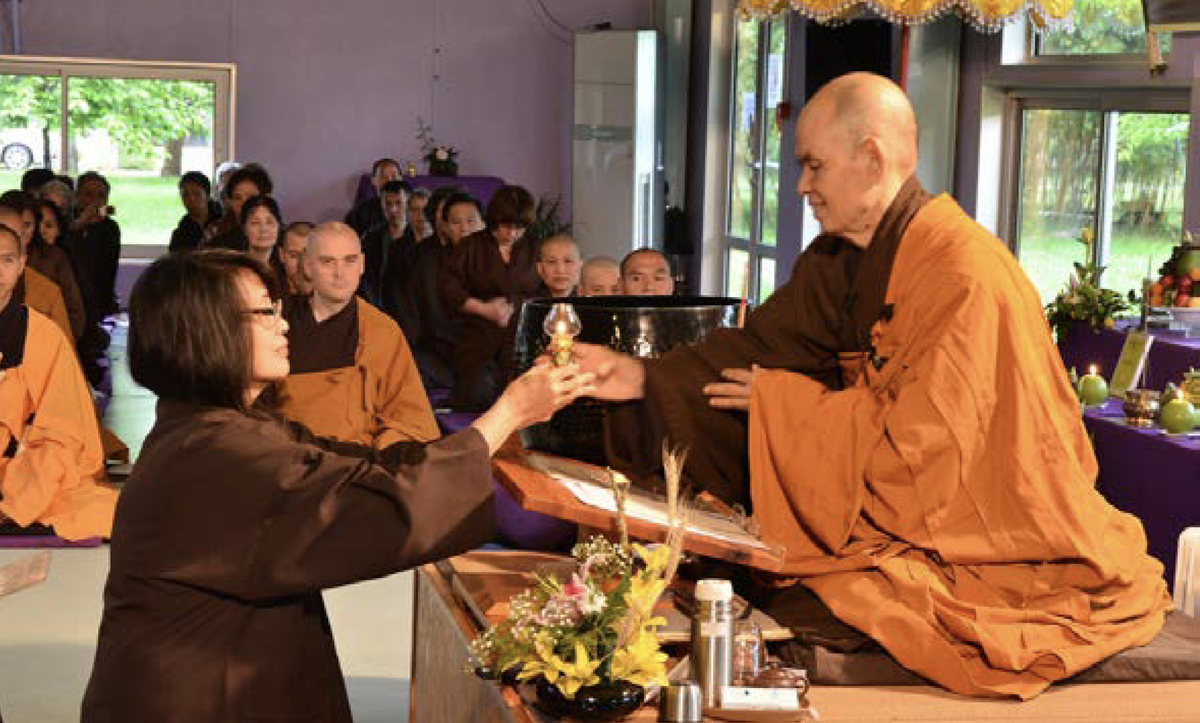
Opening the door widely for lay practitioners
In all Great Precepts Transmission Ceremonies, both monastic and lay practitioners are able to receive the precept transmission and lamp transmission. Usually, the opening ceremony is very short to save time to transmit The Five Mindfulness Trainings.
During Thầy’s many teaching years, Thầy spent a lot of energy commenting on and offering The Five Mindfulness Trainings as a path to solve the crises of our time (climate change, violence...) and revising them so that they could contribute to global ethics. That is why in all retreats and Great Precept Transmission Ceremonies, Thầy always made space to transmit The Five Mindfulness Trainings.
Besides ceremonies to transmit The Five Mindfulness Trainings, there are also ceremonies to transmit The Fourteen Mindfulness Trainings. When Thầy was a young novice, he was already spending a lot of time training Buddhist students and established the Order of Interbeing for lay people who aspired to follow the path of practice and service. From the beginning of Plum Village, Thầy already started to guide lay people to learn and practice the gathas, which are usually just for monastics. From the first rain retreat in Plum Village, lay people were already allowed to participate.
Thầy took great care to create supportive conditions so that lay practitioners could go more profoundly on the path of practice and service. With love and trust, Thầy entrusted them with the mission of sharing the Dharma with others so that Buddhist practices could be spread out to schools, hospitals, companies, parliament houses, prisons, police stations…. Lay practitioners are extended arms of Thầy and of Plum Village. They help plant the Dharma seeds in every corner of the world in different settings. Whatever Thầy transmitted to the monastics, he transmitted to the lay practitioners, with the same heart, without discrimination.
In twenty Great Precepts Transmission Ceremonies conducted from 1992 to 2014, as a Transmission Master, Thầy had transmitted his Dharma body and precept body to the multifold sangha. Witnessing such compassion and vision, I only can ask myself: what can we do to continue and transmit in a true sense the path that Thầy had opened, so that we can deserve Thầy’s effort and love, so that we won’t let him down?
Originally published in Vietnamese in Lá thơ Làng Mai 2026. Translated by Sister Trăng Mai Thôn.