Purpose Is Medicine for Despair
The first time I saw Thầy in person was also my first time hearing the Namo Avalokiteśvara chant. When the music began, a lifetime of suppressed tears cracked through the haze of undiagnosed trauma and illness around me. I couldn’t sense Thầy the person, just a bright, swirling oneness embracing us all inside the hall. It went on like this for three weeks. One special day,
Purpose Is Medicine for Despair
The first time I saw Thầy in person was also my first time hearing the Namo Avalokiteśvara chant. When the music began, a lifetime of suppressed tears cracked through the haze of undiagnosed trauma and illness around me. I couldn’t sense Thầy the person, just a bright, swirling oneness embracing us all inside the hall. It went on like this for three weeks. One special day, Thầy came to visit us at New Hamlet (Plum Village, France) for a Dharma talk. The air was abuzz with anticipation. Feeling lost in the shuffle and remembering my training, I went to the lotus pond for a moment of peace. I was tracing the edge of the pond with mindful steps when a small bright figure waving enthusiastically caught my attention across the pond. After a moment of mere recognition I realized, it was Thầy! I looked behind myself to see who he was waving at, and my heart melted when I saw it was me. This singular, sparkling moment is the only personal interaction I’ll ever have with my teacher—a wordless greeting across the lotus pond, one pure moment of silent joy. It feels fitting—words would have only been a distraction from true connection.
Later, Thầy spoke about the nature of the mind being like a frog hopping off of a plate, and meditation being the act of gently placing it back. My relationship to both mind and meditation were forever changed that day. During the retreat, Thầy also gave a question and response session. I knew this was a precious opportunity to ask my teacher what was on my heart, but I was so afraid of doing something wrong that I hesitated to line up. That’s not for me, I thought, quietly glued to my cushion. Eventually, I summoned the courage to get up. Sitting in line just a few feet from Thầy, I was a bundle of nerves, so I joined my palms to unify my body and mind, and focused on my breath. I could feel his compassionate attention on me the whole time and I sat like that until I was only one person away, but the session ended before I could ask my question. I never had another opportunity to ask Thầy for his advice, but the answer would still come.
Nine years later, I worked up the courage again to ask the question. During the pandemic, I joined an EMBRACE Sangha discussion group on Zoom. In a space made for trauma to become known, I cracked. The despair came pouring out, and mercifully, the sangha had enough space to listen. I asked, “How do I practice as a young person when the world seems to promise only darkness and despair?” Then, came the shocking response from a woman on the screen, “I’ve found that the only medicine for despair is purpose,” she said.
From then on, instead of focusing on feelings of heaviness when looking at the economic, social, and environmental problems that confronted me in my daily work as an architect, I focused on the question, what am I here to do? For six years I kept asking and refining until eventually I found myself at Deer Park Monastery in the Ocean of Peace Meditation Hall listening to Thầy Pháp Lưu talk about the School of Youth for Social Service and the new Action Wake Up program which would be its continuation. Tears were streaming down my face again, but this time from joy.
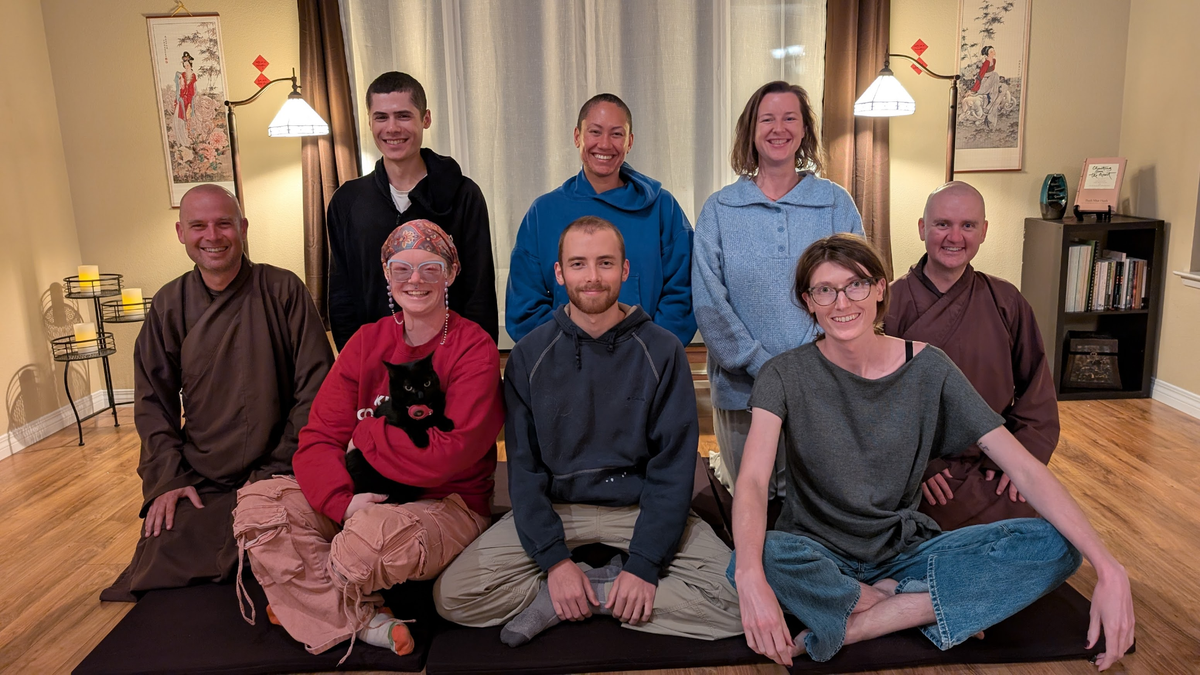
If we are nothing but the sum of our actions, certainly the powerlessness of a young person in a world screaming, “It’s all over; we have no hope!” is among the greatest suffering. I think this is what makes the Wake Up movement so powerful—young adults standing for a healthy and compassionate society instead of decline and degeneration. Born from nearly two decades of this movement, Action Wake Up (AWU) is a fifteen-month residential program designed for young adults who share this sense of purpose. Peace activists and changemakers live together ten minutes from Deer Park while engaging in projects to deepen their practice of mindfulness with the support of monastics and mentors and experience true leadership. Our engagement in social work benefits the community around us, while cultivating the ground for a direct experience of interbeing through the practice of nondiscrimination, impermanence, and nonself.
This is our first year running the program, and while we are passionate about serving the community, we know that living harmoniously is also an important practice. We are learning so much, including how notions can’t liberate us, but insights born directly from the practice can. For example, living in the AWU house means that even when I want to run away or hide, I’ve had to take refuge in the dharma and the truth of impermanence when confronted by my own fear of inadequacy, in order to continue showing up for the sangha. Another kind of action we are practicing together is loving speech. Through taking care of the house, ourselves, and our community as a sangha body, we are also learning that the way we speak can help heal the world.
Taking inspiration from Thầy and Sư Cô Chân Không’s peace activism in Vietnam during the war, AWU is grounded in The Fourteen Mindfulness Trainings as our ethical foundation. With projects in agriculture, education, healthcare, and more, we aspire to honor our teachers by supporting young people to build a society based on love and understanding. We hope this will not only support our world as a whole, but also fulfill the need young people in particular have to feel a sense of purpose amidst war, chaos, and uncertainty.
When I started this work, I was motivated by a sense of needing to do something, but I’ve been learning that service isn’t so much about what you do as it is about how you do it. Thầy’s reminder, “don’t just do something, sit there,” helps me connect with this truth. Maybe we don’t really change the world by the things we do, and instead, doing them from the right place is what really changes things. Peace and reconciliation aren’t just what I wish to see in the world, they’re a lived experience I’ve had within myself, my home, and my community. All thanks to my teacher who taught me how to love, and the brave, wild child I was and still am who refuses to accept that violence is enough.
Youth is still among the many conditions for happiness I enjoy, so I can't tell if it’s just age or practice which has made despair easier to bear. Most days, my heart still quivers at the state of the world, but I know how to let go now, and how to tell when it’s time. The perils of environmental collapse and social injustice still knock at my door, but I have learned to hold them alongside joy, so I can stay present enough to act. In that space of calm alertness, I am back by the lotus pond with my teacher, feeling light and free. I know I am enough, we have enough, and it is all already enough.