How mindfulness and interbeing can foster ecological awareness and bring about positive change
By Ami DuCre on
Unexpected invitation
I introduced myself to mindfulness by accident. You see, I was having a conversation with my friend Michele at a milestone birthday party, prompting our discussion of future goals. Michele shared that she always wanted to visit a Buddhist monastery.
How mindfulness and interbeing can foster ecological awareness and bring about positive change
By Ami DuCre on
Unexpected invitation
I introduced myself to mindfulness by accident. You see, I was having a conversation with my friend Michele at a milestone birthday party, prompting our discussion of future goals. Michele shared that she always wanted to visit a Buddhist monastery. “That’s unexpected,” I thought while encouraging her to pursue her goal. Later that week, I came across an ad on social media for a POC Retreat at Deer Park Monastery. I lit up inside. This was just what Michele was looking for! So, I clicked on the ad and sent her the link to the event page. She immediately replied with the expected, “Thank you so much!” followed by the unexpected, “Will you go with me?!”
Migrating south
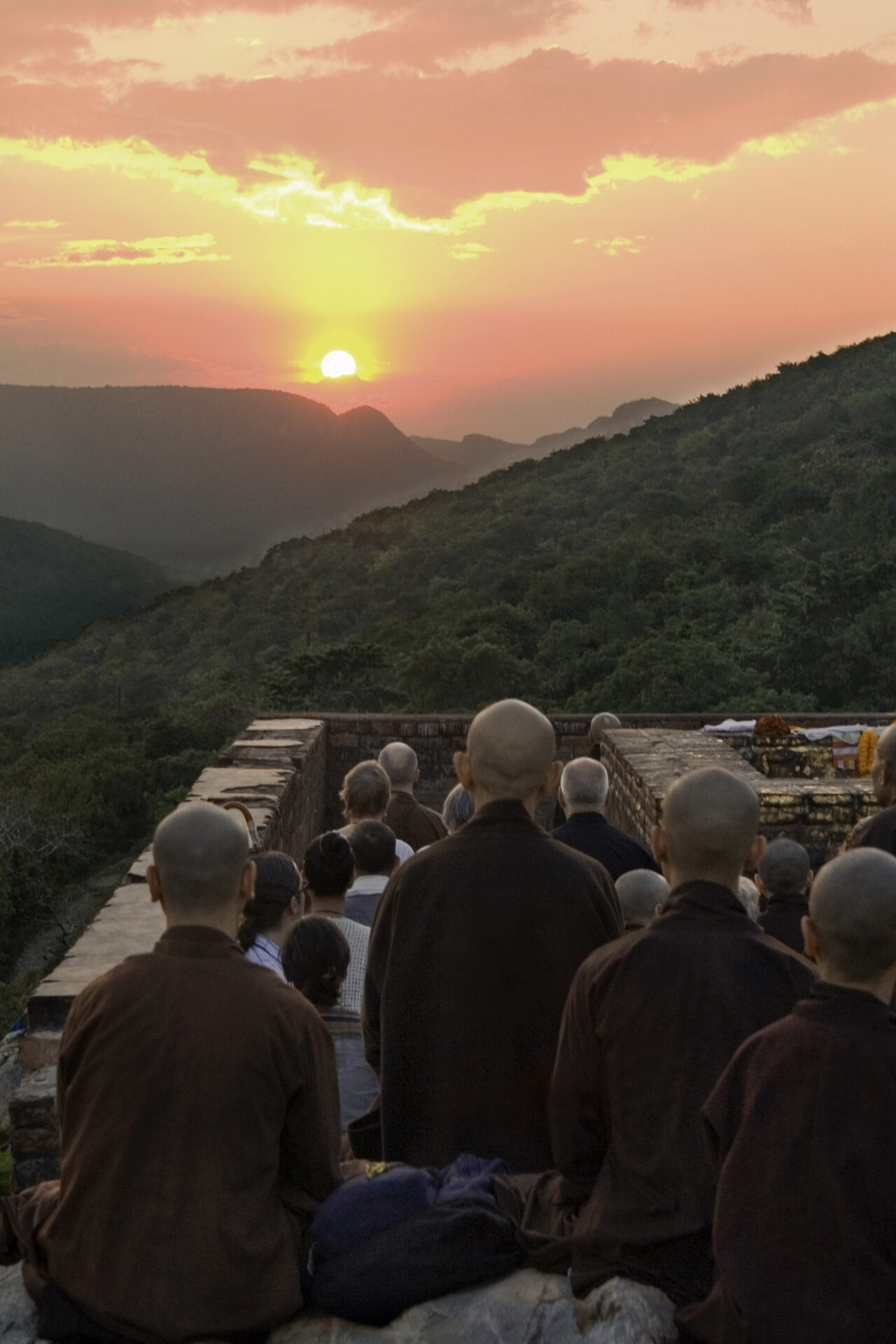
This was how I found myself pitching my tent in the late summer heat among the quiet hills of Escondido, California, surrounded by hundreds of strangers (save Michele, of course). I was brooding over the possibility of being bored for days, only to have my perspective transformed repeatedly by talks from sage community leaders who shared how they learned to hold suffering with mindfulness instead of being consumed by it.
One of those community leaders was Dharma teacher Dr. Larry Ward, who shared the story of his house being set on fire by white supremacists. When he spoke of these people who committed acts of violence upon himself and others, it was through a lens of quiet reflection that grounded an audience full of people of color who often lived in fear of racial violence. He then worked his way back from the suffering he experienced through the acts of others and showed how those people were made to suffer by others, creating a chain of events I now understand as generational trauma. He acknowledged the suffering experienced by those who, in turn, caused him suffering, which is an example of compassion I had not seen before. There was a strategically placed pause, and as I followed my breath, I felt compassion for those who had caused me suffering. What sorcery was this?!
This was my introduction to transformation through mindfulness and understanding the connection between suffering and healing. I also learned to practice turning my fledgling gaze of mindfulness and compassion inward, and that was when things started changing for me.
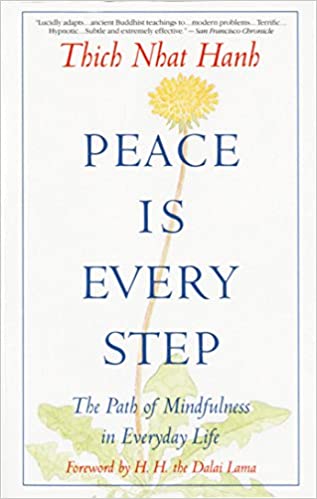
When I first went to the monastery, I was struggling with a severe bout of depression. The skills I gained at the monastery helped me shift my perspective on daily life. I learned to understand my depression and to separate myself from it. By doing so I became the observer of my emotions, becoming aware of thoughts, speech, and actions in a new way. As Thầy taught us in his book Peace is Every Step, instead of thinking, “I am depressed,” I thought, “I feel the presence of depression.” I even gave my depression a name, and when it made itself known, I would greet my depression with my mindfulness “like a mother tenderly holding her crying baby,” until it calmed down.1 Not identifying with the depression gave me the space needed to treat it with compassion, asking it “what is wrong?” and addressing the issue. As time passed and depression’s presence receded, I realized that mindfulness was not just a practice; it was a way of being.
As I enjoyed the inner quiet of cultivating peace in my inner world, the external world brought me a tiny, feathered contradiction. My journey inward was met by nature’s insistent call outward.
Little did I know, the next teacher on my path would come not in a robe but clothed in feathers to show me that the same compassion I was learning to offer myself could be extended beyond the self.
Nature’s bell ‘chirp’ of mindfulness
“Squee! Squee! Squee!” Persistent trills were coming from my… balcony? My housemate and I investigated and found a very tired and dirty baby starling. They had fallen out of their nest and onto the balcony of our LA apartment. We lived on the third floor, and the nest was very far from being safe to reach. Wildlife rehab centers would not accept it because it was an invasive species. So I found myself the adoptive parent of this tiny life that now depended on me to survive. Without realizing it, I had been practicing for this moment since the monastery.
Life with Baby Bird was messy, funny, disruptive, and surprisingly tender. I pulled from my experience babysitting baby cockatiels for their biological mom when she needed a break. Feeding them every 20–30 minutes and watching as this scraggly, noisy ball of fluff transformed into a sleek teenager with attitude. They’d sit on my yoga mat as I did sun salutations, perch on my shoulder, melt into my neck to nap, and scream for mealworms at sunrise. Caring for them meant living by a rhythm not entirely my own.

My mindfulness practice helped me transform my suffering, enabling me to see beyond the self that my personal well-being was interconnected with the well-being of others, including this tiny being.
It wasn’t long before Baby Bird became a young adult. After a visit outside and hearing their family’s call, Baby Bird gave me one more glance, turned, and flew away with them. I was elated to see Baby Bird rejoin their family, relieved that I would no longer find random mealworms wriggling across my bedroom floor, and bereft at the loss of my bird-child.
So, I had tea with these emotions, and they informed me that the hurt was coming from a perceived disconnection from nature. But as we all know, separation is an illusion. How could I continue to “inter-be” with nature?
The universe has a way of answering our deepest questions, sometimes in languages we’re just beginning to understand. But I was already pretty fluent in this one.
“Squee!” “Chirp!” “Peep!” “Squawk!” came the call—not from my balcony this time, but from the baby bird nursery at a wildlife center in Malibu, California, where a steady stream of hungry, impatient birds and squirrel children cycled through all spring and summer.
Thanks to advice from a dear yoga friend named Angel, I found myself interbeing with nature in a whole new way—scooting from one cage to another on a rolling stool, syringe filled with formula in hand, as “beep, beep, bee-beep!” timers went off every 15-60 minutes, depending on the developmental stage of the baby birds, of course.
What began as a response to a single bird’s cry became a sustained practice of connection. The disconnection I had once felt from nature was slowly dissolving, replaced by a rhythm of care, attention, and presence—one that deepened with each season and each small life I shared the responsibility of supporting.
Integrating mindfulness into conservation
When shelter-in-place began in 2020, I revisited a familiar question: How can I continue to “inter-be” with nature? And also, a new one: What can I do with the options I have now?
I figured I wasn’t the only one stuck at home craving meaningful connection, so I contacted conservation professionals on Instagram. I didn’t expect many replies, but most of them wrote back. Informational interviews meant to be fifteen minutes turned into hour-long conversations filled with advice, personal stories, and a surprising theme: burnout.
Many conservationists spoke of climate grief, emotional fatigue, and years—sometimes decades—away from the field to recover. I was struck by this pattern and quietly grateful for the resilience and emotional regulation my mindfulness practice offered me.
Encouraged to pursue graduate studies, I applied to a master’s program in biology through Project Dragonfly at Miami University, Ohio. It felt like a natural extension of my path—and, to my surprise, one of the course offerings was a field expedition in Thailand called Buddhism and Conservation, the perfect dovetail to two of my favorite subjects. I later joined another expedition to Kenya—different landscapes, different lessons, but a deepening of the same thread of interconnection I’d begun exploring.
Finding strength in collective action
Scientific research gave me structure and clarity, but the real wisdom arrived with morning chants, bare feet on the earth, and the quiet presence of lions in the tall grasses.
During the expeditions in Thailand and Kenya for my graduate program, my classmates and I listened to teachings and stories from our in-country hosts. Some were adventures, others comical misadventures, and others were deeply personal moments of loss or challenge in their conservation work. In Thailand, a monastic named Phra Paisal Visalo took us to a stretch of tilled land next to a forest. He shared that his community had lovingly replanted a forest, only to be destroyed by fire a few years later. What remained was the tilled land we stood on. In Kenya, a Maasai conservationist shared about a young lion he had been monitoring—how it had killed a cow before it had fully learned to hunt wild prey and how the community, in grief and frustration, killed the lion in retaliation.
In both cases, there was sorrow—but not bitterness. These stories touched us deeply, raising the question: “How do you do this work and maintain hope for the future?”
The response was nearly the same: a slightly confused look followed by some version of, “Because I am aware I am doing my part, and so are those around me, and even you all are coming from the other side of the planet and you are also doing yours.” In highlighting that their work is supported not only by their individual efforts but also by the combined efforts of others, they indirectly taught us about interbeing, the understanding that all things are interconnected and no action exists in isolation. They maintained hope not by clinging to the promise of success but by focusing on their own actions and trusting that others were doing the same: embodying Right Effort, the Buddhist principle of continuous, mindful effort toward goodness, even in the face of difficulty.
As I sat with their words, I realized that hope isn’t rooted in certainty but in the shared commitment to keep showing up—each of us doing our part, trusting that others are doing theirs. This understanding of interbeing extends beyond conservation; it invites mindful action—even in the most unexpected places.
That day in Thailand, my classmates and I donned our sun hats, rolled up our sleeves, and, spades in hand, joined the community in replanting the forest—sapling by sapling.
I still carry the words of Phra Paisal Visalo with me: “Have hope, not expectation.”
When one person steadies the ground
In July of 2021, the “Magic Carpet Ride” malfunctioned at the National Cherry Festival in Michigan. One side of the ride dislodged from the ground with each swing, and the entire structure rocked dangerously as panicked screams filled the air.
Multiple videos of the incident from different angles exist—a testament to how many people chose to watch and record rather than intervene. But then, one person ran forward and grabbed the railing. Then another. And another. In moments, more people rushed to the ride’s base, using their collective weight to hold it steady.
It didn’t take a leader or a plan; it took just one person stepping forward and then another. An impromptu sangha rose from the crowd, shifting fear into presence—preventing what, perhaps even you thought, was to be a tragic catastrophe.
Mindfulness practitioners in conservation
Just as one bystander at the carnival transformed inaction into action, mindfulness practitioners can step forward in conservation. Despite emotional overwhelm and the weight of the Anthropocene, the environmental movement is filled with people who have chosen to hold steady—grabbing onto the dislodged ride that is our planet.
What if we, as mindfulness practitioners, stepped forward, too—not to lead or fix, but to lend our weight and help steady the ground beneath them?
Mindfulness practitioners in support of conservation
There is a gap of knowledge in the environmental movement that practitioners are uniquely equipped to help fill. Many environmentalists and conservationists lack access to emotional regulation tools, which often leads to burnout.
Studies have found that suppressing difficult emotions and leaning on numbing behaviors are common responses to anxiety, including eco-anxiety.2,3 Mindfulness offers an alternative by fostering awareness, acceptance, and emotional regulation, preventing burnout and apathy while building resilience.4 Rather than avoiding distress, mindfulness encourages sitting with discomfort, preventing the rumination that worsens climate anxiety.5 A mindful outlook also reduces fatalistic thinking—those who cultivate mindfulness are more aware of their actions, less judgmental, and more likely to believe their efforts matter, even in the face of uncertainty.6
As experienced practitioners, we all can have stories of how mindfulness has helped us transform suffering and improve our well-being.
Suppose your practice has helped you navigate difficult emotions. How might it support those working on the front lines of conservation?
What might shift if conservationists had access to the same tools that have steadied you?
What if we, as mindfulness practitioners, stepped forward to share these tools? As the Climate Psychology Alliance affirms, one of the most effective antidotes to climate anxiety is meaningful climate action—grounded, collective, and compassionate.7
How might our sangha create space for conservationists to process strong emotions together—in safety, silence, and community?
As conservationists find hope by seeing others doing the work, mindfulness practitioners can find meaning by supporting those on the front lines. Change does not happen in isolation; it happens through interbeing.
Like the bystander at the carnival, we can step forward and shift the course of events.
Sometimes, that’s all it takes to steady what feels unsteady, to remind one another that we’re not alone.
Thầy once said, “...the next Buddha will not take the form of an individual. The next Buddha may take the form of a community ... practicing mindful living.”8 This is an invitation to put down the heavy burden of having to do it all alone. We don’t have to be the Buddha alone; we only have to be a part of the Sangha. That community is already sprouting—whenever we show up, breathe, and begin together, not with expectation, but with hope.
1 Thích Nhất Hạnh, Peace is Every Step: The Path of Mindfulness in Everyday Life (Bantam Books) 1991: 53-54.
2 Isabel Grace Coppola, “Eco-Anxiety in ‘The Climate Generation’: Is Action an Antidote?” Environmental Studies Electronic Thesis Collection, University of Vermont (2021).
3 Leah R. Gerber, Zachary Reeves‐Blurton, Nika Gueci, Gwenllian D. Iacona, J. A. Beaudette, and Teri B. Pipe, “Practicing Mindfulness in Addressing the Biodiversity Crisis,” Conservation Science and Practice, 5 no. 7 (2023). https://doi.org/10.1111/csp2.12945
4 Michel Bourban, “Eco-Anxiety and the Responses of Ecological Citizenship and Mindfulness,” in The Palgrave Handbook of Environmental Politics and Theory, edited by Joel Jay Kassiola and Timothy W. Luke (Palgrave Macmillan) 2023: 65–88. https://doi.org/10.1007/978-3-031-14346-5_4
5 Lorraine Whitmarsh, Lois Player, Angelica Jiongco, Melissa James, Marc Williams, Elizabeth Marks, and Patrick Kennedy-Williams, “Climate Anxiety: What Predicts It and How Is It Related to Climate Action?” Journal of Environmental Psychology, 83 (2022). https://doi.org/10.1016/j.jenvp.2022.101866
6 Christine Wamsler and Ebba Brink, “Mindsets for Sustainability: Exploring the Link Between Mindfulness and Sustainable Climate Adaptation,” Ecological Economics (Amsterdam) 151 (2018): 55–61. https://doi.org/10.1016/j.ecolecon.2018.04.029
7 https://www.climatepsychologyalliance.org/
8 Thích Nhất Hạnh, “The Next Buddha May Be a Sangha,” Inquiring Mind, 10 no 3 (1994). https://inquiringmind.com/article/1002_41_thich-nhat_hanh/