Thích Nhất Hạnh offers a powerful Dharma talk on the essence of the sangha and the Order of Interbeing as a living organism.
By Thich Nhat Hanh on
Taking refuge in sangha is a very deep practice. You trust the sangha. You become the sangha. If you are a drop of water, you might wonder whether you have the capacity to go to the ocean.
Thích Nhất Hạnh offers a powerful Dharma talk on the essence of the sangha and the Order of Interbeing as a living organism.
By Thich Nhat Hanh on
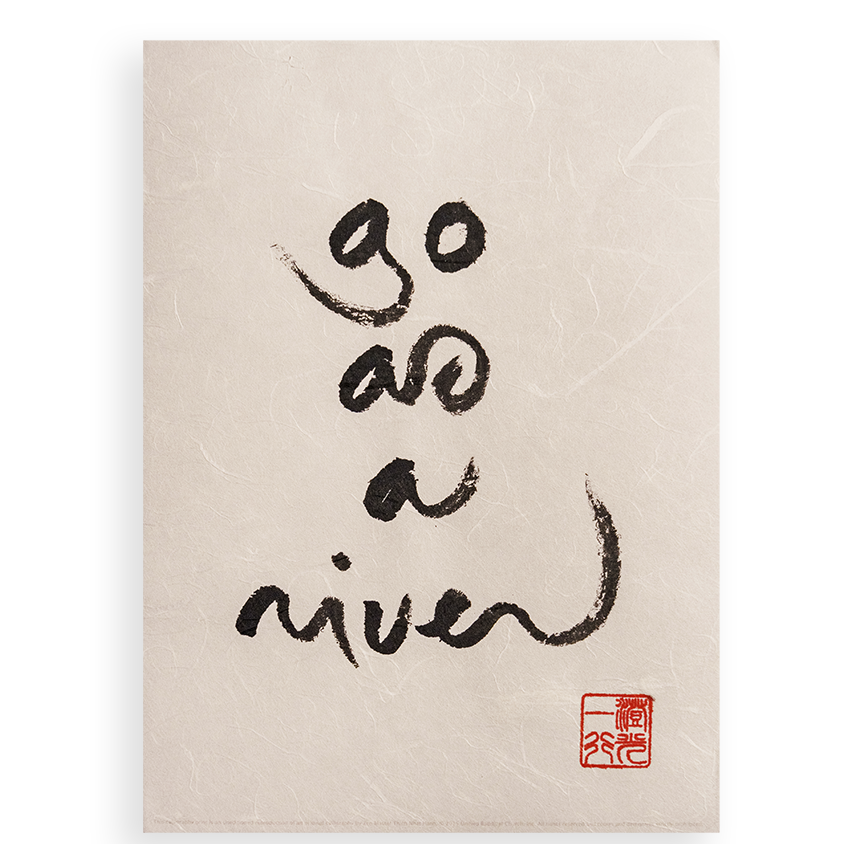
Taking refuge in sangha is a very deep practice. You trust the sangha. You become the sangha. If you are a drop of water, you might wonder whether you have the capacity to go to the ocean. But when you become a river, you are sure you don’t have to worry. You will certainly come to the ocean. In Plum Village, we try to practice like that. We don’t want to be a drop of water. We want to be a river. And by practicing becoming a river, we suffer much less. Individual suffering can be transformed very easily when we share the concern of the sangha, the happiness of the sangha, the dedication of the sangha.
And that is why when we come and sit together, when we come and walk together, when we come and eat together, and work together, there’s a powerful energy in us. That energy is the energy of mindfulness. That energy is embracing the pain, looking deeply into the pain in order for us to understand the pain and to have the kind of insight that will lead to the transformation of the pain. On the individual level, your deepest concern becomes the object of your practice, of your mindfulness. In the Zen circle, there is a practice of kung-an 公案 [Chinese], in Japanese, kōan.
This is the deepest concern.
The kōan should be something that you are deeply interested in, your deepest concern.
The practice of kung-an
You want to understand. You want to transform. It is like when you are struck by an arrow, and you carry with you the arrow in your flesh. Standing or sitting, being awake or sleeping, you still carry the arrow. The kōan, the kung-an, should be something like that. Your daily life is fully focused on that. And if you are, the kung-an should be something that can draw all your energy, your interest, your mindfulness, your concentration on it. And you are holding it day and night, embracing it, looking deeply into it. And one day, insight will come. You understand, and you will be liberated. So kung-an is something that should have the capacity of bringing all your concentration, all your energy into it. Because without that, there cannot be a breakthrough. The suffering in the Middle East, for instance, is a kung-an for the whole of humankind. Not only for the Israelis or the Palestinians. But as a human family, we are so busy. We are not a sangha. We don’t have enough mindfulness, concentration. We cannot make it into a kung-an.
We pay some attention, and then we remove attention. We focus our attention on other matters. And that is why it is not a kung-an for the human family yet. When the teacher understands the difficulties and the suffering of the disciple, he or she will offer a kung-an. Like, “Tell me, dear one, what is the sound made by just one hand?” Usually we need two hands in order to make a sound. “Tell me. How can you produce sound with one hand?” So that is a kind of skillful device in order to help the disciple to find out, to understand his or her situation. And the disciple cannot just use his or her intellect in order to work on the kung-an, because the intellect is only part of us; underneath there is the whole subconsciousness, unconsciousness. Underneath there is your body, all the mental formations, your store consciousness. That is why the kung-an that has been offered by the teacher should not be entertained only by the intellect. It should be buried deeply in the soil, in the flesh of your being. And during your daily life, you have to carry the kung-an with you day and night. Eating, sleeping, doing things, you are embracing it. That is the full-time embrace.
It is by being there, producing the energy of mindfulness, concentration, and insight that we realize, we invent, we create the energy of harmony, of togetherness.
The sangha’s role in individual and collective transformation
Whether your suffering or your situation is at an impasse, you are stuck, that is your kung-an. You should be able to mobilize all your strength, all your energy, all your mindfulness and concentration in order to embrace deeply that difficulty, that situation, that deep suffering. And day and night, at every moment, you only do that. Embracing deeply, tenderly. And with the support of the sangha, one day you will have a breakthrough. The insight can come from you. The insight can come from the sangha, your insight has been supported by the sangha, your insight may be an expression of the collective insight of the sangha, because you are practically living in the sangha and the sangha is practically working with you and supporting you in that attempt to understand your situation. And when the practice comes to the sangha level, it’s very powerful. If the whole sangha embraces your pain, day and night, and looks deeply into your pain with the energy of mindfulness and concentration, then there will be quick relief. And there will be insight that can help you overcome that suffering, can help you see the path, and can help you get the liberation, the transformation. That is the way it works with you and with your sangha.
From organization to organism
I would like to offer an example. There is a community called Order of Interbeing, composed of many members. The Order of Interbeing was founded in Vietnam during the war around 1966. It’s composed of monastics and laypeople. It’s composed of two kinds of communities: those who have formally received The Fourteen Mindfulness Trainings are called the core community; and there are those who have not formally received The Fourteen Mindfulness Trainings, but who participate in every activity of the sangha, who we call the extended community. And as a community, we need some kind of organization. We should organize. But we have learned that if you are too well organized, it’s not too good. We have seen the difference between an organization and an organism.
Being an organism that functions well, naturally there is some organization in that, but it’s not intended. If there is harmony, if there is understanding, then you don’t need to organize, and yet it is very well organized. When you look at the community of bees, you don’t see a leader giving orders: you do this, you do that, coordinating things, because the beehive is an organism. And the element of togetherness is there. The raison d’être of the community is to be together, to be wonderfully together. And when you come together as an organism, suddenly the insight comes and everyone knows what to do. And it becomes very well organized without your attempt to organize. Many of us are sangha builders. We have to focus our attention on this.
Embodying the practice
Sometimes the more we organize, the more trouble the organization will become. It is our way of being that can bring about the well-being of the community. It is our practice of mindfulness, concentration, insight, loving-kindness that is doing the work of organizing. The Buddha, before his passing away, was asked whether he would like to appoint someone to continue to lead the sangha. He said, “No, we don’t need a leader.” And he was very aware that the sangha is an organism. If the sangha practices well, everything will be fine. We don’t need a leader at all. The Buddha did not consider himself a leader. He did not consider himself a director. He did not consider himself the boss. He was very pleased to be a monk. He [held] his bowl, and he went begging for food like any other monk. He [sat] at the foot of a tree like any other monk.
But he is a great inspiration for the whole sangha. And that’s what we should do. We should be an inspiration for the sangha by our way of acting in harmony, in compassion. When the sangha comes together as an organism, the sangha will know how to do it. Because the ground of to do is to be. If you know how to be, then naturally, you don’t have to worry about to do. To be is the foundation of to do. So many of us have thought that we need to organize somehow because that is an order, the Order of Interbeing.
The sangha’s natural harmony
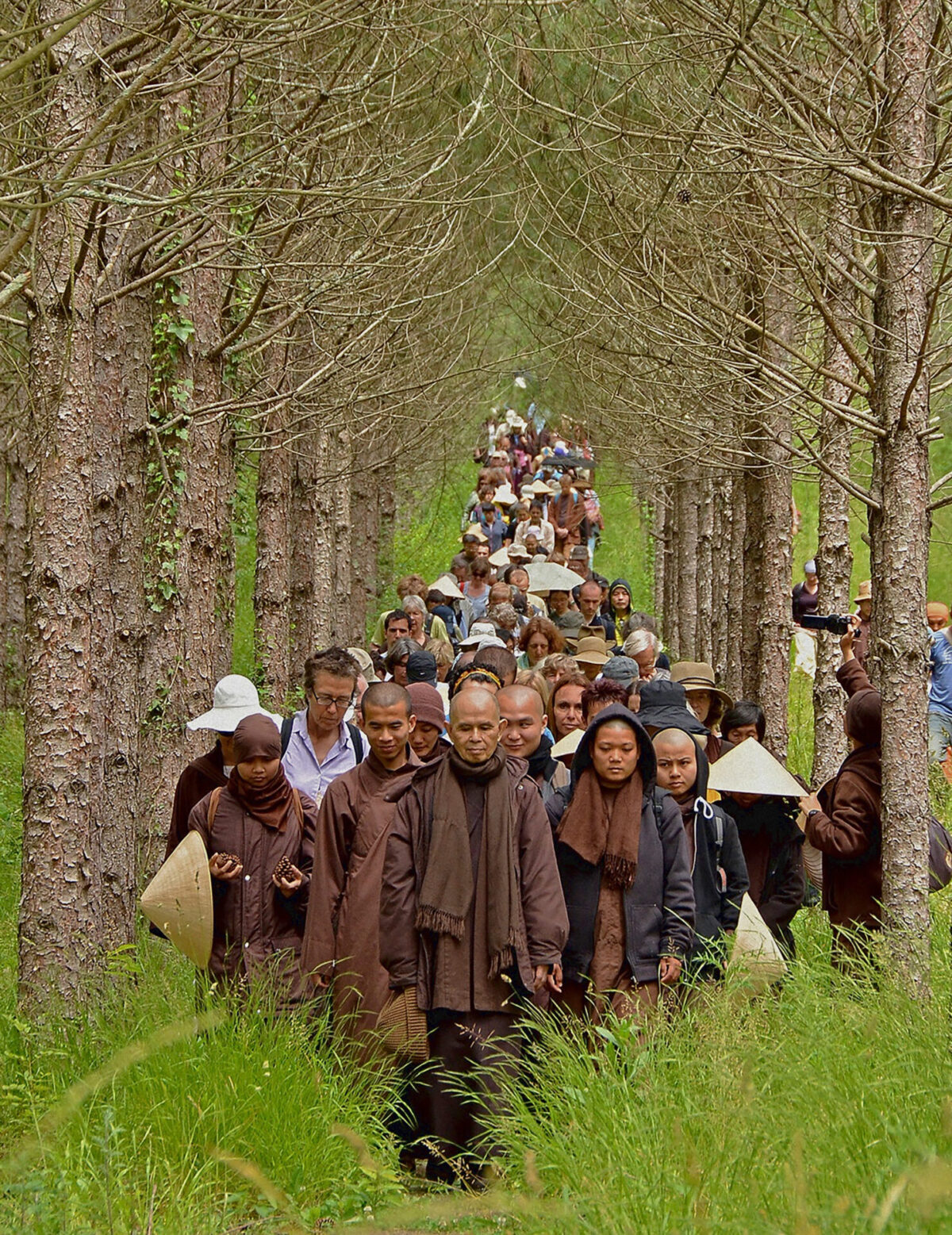
The Vatican is very well organized as a religion, but we don’t want the Order of Interbeing to become something like that. We want the Order of Interbeing to be a living organism. We don’t want any leader, any boss, any director; that is what we want, and some of us will say, “How can we survive without some organizing?” In the beginning, someone may have thought like that, but by this time she has awakened to the fact that we need only to be, and that will take care of everything. When the sangha is together in harmony, that is all. You don’t need to do anything more. You behave like the birds flying in formation. They don’t fly as individuals. You know very well that they fly as a formation. It’s very beautiful, very powerful. The sangha is like that. And the question is, how can we allow the Order of Interbeing to be an inspiration for society, to become a kung-an?
And that cannot be solved by the intellect alone. When you discuss organizing, you are using your intellect. But when you come together and practice sitting and breathing in and out, and become together, you become an organism. And the question, “How can the Order of Interbeing become an inspiration and a refuge for the world?” becomes the kung-an. You need only to be there as an organism and hold very tenderly that question, that kung-an in your mind, and then the insight will come. It’s not by doing a lot of thinking, it’s not by doing a lot of organizing that we can answer the question. It is by being there, producing the energy of mindfulness, concentration, and insight that we realize, we invent, we create the energy of harmony, of togetherness. And from that foundation will come the insight into how to be the inspiration as an organism. It’s clear?
This way of being, this way of operating, is quite different. The sangha way. It is the energy of mindfulness and togetherness, and not some five-year plan, that will realize everything. The question is whether the sangha can come together and be together as an organism. The whole question is that—how to arrange so that the sangha can be together—a lot, a lot, a lot. That is the only concern, because the coming together of a sangha can bring a lot of happiness, can bring a lot of relief, a lot of transformation, a lot of confidence. Because the sangha always generates the energy of mindfulness and concentration and insight. And the sangha becomes holy because of its practice of mindfulness. It’s very beautiful to see a sangha silent, moving silently and in harmony. They organize, but they don’t look as if they are organizing. They are moving very, very softly, very silently, like the bees. No one is giving orders to anyone. We look at each other, we are aware of each other, we are aware of the situation, and naturally the situation becomes as we wish.
Learning from nature
Do we have lessons to be given to the bees, to the termites, to the birds, to the fish? It seems that we can learn something from them. The scientists of our time begin to speak of animal culture. They do have their culture. They do have their wisdom, their way of life. And much of it we can learn from, because there is a lot of suffering in our human community. We suffer more than these societies of animals. Individualism prevails. We are deeply divided. We hate each other. We are afraid of each other. And that is not the case for the bees. That is not the case for the fish. That is not the case for the birds. So we can learn many things from them. And this is in the line of sangha building, of becoming a river.
This is an excerpt from a Dharma talk given by Thích Nhất Hạnh during the 21 Day Retreat on June 8, 2002 in the Loving Kindness Temple, New Hamlet, Plum Village, France. It has been lightly edited for clarity.