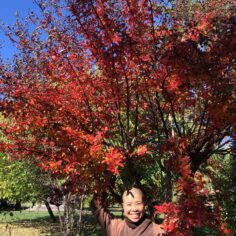
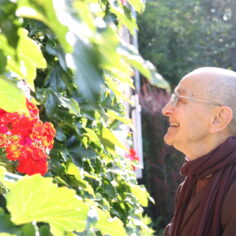
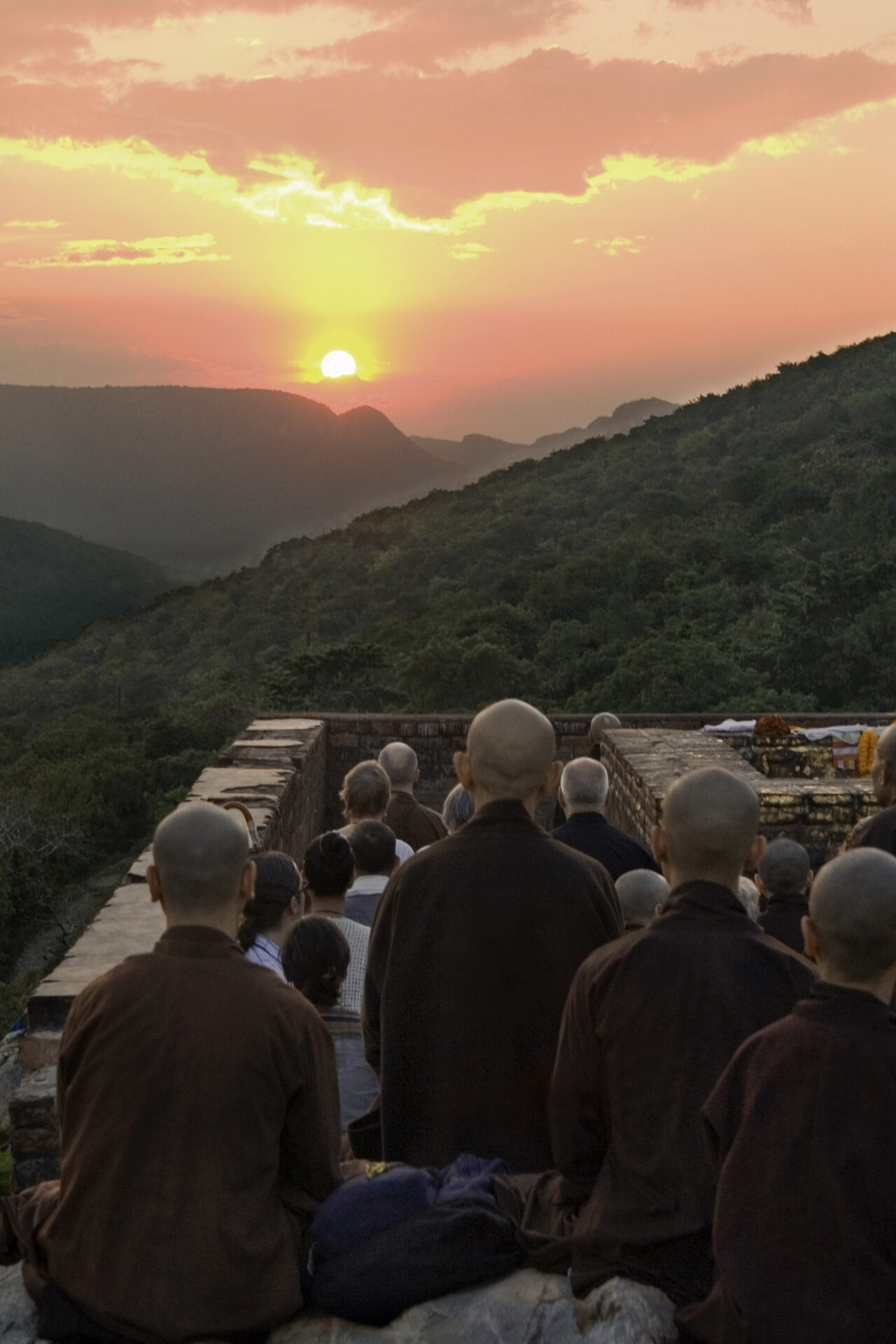
This conversation with Sister Giác Nghiêm, originally conducted in French by Sister Tại Nghiêm, offers a glimpse into her journey of faith, transformation, and deep joy in service.
By Sister Tại Nghiêm, Sister Chân Giác Nghiêm on
Sister Tại Nghiêm: Dear sister, in 2026 we will celebrate the sixtieth anniversary of the Order of Interbeing. After so many years of practice and commitment,
This conversation with Sister Giác Nghiêm, originally conducted in French by Sister Tại Nghiêm, offers a glimpse into her journey of faith, transformation, and deep joy in service.
By Sister Tại Nghiêm, Sister Chân Giác Nghiêm on
Sister Tại Nghiêm: Dear sister, in 2026 we will celebrate the sixtieth anniversary of the Order of Interbeing. After so many years of practice and commitment, what does Engaged Buddhism mean to you?
Sr. Giác Nghiêm: It is precisely that which brought me to Thầy. I could have chosen a contemplative religious path, but the life of Thầy and Sister Chân Không, whom I met in 1985, led me to choose this way. Thầy was giving his first teaching in French in Lyon. When I encountered Thầy’s Dharma, I said to myself, “I have to apply it right away—not just for myself.” That’s what “engaged” means to me.
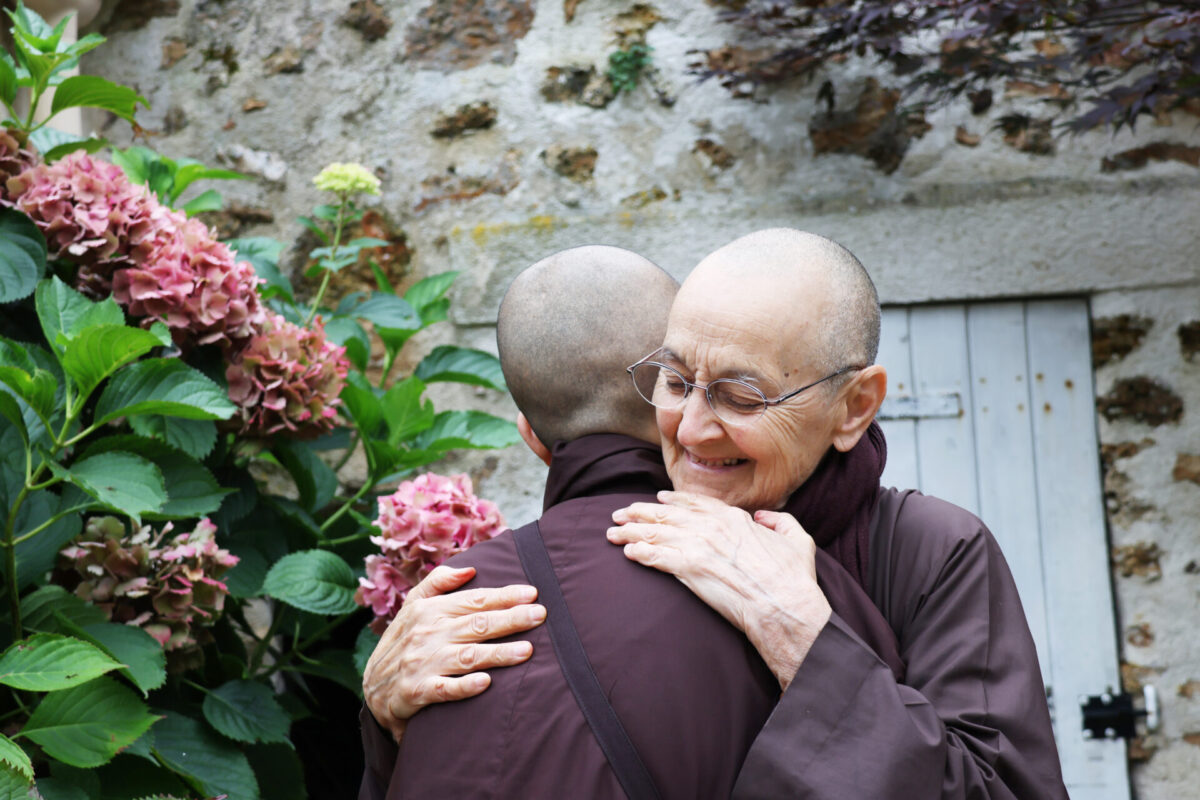
Look into my eyes—
they’re overflowing with love—
you have chosen the most beautiful path.
At that time, I was working in a hospital as a physiotherapist with elderly and terminally ill people. I saw them suffer, not knowing how to handle their emotions and their pain, how to keep going. And I delighted in bringing the Dharma, the practice, straight into the hospital without ever saying that it was Zen. I practiced walking meditation for myself in the corridors—it calmed me. I would leave one patient’s room and go to the next, breathing mindfully. Standing before the new patient’s door, I would leave behind what the previous one had said, keeping only what was essential to convey to the medical staff. Thầy had taught me that.
Entering a room, I would look with fresh eyes—like a flash—quickly seeing what was important and what was not. Without saying anything, I brought meditation to the patient’s bedside—the meditation of interbeing. Some people were deeply lonely. For me, the Dharma is joyful, so I would show the patients the cotton sheet—how it was planted in Africa, the tiny seeds watered, then the people who had transported the cotton. It was a deep looking. I saw that it relieved them greatly; they no longer felt alone. I spoke to them about all the people who had worked to make the sheet for them—even the little butterflies, the earthworms—everything was there: the rain, the sun. Without saying it directly, I showed them that they were not alone.
For patients suffering from hemiplegia or Parkinson’s disease, I taught walking meditation in the corridors—without ever mentioning the word “meditation.” We walked slowly, in silence. Whenever they had difficulty moving forward—especially those with Parkinson’s—we stopped, and I would ask, “What is your favorite tree?” (They wanted to keep trying to move, but I told them, “No, no—we must practice stopping.”) If they said, “The cherry tree,” then I would say, “Okay, let’s become cherry trees in bloom, right here in the hospital corridor.” That released the feeling of helplessness. It was a creative kind of stopping—beauty was there inside it—and they loved it.
There are synapses in the brain—the tiny spaces between nerves. For those with Parkinson’s, even for young people, dopamine doesn’t flow easily; it becomes depleted. When we practiced stopping, something changed—we were no longer straining the neurons, and the synaptic space could refill until they were ready to walk again.
I didn’t do anything—I just helped. I transmitted bedside meditation, which was very helpful during the changing of dressings for bedsores—often a painful moment—and for people losing their memory or no longer fully aware of the world. I would visit them, ask about the beautiful things in their lives, and use that to counterbalance the pain.
I helped them practice stopping—seeing and recognizing reality as it is—and then gently “changing the record” as Thầy used to say. Before the dressing change, when they heard the cart approaching, they would sigh, “Ah!” And I would say, “Yes, that’s the dressing cart. Tell me about the flute your son plays.” By the time they were lying down, we could begin.
I never denied the truth. When the dressing was removed and the pain was intense, I would say, “Yes, it hurts a lot. Come back to your breathing and gently say, ‘It hurts a lot,’ while breathing calmly.” Then I might add, “There are also other places in your body—if I place my hand here, is it cool or warm?”
I helped them shift their attention. And if the pain was still too strong, mindful breathing and presence made it bearable. The person no longer screamed. I shared this with the nursing staff—“You can do this, together, as a team.” Otherwise, the person would struggle terribly.
I also helped to “bring back to life” the bodies of patients—the untouched parts that had been completely forgotten. I taught caregivers how to wash their patients with mindfulness—to always announce what they were doing: “Now I’m dipping the washcloth in warm water” so the patient could smell the soap and recognize the scent first, or “I’m going to touch your arm, or your face. Can you feel my hand? It’s soft.” Washing the body in this way helped reawaken the body’s image in the brain—stimulating forgotten areas that had not been touched for a long time.
One day, the head of the department called me in and said, “Madame, you’ve been working this way for several months. I don’t know exactly what it is you’re doing, but thank you—it’s working. You have carte blanche to continue.” (Of course, the results didn’t come from me—they came from the practice!)
I explained to the department head why I was working in this way, and that I belonged to a meditation community. I told him that walking like this is also meditating—that when I enter a patient’s room and try to see what they need, what’s right and what’s not, it’s only possible with a completely empty and clear mind.
For me, Buddhism is engaged in life itself. Whatever our profession, we can always find meditations that bring relief.
TN: Did you share with Thầy what you applied in the hospital?
GN: Whenever I began a new kind of meditation practice, I would write to Thầy: “Dear Thầy, this is what I did today….” —though I never received a reply.
One day, during a stay at Plum Village, I skipped walking meditation. Sitting under the linden tree in Upper Hamlet, I wrote to Thầy about what I had been doing with my patients. Thầy came by, very gently, and said, “So, Sister Élisabeth.” He always called me Sister Élisabeth. He didn’t say, “You didn’t come to walking meditation.” No, he simply asked what I was doing.
“Dear Thầy,” I said, “I’ve put your teachings into practice at the hospital, and they’re bringing good results. I’m writing everything down.”
He just said softly, “Each time you find a new way to practice, send it to me.” So that’s what I did. I used walking meditation a lot—that’s important to emphasize. The results of this Engaged Buddhism were so clear that I began to have physiotherapy students ask me to give classes at their school. Nurses and caregivers also invited me to speak at the Department of Rehabilitation Medicine.
They were so amazed by the results. Not because of me, of course—once again, it was the practice.
... nothing can be done except together.
Together, we can do everything.
Together, we can rise above every difficulty.
TN: After your experience sharing mindfulness in the hospital, how did Engaged Buddhism continue to manifest in your daily life?
GN: In my own family, I never imposed silent sitting or stopping with the bell; I simply continued my life as before, but with more and more awareness and presence. That, too, was Engaged Buddhism.
I used to write little stories and read them to my children—stories that carried the teaching of non-fear and many other seeds of understanding. When they asked questions, I always answered in natural, simple ways, to help them touch the deep teachings that Thầy had given us. That’s something very important to me.
Engaged Buddhism also means daring to pick up a pen—to write to heads of state and say, “This isn’t right,” but always with gentleness. During the war between Russia and Ukraine, I wrote a kind letter to Mr. Putin, telling him that he was sending his own children to die—that there was no difference between the Ukrainian children, the young soldiers, and his own Russian sons. These were poor young men who would die, be mutilated, or carry deep wounds in their hearts.
I told him that I knew he loved his family, that he cherished his children. I wrote, “If you want your name to be remembered with beauty, you can stop the war now. You just need to say, ‘That’s enough—we stop,’ and withdraw your troops. You could become famous for this beautiful act.” I sent the letter in Russian, directly to the Kremlin—without my address, out of respect for my sisters… you never know.
I was also part of Amnesty International—first writing letters, and later as a medical secretary. For me, that too is Engaged Buddhism: receiving a letter from Amnesty International and responding, “Dear Mr. President…” and signing my name with mindfulness. Always polite, respectful, and courteous, but clear and direct—leaving no room to hide. I did that for years. We can be engaged in so many ways.
In our sangha in Saint-Étienne, we also cared for people experiencing homelessness. Many came to us; we offered clothes, a place to wash, haircuts if they wished, and beard trims for the men. We prepared meals and created joyful little moments. We listened deeply and spoke with them with warmth and understanding. Thầy knew about it; he and Sister Chân Không protected us.
That continued for ten years while I was there—and after I left, the others carried it on for almost ten more.
There you are—very simple things.
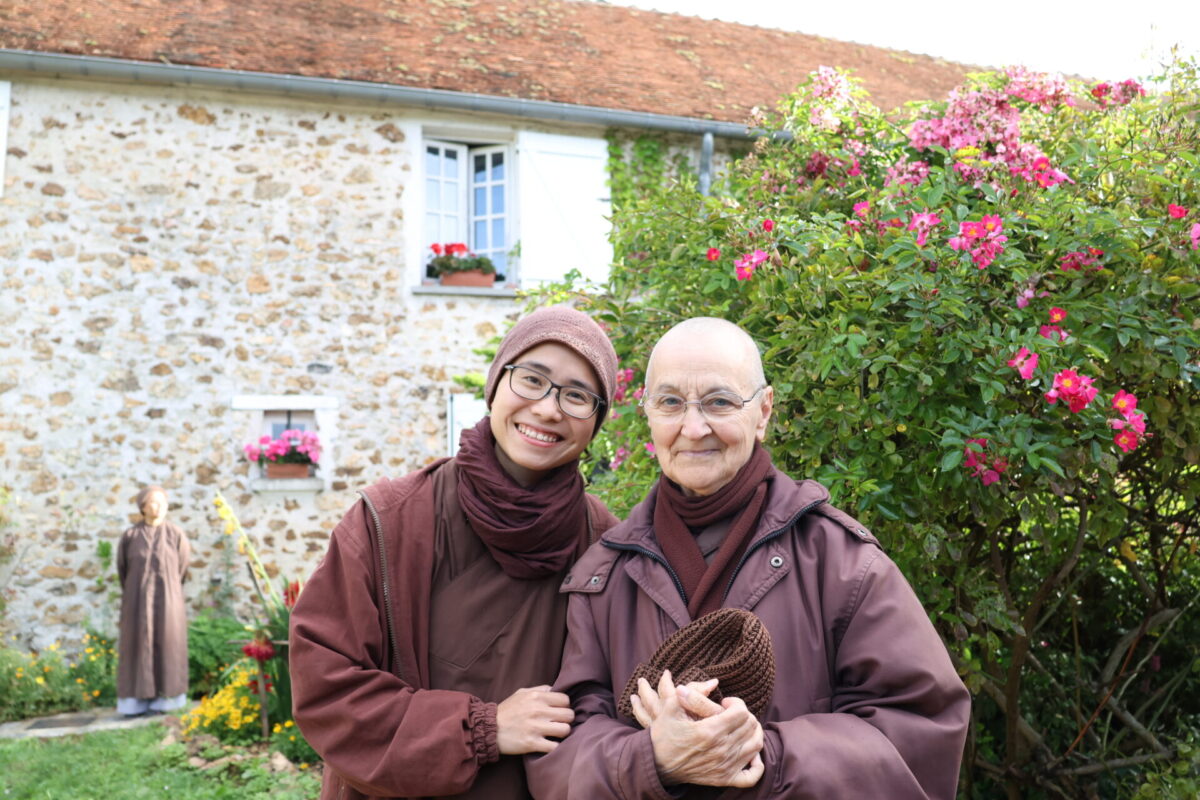
TN: How do you and the community at Maison de l’Inspir continue to share the practice with families and young people?
GN: We are deeply engaged and continue to welcome many young people, including those from Wake Up. For many years, we offered a half-day every other Saturday afternoon at Maison de l’Inspir to receive families.
We guided parents to learn how to trust their children—even the very young ones—who would lead walking meditation or the tea ceremony, and invite the bell. During walking meditation, the parents would close their eyes and allow themselves to be guided by a small child. Everyone was so present, so full of mindfulness.
This, to me, is Engaged Buddhism in action—transforming the lives of families. Once a year, the parents would organize a retreat of three to five days, where parents and children practiced together.
TN: On the path of service, what were the greatest challenges for you, dear sister? And how did you overcome them?
GN: I think the greatest obstacle I encountered was wondering how others would perceive what I was doing—it was so original! That was my challenge: the fear that others wouldn’t understand.
At that time, Buddhism was not well known. Thầy’s first teaching in French was in 1984 or 1985, just before Christmas, I think. So my fear was that this kind of engagement would be misunderstood—seen as belonging to a sect—and that I might be forbidden to continue my work in the hospital—even when I could see the positive results. But when the head of the department said, “Madame, you have carte blanche,” all my fears disappeared. My obstacles came from within me, not from the outside.
TN: You are a bodhisattva of deep listening, a beautiful continuation of the Bodhisattva Avalokita. Could you tell us what inspired you to offer deep listening to friends at the Maison de l’Inspir?
GN: It’s hereditary. My mother listened to people a lot. Sometimes she would bring unhoused people home—they could sleep, wash, and rest before going on their way. That was part of our home: listening. My grandfather did the same, and my grandmother too. So, it’s in our family—in our genes. There's no need for me to take credit for listening that way.
But I can tell you how the sangha’s deep listening once transformed someone. Would you like to hear a beautiful story?
TN: Of course!
GN: One day, at the Maison de l’Inspir in Noisy-le-Grand, a man arrived on his motorbike, with tattoos, wild hair, and a black leather jacket—a true old-school rocker. At that time, not everyone had tattoos yet! He said, “My name is François.” He’s happy for me to share his story—just François, no last name.
He listened to the teachings, joined the walking meditation, and shared during Dharma discussion. I welcomed him as I would any person without housing—that was familiar to me. It didn’t scare me or impress me; I had already spent time among people living on the streets.
During the sharing, he told us his story—abandoned as a child, living on the streets, drinking by the age of ten or twelve, then taking drugs. Even though he was still young, his body was already badly damaged. You could see he had lived too much—and lived badly.
All of us—monastics and lay friends—simply listened. We didn’t interrupt, we didn’t comment, we just listened deeply. He said, “I came to you today because I almost killed my wife’s lover. I had a knife in my hand, ready to kill him—but I didn’t. I remembered seeing a book with an address—Noisy-le-Grand, the Maison de l’Inspir—so here I am.”
From that day on, every Thursday, he came to our Day of Mindfulness—learning to live, to be loved, to be recognized, to be listened to, no matter what he said.
One day, he arrived and said, “This is my daughter. I asked her to give me the most beautiful gift possible for my birthday. She asked, ‘What would make you happy, Dad?’ and I said, ‘Give me a day.’ She asked, ‘Which day?’ and I said, ‘Thursday.’ So here we are—I came to spend this day with her.”
Together, surrounded by the sangha, he made a confession and asked his daughter for forgiveness. Everyone was in tears. It was deeply moving—especially knowing the life he had lived. Later, he did the same with his son, bringing him to the Maison so his son could see the place where his father had found refuge. Again, he made a confession before his son—a young man of seventeen. He changed completely.
One day, we were a very small group—just five people—including a police officer who came to learn about nonviolence and calm. We never spoke of our professions, just our names. When it was François’ turn to share, he looked at me with sparkling eyes:
“You know what?”
“No,” I said, smiling, to encourage him.
“I looked for all the weapons I had in my house.”
Right away, the police officer turned pale—thinking, “Oh dear, where have I ended up?”
François continued, “I took all my weapons and piled them in the middle of my living room—a great mountain.” You could imagine how much fear he had been carrying!
“So, what are you going to do with them, François?” I asked.
“I have an idea, Sister Élisabeth. I have a friend who’s a blacksmith. I’ll give them all to him—he’ll make a statue of liberty. Not the one over there, but the one we feel inside when we’re truly free.”
He had stopped drinking, stopped taking drugs, stopped stimulants. He was living peacefully. He had melted down his weapons to create a statue of inner freedom.
“Excellent idea, François! You must do that!” I said. Meanwhile, the police officer looked even paler!
Then he looked at me seriously and said, “I kept something.”
I smiled and said, “It’s already wonderful that you could let go of all the rest. What did you keep?”
“A hammer—with a long handle—for when I’m on my motorbike, in case he comes close.” You could see the old fear still there.
I said gently, “You’ve already made a great sacrifice. If you still need that one for now, keep it.” He was amazed.
The following Christmas, I was just about to leave to visit my mother when I saw him arrive.
“Oh, how wonderful! If you’d come five minutes later, you’d have missed me!” I said.
“Sister Élisabeth,” he said, “I have a gift for you.”
He handed me something wrapped in a red-and-white checkered napkin. It was the hammer. He had given up his last weapon—thanks to the sangha.
I told him, “You’ll wrap it again and place it on the Buddha altar for five days, to purify it. You’ll offer it yourself, saying, ‘This is my last weapon, Lord Buddha.’”
I had told him the story of Aṅgulimāla—and that’s what he did. Later, he became a filmmaker. He made a film in which his son played his younger self—and it was a success. He was so happy. Such a transformation—such a beautiful story.
There are so many like that: reconciliations between couples, between parents and children, between human beings and life itself.
It is truly the hand of Thầy reaching out to those in need.
TN: What would you like to say to the young members of the Order of Interbeing, to inspire them?
GN: First thing: life is beautiful. For me, it truly is.
Second thing: you have chosen the most beautiful path. Look into my eyes—they’re overflowing with love—you have chosen the most beautiful path.
In the year 2000, the United Nations Educational, Scientific and Cultural Organization (UNESCO) invited Thầy to propose something to change the world. Thầy presented The Five Mindfulness Trainings and said, “Here—with this, we can change the world.”
UNESCO included six points in the final manifesto, but the spirit of The Five Trainings was completely within it. I heard that sixty million people signed that manifesto.
Real change is possible. If we change our attitude, everything will change.
And lastly, nothing can be done except together. Together, we can do everything. Together, we can rise above every difficulty.