Dharma teacher Trish Thompson shares three transformative experiences of meeting her teacher and her spiritual family.
Finding the Teacher
Why in the world would I go to a retreat offered by a teacher whose name I cannot pronounce? This was but one of my responses to Carol, my dear friend who had inquired once again if I was going to a retreat being offered by the Zen Master Thích Nhất Hạnh.
Dharma teacher Trish Thompson shares three transformative experiences of meeting her teacher and her spiritual family.
Finding the Teacher
Why in the world would I go to a retreat offered by a teacher whose name I cannot pronounce? This was but one of my responses to Carol, my dear friend who had inquired once again if I was going to a retreat being offered by the Zen Master Thích Nhất Hạnh. She had read somewhere that he was coming on a US tour. The retreat would be held in Key West, Florida, not so far from my home in South Carolina. I had several perfectly valid reasons why I wasn’t interested in attending his retreat.
First, I had never read a book by him. Well, I had tried but found his writing to be so simple. I was loving the complexity of the concepts and teachings in the Tibetan tradition. I had spent six months living with Tibetan nuns near Dharamsala, India the year before. I’d had the supreme happiness of having a one-on-one, private audience with His Holiness the Dalai Lama. True, my Tibetan mentor had suggested I find a teacher in the US, and I had made a half-hearted effort which had borne no fruit. I dreamed of returning to India as often as possible, if only my husband would agree to my being away.
Second, this retreat was designed for those in the field of mental health: psychologists, psychiatrists, psychotherapists, and social workers. I was none of these. Carol chuckled at that excuse. “I think you qualify,” she said. She was referring to my eight solid years of intense private and group Healing the Inner Child/Family of Origin psychotherapy.
No, I was not interested. She was insistent. “I don’t know why, but I keep thinking he might be a teacher for you.” Nope, I thought; I’m going back to India.
Later that summer, I was on a boat off the coast of Nova Scotia, Canada, with my husband when I received a fax from my friend. She included the registration material. In those years (this was 1997), Thầy’s US tours were organized by the Omega Institute.
Watching the huge sea turtles swimming off the helm, I thought, She just won’t let this go. Hmm… every suggestion Carol has made, everywhere she has taken me since my mother passed away eight years ago, has been exactly what I needed. I trust Carol’s insight.
I immediately called the Omega office and mailed my registration.
Days later, I received the registration packet which included, on one sheet of paper, something called The Five Mindfulness Trainings. Here they were, exactly what I had been looking for my whole life. Reading them, I burst into tears.
After driving for two days (all flights were full), I arrived in Key West on a Sunday afternoon, still wondering why, still feeling some resistance. Almost immediately, I sensed something new. Smiling monks and nuns in brown robes were walking slowly, so very slowly, as though they had nowhere to go. Smiles were everywhere and they were contagious. Soon, even though weary, I was smiling too.
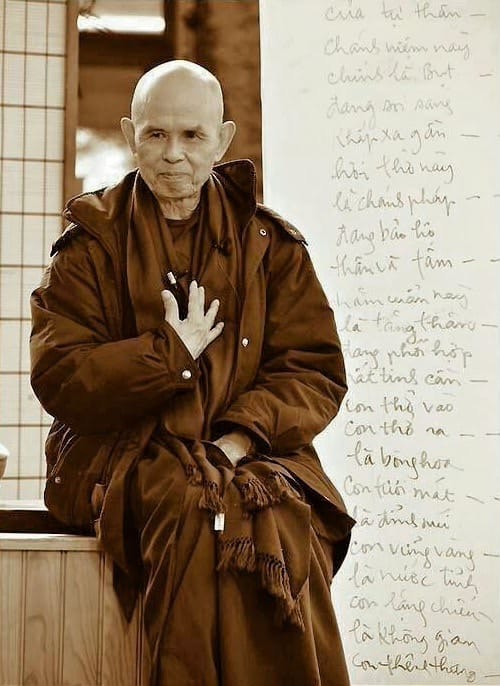
That evening, Thầy gave his orientation talk. I am from the southern US where preachers talk fast and sometimes even shout from the pulpit. His soft, soothing voice and slow, measured style, certainly different, even from the Dalai Lama, made it difficult not to doze off.
The next morning, determined to stay alert, I positioned myself on a cushion near the stage. I need not have worried. Seeing him glide across the stage, bow, and take his seat, I woke up.
He talked; he wrote on a whiteboard, beautifully, in Vietnamese, in English, in Chinese, in Sanskrit. His every move was graceful, mindful. I was totally concentrated, captivated.
He finished his Dharma talk, stood, and bowed to us. We stood and bowed. I continued to bow, hands folded in front of my heart, as he walked off the stage and down the steps. I do not believe I had ever been more concentrated as I was in those moments, and Thích Nhất Hạnh was the object of my concentration.
Suddenly, he turned his head, very forcefully, as though he had heard something. He stared into the group, and his eyes locked on mine. The contact was deeply intense; I was aware of the challenge to not look away (shame, not feeling good enough to look into the eyes of the teacher). And then, I heard a whispered voice in my left ear, “What are you waiting for? When are you coming up here?”
He turned, put on his jacket, and walked out into the Florida sunshine. I was immobilized. My heart was pounding; adrenaline was rushing through my body. I had to breathe deeply for a few moments to calm myself before I could manage to walk at all.
I broke Noble Silence to share with my roommate, “I’m not returning to India. I must go to Plum Village.”
When I told this to my husband, he became very angry. I realized we both felt afraid. Our paths had become incompatible, threatening the foundation of our marriage. Even so, I could not ignore the teacher’s call. Sometimes we must leave in order to follow our path—like a snake must shed its skin. Six weeks later, I was in France for the three months of the Winter Retreat.
After countless lifetimes, the student had found her teacher.
Where do the daffodils live?
My first personal, one-on-one, teaching I received from Thầy is a moment to which I have returned many times over the years. That experience stays very present with me.
Immediately after the 1997–1998 Winter Retreat at Plum Village, France ended, the monastics entered their ten-day rest period. I had asked for, and was granted, permission to stay for an additional week or so.
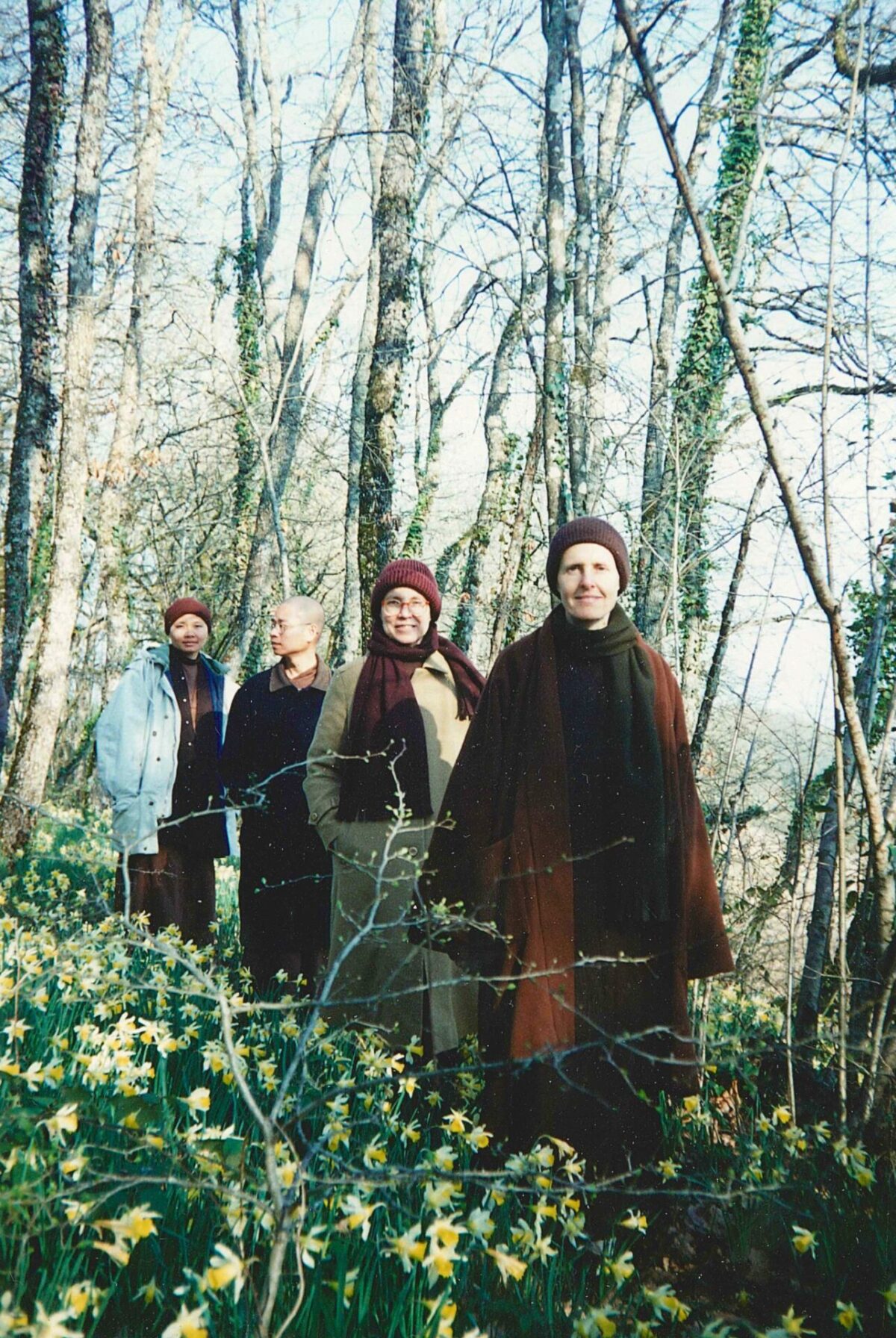
One particularly beautiful, sunny, and warm day in March, we were at the Upper Hamlet for a special occasion. The daffodils were in bloom and the brothers had arranged for everyone to enjoy a Daffodil Festival. The scene was quite joyful. I was the only layperson there, and so, of course, I found myself hanging back, aware that I was not really part of the family, or at least not yet feeling like I was. I was still very new to the community and somewhat intimidated, especially by the elder monastics. Looking back, I can see how much of that came from my own insecurities, of which there were many in those days.
The cameras were out for the occasion, one of which was a video camera on a tripod. Thầy announced that he wanted to shoot some videos. He was so playful. The feeling of being a witness to the interactions in a large and loving family was so strong, as it had been for the whole retreat. It was beautiful to see, and I knew I was being healed. Thầy was obviously enjoying himself as he got behind the camera. There was a lot of laughter as we stood in the open area where the walking paths were, very close to where there is currently a large lotus pond. At that time, it was just a wide grassy space.
After the filming and laughter, Thầy decided to lead us in walking meditation down the hill beside his hut. We followed, with me bringing up the rear.
Oh! My goodness! As we made our way down into the wooded area beside Thầy’s hut, a most wonderful sight came into view. Beneath the tall trees, the floor of the forest was covered in the greenest grass and thousands of blooming yellow daffodils, my mother’s favorite flower.
My mother’s sudden death, nine years earlier, had been the wake-up call I needed. Now, here she was with me on this path as I followed my spiritual teacher. I knew she was smiling, though for a few moments, I had to fight the tears.
We slowly made our way down the hill. At some point, Thầy perched himself on top of a very large boulder as the rest of us continued down the path and finally settled ourselves, some sitting on the grass, others strolling about.
I sat on my heels, my back against a pine tree, and looked up the hill toward Thầy. Sister Chân Không was off to the right, quite a way up the hill, standing near him.
After a moment, she began motioning to me. At first, I looked around, unsure if she meant me, but she did. She was inviting me to come up.
I slowly walked up the hill, through the grass and flowers, until I was standing in front of the two of them. (I’ve wondered all these years if I remembered to bow. I must have. I remember feeling awkward, shy.)
She introduced me to Thầy.
“Thầy, this is Trish. Trish has been here for the whole Winter Retreat. She wants to develop a practice center.”
He looked at me and said, “Oh?”
Then he said, “Here, sit beside me.” And he patted a space on the smooth boulder.
I sat beside him, just inches away.
He asked, “Where would this be?”
I said, “On the coast of South Carolina. I am from South Carolina in the US.”1
He asked, “Are there trees?”
“Yes,” I said. “Oh yes, Thầy, there are beautiful, very large live oak trees on the property.”
He nodded and said, “Good. You build it, and then invite us, and we’ll come.”
I must have said, but cannot be sure, “Thank you, Thầy.”
Then he reached for a nearby blooming daffodil. Cupping it in the palm of his hand, he said, “Do you see this flower? Always ask permission before you cut a flower, for it lives in the ultimate dimension.”
I probably looked a bit blank, for even after three months of his teachings, I still wasn’t quite sure what that meant, that the flower was living in the ultimate dimension.
But of course, I nodded and said, “Thank you, Thầy.”
And with that he suggested, “Why don’t we sing a song?”
Until this retreat, I had not sung since being told (and believing!) in ninth grade that my voice was not good enough to join the school choir. Even after three months of practicing singing every day, my voice was still quite croaky, but of course, I opened my mouth, and I sang with our teacher, and I have continued to sing. With the support of the sangha, I have learned that the quality of my voice is not as important as my intention to generate joy. We sing for the pure joy of singing.
Together, our teacher and I, we sang, “I have arrived, I am home.” And then he asked, “Have you arrived?”
I, quite sheepishly, replied, “I don’t know, Thầy. Maybe some of the time.”
Maybe I would still answer that question that way … some of the time.
Bát Nhã: A Life-Changing Experience
As one of Thầy’s disciples, I was approved to be a part of the delegation that would accompany Thầy and the monastics on his triumphant 2005 return to Vietnam. Seven of us were present for the entire three-month teaching tour, during which we spent time in the north, south, and central parts of the country.
Traveling throughout Vietnam with the sangha was one of the most beautiful experiences of my life, a time of daily exposure to the love of the Vietnamese people. Throughout the tour, not due to any conscious effort on my part, I seemed to be in the right place at the right time for big and small interactions with our teacher, interactions that impacted my spiritual growth in countless ways.
One late evening in week four, as we, almost ninety lay friends, were preparing for bed in our hotel in Saigon, we received a message with instructions for the following day. We would leave quite early to go somewhere in the Central Highlands. We would spend one night. We would probably sleep in our clothes. We should take with us only essential toiletries, our water bottle, and our personal food bowl. The Central Highlands! Those of us who were old enough knew of that area’s importance during the Vietnam/American War.
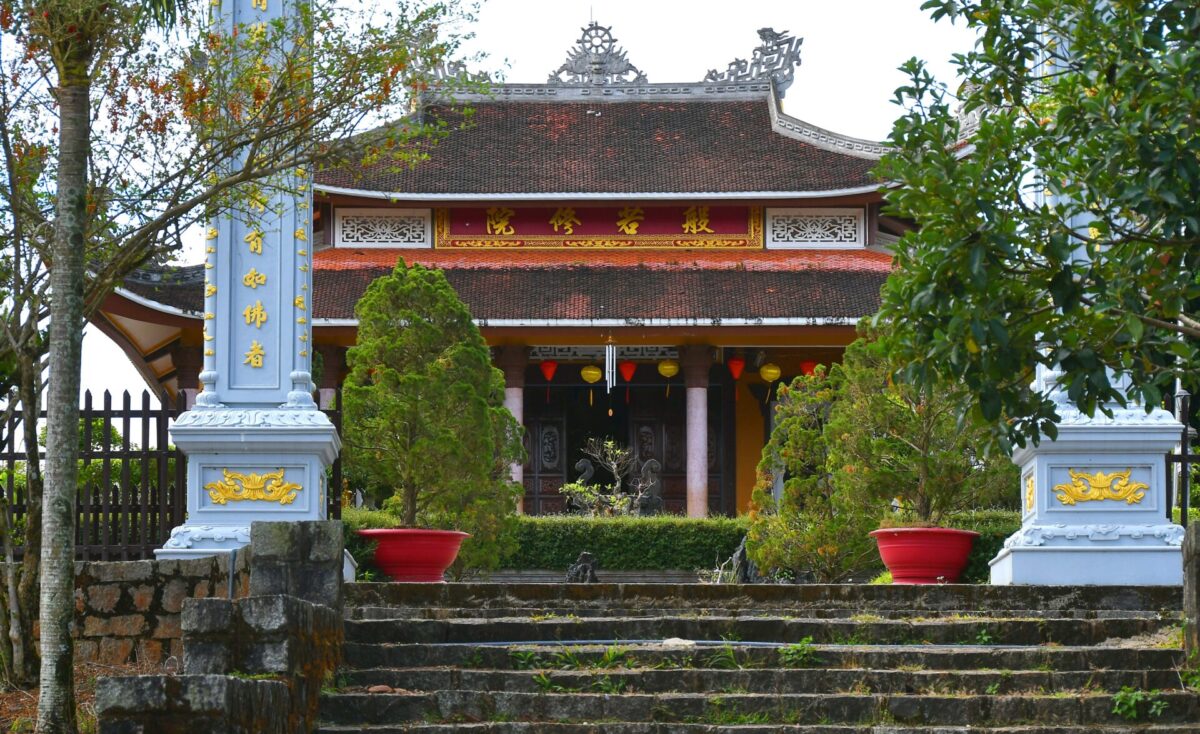
Our five large buses required almost five hours to drive from Saigon to our first stop: Phuong Bội, the beloved land that had served as a refuge for our teacher and his friends. It was there that they contemplated and developed their ideas for a renewed Buddhism that included engagement in the world. I had read Thầy’s description of the place in Fragrant Palm Leaves, and I wondered how Thầy felt as he surveyed a very different landscape. The buildings were no longer there and the ancient forest was long gone, as were the tigers and other wild creatures, due to war and time.
We continued to the small town of Bảo Lộc. Lunch was waiting for us at a temple where, we were told, Thầy had served as abbot for one year.
I had no idea about our destination, and it didn’t matter. Just being together with the sangha was wonderful. I had learned, in the first days, in Hanoi, to let go of my need to know anything. I only needed to follow the instructions given to us by the monastics in charge, show up, and be on time. I was practicing “not knowing” and enjoying a profound sense of freedom, a kind of childlike wonder, beginner’s mind.
Eventually, we arrived at a small yet imposing temple in the countryside. Everywhere I looked, I saw loveliness. The temple grounds were large, and we had the entire afternoon to explore them.
That evening, we gathered in the Buddha Hall, bunched together, totally filling up the space. Thầy and the abbot of the temple sat up front.
Then came the big announcement. We learned this temple was being given as a gift to Thầy and the Plum Village community. The plan was to develop it into a place of training for young people in Vietnam who wished to become monastics. It would be known as Prajñā Temple, Bát Nhã, a place of wisdom.
We were excited and happy to hear this incredible news, which most of the ninety-nine monastics were also hearing for the first time. We laughed and cried tears of pure joy. After almost forty long years of exile, Thầy was truly being welcomed home.
We laywomen slept that night in the administrative building directly behind the Buddha Hall. We needed every inch of the available floor space. I ended up getting a spot on the wide, covered veranda that surrounded three-fourths of the building. From my spot, I could see a few lights from the simple farmhouses on the far side of the valley below.
This was February in the mountains. After sunset, the night turned cold, but the heavy blankets provided for us felt warm and snuggly.
It had been a long and eventful day. Drifting off to sleep, with the sound of the snoring of my sisters lined up like children at kindergarten, my happiness knew no boundaries.
I woke at 4 a.m. to the sound of the bell and a nun offering the morning chant. Lying there, all warm and cozy, staring at the stars in the still dark sky, I knew I was in the Pure Land. Then nature called; I needed to visit the toilet.
Picking my way around the sleeping women, I went to the opposite side of the building from the temple, heading for the women’s porta-potty on the edge of the rear garden.
Just as I was about to step down from the veranda, I could see, in the moon and star light, several people slowly walking in my direction.
The person in front was Thầy! I could see the silhouette of his distinctive ears. All of us know those big ears of Thầy’s, so wonderful for deep listening.
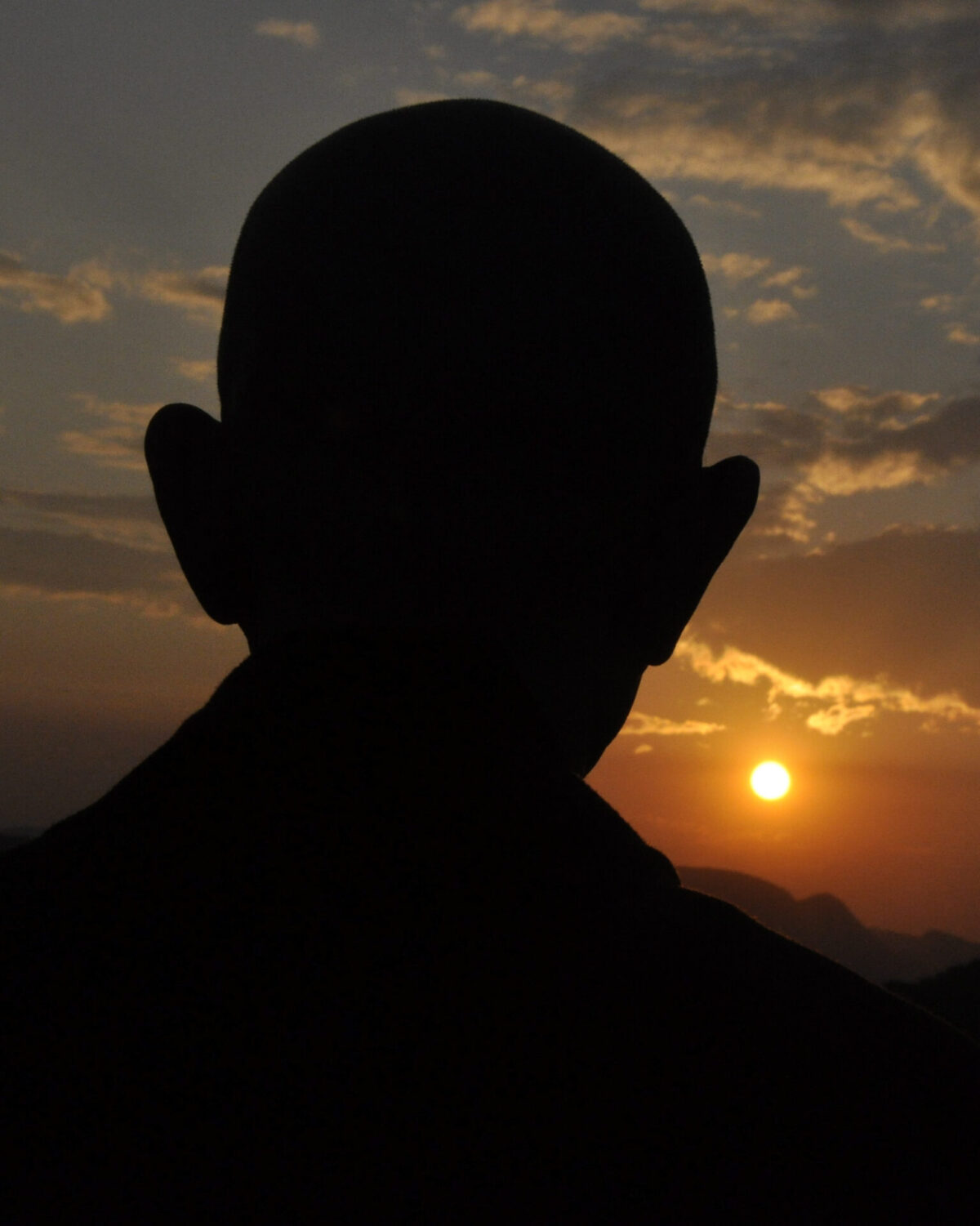
He was enjoying his morning walk, and he was coming straight toward me. Following him were two or three other people. I stopped and stepped aside, standing on the step.
Clearly, his intention was to step onto the veranda, walk around the corner, and come out the other side of the building on the side of the Buddha Hall. He didn’t yet know about all those sleeping, snoring sisters.
Sure enough, he stepped up, passing me by inches. He started around the corner, the group following. Of course, he didn’t get far. He quickly turned around and again passed by me. This time, I could see his broad smile.
I forgot about having to go to the toilet. I don’t remember thinking. I just fell in behind the last person in the group and began to focus on my steps and my breath in the crisp morning air.
We practiced walking meditation through the many roses, the silence so deep, broken only by a distant barking dog, a crowing rooster, and the crunch, crunch of footsteps on the garden soil. And it was… I don’t know a better word…. magical.
Thầy led us around the front of the temple until we faced the valley in the distance. By that time, Sister Chân Không had joined the walking and was directly in front of me.
The men, including Thầy’s attendant and the abbot and his attendant, settled at the top of the temple steps. Sister sat a little below them in the middle, and I sat on the bottom step, away from the group.
The men talked quietly, with Sister Chân Không occasionally joining the conversation. Suddenly, always so inclusive, she turned to me and said in English, “We’re talking about our plans for this place.”
And with that, I completely surprised myself by blurting out, “Oh, Sister, will you ask Thầy … can I stay here? Can I live here? Can I be a part of building this place?”
She turned to Thầy and spoke in Vietnamese. I heard him murmuring, and then she turned back to me and said, “Thầy says it’s too soon, too soon for you to do that.” I don’t remember having time to think or feel anything about my question, which had revealed a deep aspiration I had not consciously known I had, nor his answer, for at that moment, the men got up and left. Sister Chân Không stayed with me.
We walked a little as she pointed here and there, saying, “Here is where we’re going to build the nuns’ dormitory. This will be the kitchen and dining area,” and so on.
Then she said in her trademark conspiratorial tone of voice, “And you can stay. Thầy is right, of course. It’s too soon. But you can get a three-month tourist visa, and at the end of three months, you go away for a while, and then you come back for three months. You can do it like that.” And with that, we parted, and I finally went to the toilet.
For twenty-one years, until this writing, I have lived and built sangha in Vietnam, with the blessings of our teacher. And I continue to be here, as Sister Chân Không suggested, on a succession of three-month tourist visas.
1 Conditions weren’t sufficient for this to happen. My husband and I divorced, and I moved to Hanoi, where I founded the first sangha in our tradition in the north.