An Interfaith Action for Palestine: The Power of Grief, Communal Solidarity, and Entering the Kōan of Compassionate Action
This article reflects deeply on human suffering and contains detailed imagined descriptions of physical war trauma, limb amputations, and child casualties as part of a reflection on bearing witness. Please engage with care for your own well-being.
Last year, I visited my family in California, including my two-year-old nephew. His cute toddler belly popping out,
An Interfaith Action for Palestine: The Power of Grief, Communal Solidarity, and Entering the Kōan of Compassionate Action
This article reflects deeply on human suffering and contains detailed imagined descriptions of physical war trauma, limb amputations, and child casualties as part of a reflection on bearing witness. Please engage with care for your own well-being.
Last year, I visited my family in California, including my two-year-old nephew. His cute toddler belly popping out, adorable mini legs speedily carting his wobbly body around, the soft glow of his cheeks, and his carefree, innocent eyes that seemed only to wonder, “Are you gonna play with me or not?” Gazing at his tender, little body squiggling around while feasting on crackers and hummus awakened feelings of pure cherishing of life. Suddenly, mental flashes sparked in contrast—his arms and legs partially blown off, shrapnel grinding his face to the bone, being rushed to a barely lit hospital with no beds, a full leg and partial arm amputations, and then released before he could open his tender eyes again. “But not to my nephew, not to us here…” my mind protested in panic.
I snap out of the horror reels, resettle my attention with him, and eventually toss a sand-filled gecko lizard on my head so that he can knock it off for the fourth time. His timid face unhinges into wild laughter, and I feel relieved and grateful that we can be safe, healthy, and alive together. I hand the poor lizard back to him so we can do it all over again, as I notice his unscathed and tiny tender fingers brush against mine.
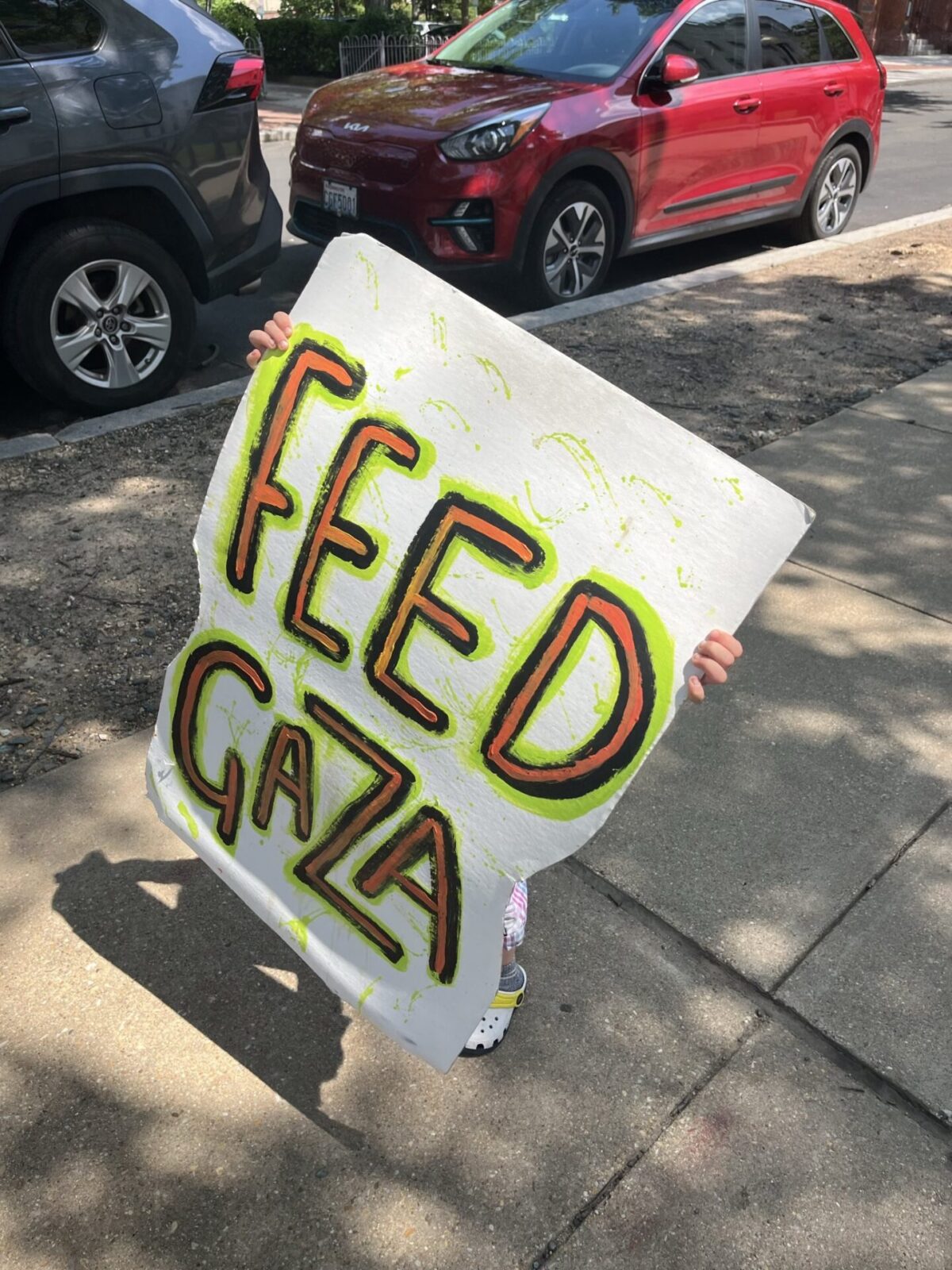
Palestine is presently home to the most child amputees in the world. I wonder what makes their lives more easily discarded or less humanly precious than this heart-melting blonde child that I’m watching pound grape halves into half-full cheeks? The ways my mind blocks the possibilities of shared humanity have become a necessary and powerful subject of practice for me—the art of not turning away.
During the first year and a half of the genocide in Palestine, I could barely watch the livestream nightmare unfold. Looking back, I can clearly see that I was paralyzed, feeling helpless and removed. I didn’t know how to respond, whether internally or externally. Among the circles that I’m a part of—the sanghas I take refuge in, my family, the retreat centers—almost no one exhibited responses that visibly embodied compassionate and courageous resistance. Aside from some press statements during the first month of the bombardments in Palestine and deaths in Israel, the Buddhist community was generally quiet. Each time I heard, watched, or read the horror-filled stories, I sighed and slowly turned back away, feeling unable or unwilling to help.
To not turn away, to actively stay with, requires one to bridge the shadowy chasms within. Safety check: welcome to the shadow-probing privileges of a white middle-class man in America. If I let myself listen, truly listen, I hear the hidden self-protecting stories that I don’t want to admit: That could never happen to me and my nephews here in California. Well, maybe for them on the other side of the planet, the poor things, but not us. I refrain from repressing the thoughts and just bear witness to my own self-disclosing shadows. But why do they deserve this living nightmare and we don’t? Because they’re not my family? Or not in my country? Is it because they’re poor and live in the desert like some Mad Max film? Or is it because they’ve been fighting like this for so long now, so they’re just used to losing newborns to winter storms? Is it that they’re a bit more brown, a bit more Muslim, or Arabic? Is their pain just as unimaginable as if I watched my nephew’s body shrivel and his glowing eyes darken from starvation? What if Palestine were filled with 100,000 little blonde nephew lookalikes? Then where would we be? If my kids were starving, would others help them, feed them, and protect them, or turn away?
To turn towards the unspeakable, I have to turn towards myself—trying, and trying again, not to turn away. The more I learned, the more I realized that this genocide couldn’t happen without the US, without us. Our government is directly feeding and supporting all of it—with military intelligence and arms, bombs upon bombs, financial assistance, and international political shielding. The more I turned away, the more my frustration, confusion, and shame increased, feeling not right with myself in the world. Letting my country commit these atrocities, without actively trying to stop it, feels like a crime we’re all committing.
…
Last year, a dear sangha friend, Sophie Sarkar, encouraged me to join a multi-day interfaith action for Palestine in Washington, DC. Coincidentally, just a week before that call, I had finally told myself, I’ve been passive about this long enough. No more waiting for others. When intentions become clear, opportunities manifest.
Sophie and Kareem, both cofounders of the Plum Village Solidarity Council, were my only two friends at the time who I knew were actively community building to prevent further genocidal destruction, preserve life, and build peace in Palestine. Sophie was collaborating with the codirectors of Buddhist Peace Fellowship to steward the Buddhist contingent of the interfaith action.
The interfaith action was organized by Christians for a Free Palestine, an activist community I had never heard of. But I trusted Sophie, a deep practitioner and social justice warrior. I was very hesitant to participate. Their strategy was not the typical Plum Village way, such as quietly sending metta to both victims and offenders, or offering a public peace walk in the form of walking meditation. The interfaith action centered on protesting Christians United for Israel (CUFI), a larger Christian lobby supporting the genocide. Given our Order of Interbeing (OI) precepts, “We should strive to change the situation, without taking sides in a conflict,” I felt uncomfortable about, well, taking sides. At the same time, I could no longer sit in frozen isolation, letting genocide unfold without trying to do something to prevent such further slaughter at the hands of our government.
Instead, I decided to learn from those already engaging, those who were unafraid to acknowledge the horror and were willing to show up. I decided that I should learn more from communities already engaging wholeheartedly in this struggle. Instead of thinking that only my spiritual tradition and community have all the best responses, I asked myself, What could we learn from this broad, interfaith community of activists? What does an appropriate and compassionate individual and communal response to genocide even look like? At the very least, I could offer my own deep drops of mindful walking, breathing, and compassionate looking to this multi-faith gathering.
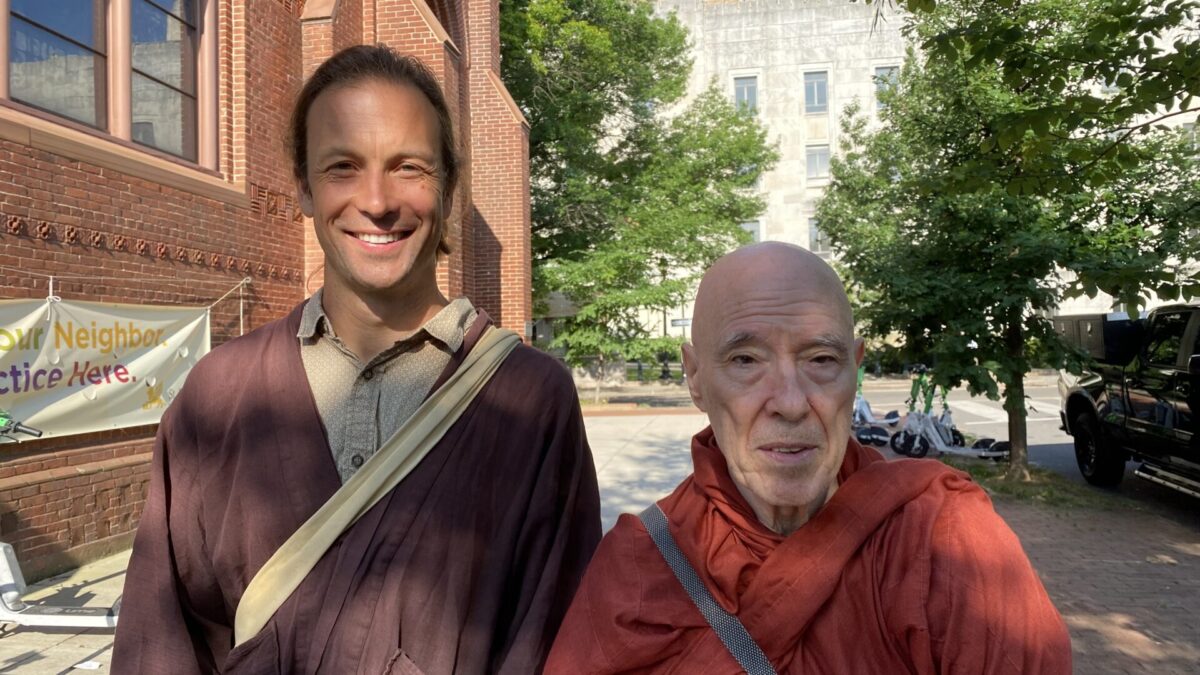
About a week before the events, Venerable Bhikkhu Bodhi, a legendary and pioneering Buddhist teacher, agreed to attend as a keynote speaker. As I was staying near his monastery, I was invited to give Bhikkhu Bodhi a ride to DC! Originally from Brooklyn and of Jewish background, the Venerable was by far the most knowledgeable and dedicated person that I had ever met regarding the complex history and current humanitarian needs in Palestine and Israel. We spent six hours in the car together, so I learned a lot! I can’t tell you how relieved and grateful I felt, hearing such a revered Buddhist teacher speak so fiercely and openly about protecting Palestine, unapologetically standing up for those unable to protect themselves. Although he was courageously outspoken about the genocidal acts, I detected no inklings of ill-will or hatred towards Israelis or Palestinians. I felt that I didn’t have to figure things out or take a stand alone. I realized that I could trust the guidance, love, and perseverance of those farther along than myself; those already walking the path of not turning away.
In DC, I immediately found myself surrounded by hundreds of people of faith, all coming from various churches and religions around the country, all determined to show up and concretely support those bearing the unbearable. Being surrounded by this fierce presence of compassionate determination felt almost dreamlike. My spirit soared as the genocidal burden rose from two shoulders to this multi-faith body.
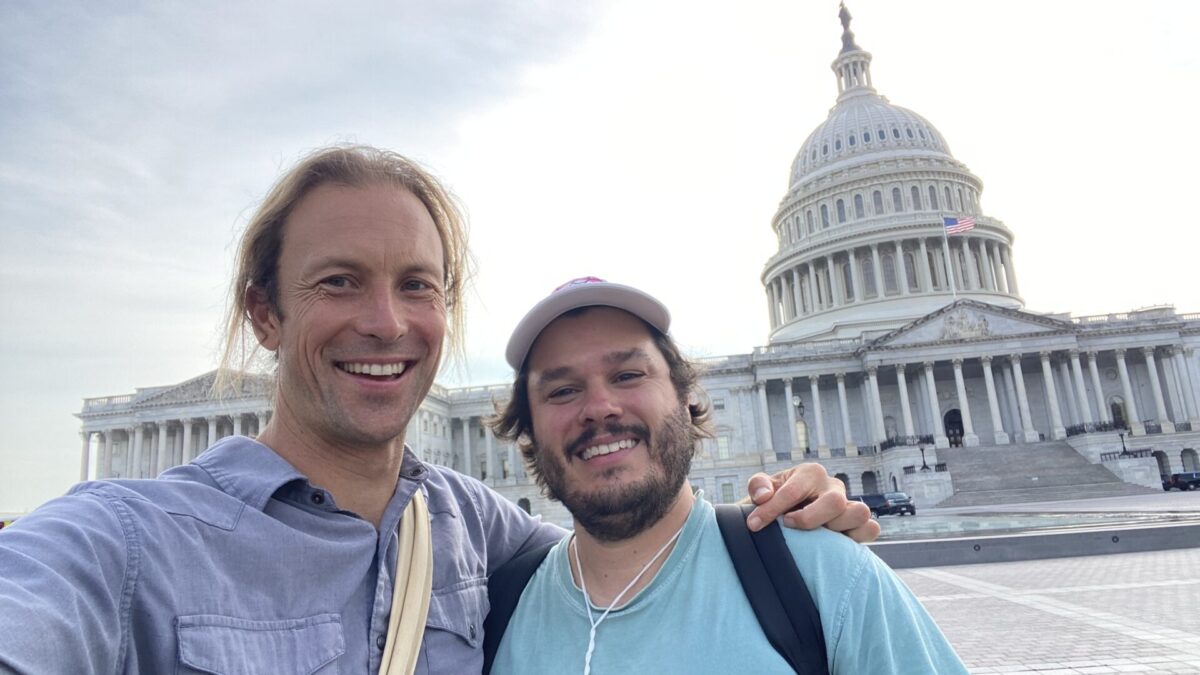
The last and most powerful day was an interfaith prayer service that was originally planned to be held on the steps of the Capitol building, but due to rain, we gathered at a Lutheran church downtown. I didn’t know what to expect, but the gathering was like a Dharma talk combined with a collective grief ceremony, where fierce love held the pain and despair of the world, like a mother carrying her wounded children. There were about fifteen teachers, all representing different spiritual traditions and communities, all showing up, speaking, naming the harm, acknowledging the US’s role in supporting and defending this genocide. I didn’t feel any hate that day, just deep, inexpressible grief and powerful, loving presence. The congregation sat on timeless wooden pews, held by high, dark cathedral walls, and contrasting bright rainbow stained glass stories; for the next few hours, our interfaith sangha held vigil for the voiceless, naming the unnameable, surrendering to the overwhelming, validating the invisible, and holding the weight of the terror and despair that no solo heart and mind can bear alone. Together, we prayed for the relief of those writhing and cowering in the torture chambers of humanity’s hatred, greed, and ignorance, where a world outside was unwilling or unable to protect them. This was the spiritual leadership and soulful presence that I had been craving for so long; I never imagined I would find such Dharma liturgy in a church.
The deep presence tightly embraced our searing rage and the bottomless wells of sorrow and despair for the nightmarish reality of what has happened, what continues to happen. Songs gave body to the messages, and at one point, a short, Black rabbi, was speaking and started to lead us in a song called “Carry this All” by songcatcher and grief ritual facilitator, Alexandra “Ahlay” Blakely.
You do not carry this all alone / This is way too big for you to carry on your own1
I felt myself so held in that space, in ways that I never expected and didn’t even know was possible. In the midst of singing, something cracked open in me. For years I had been feeling frozen, in paralysis, witnessing this genocide and unable to respond in any meaningful way. My body began to quake from the inside, my face trembling. Although rigid and afraid, I felt myself trusting the song’s medicine, trusting the congregation to hold more, trusting my body to reveal more. Streams of thawed grief poured down my cheeks, and my shoulders shook freely, expunging the paralysis and frozenness stored inside. My sangha sister held my left shoulder and I knew I was not alone.
Thầy famously said, “It is possible the next Buddha will not take the form of an individual. The next Buddha may take the form of a community—a community practicing understanding and lovingkindness.”2 I had always imagined this would be a Buddhist community, my personal tradition. But in those moments, I realized that the Buddha manifested as a vibrantly diverse interfaith community sangha. The unique songs and colors of each religion, of each person, all chanting the same compassionate rhythms. It was by far, the most powerful interfaith experience of my entire life.
…
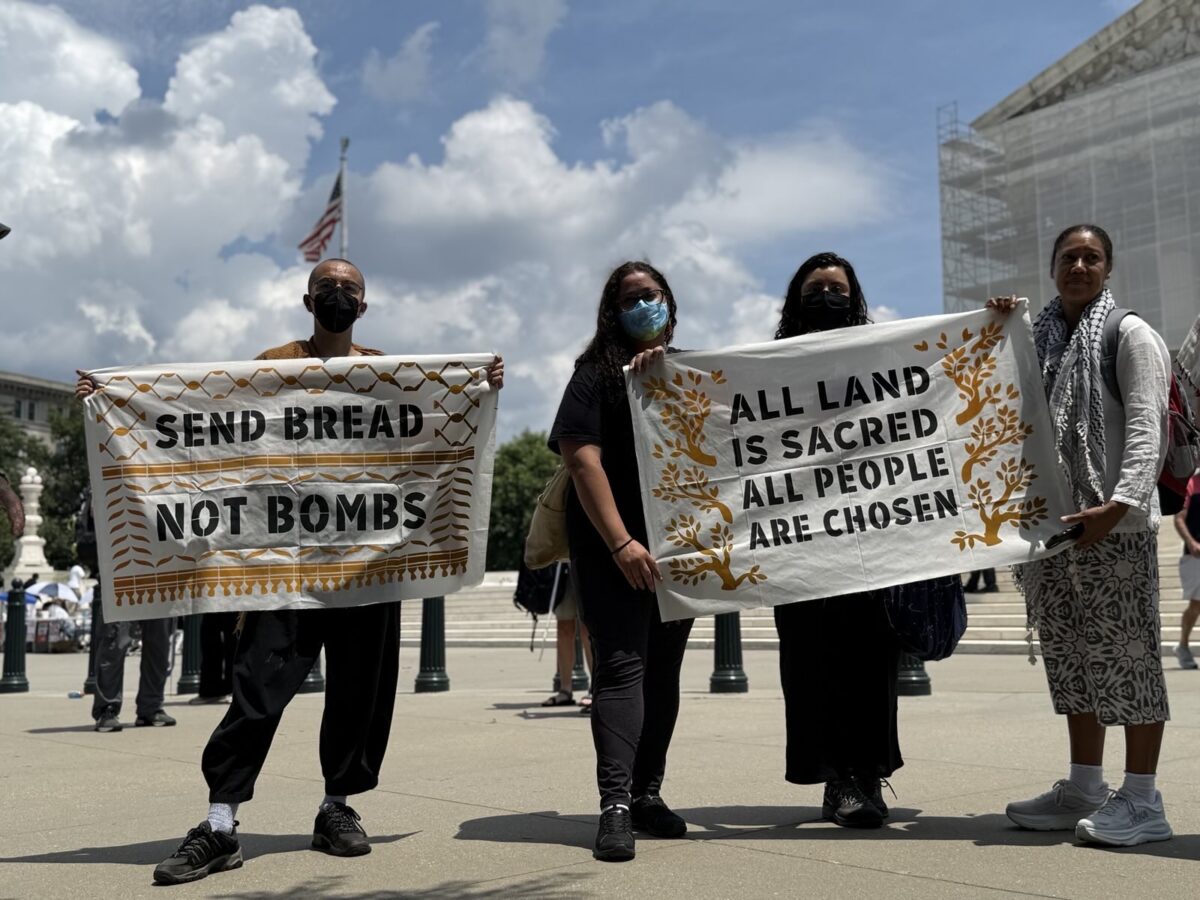
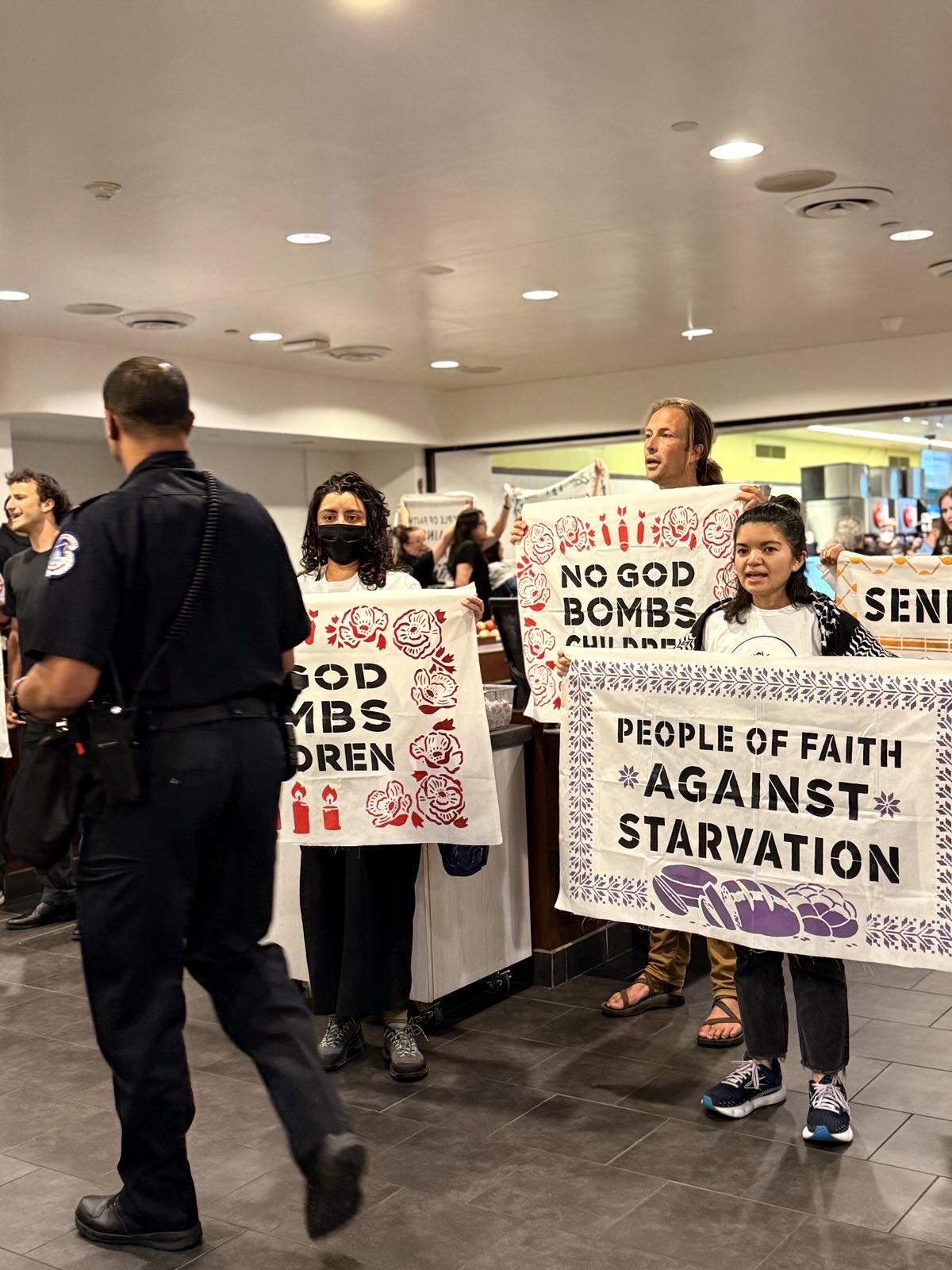
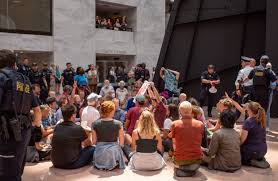
Later that afternoon, several dozen members of our interfaith community walked several blocks from the church to the Senate building, where we held a peaceful protest inside. I held a cloth sign, with painted purple flowers and red bombs surrounding the bold words, “NO GOD BOMBS CHILDREN.” About eighty of us were, all chanting a song together, “Summons” also from Blakely, who adapted the poem, “Summons” by Aurora Levins Morales, also Ashkenazi.
Last night I dreamed
10,000 grandmothers
Stepped in between
The bomb and the family
They said don’t wait
For your leaders to say
Each life is precious
It will have to be us.

Last night I dreamed
10,000 grandmothers
Stood in their grief
and stopped the machine.3
Many people came to take photos in wild surprise, and laughed and mocked our dramatic presence. The protesters stood firmly in their presence, and many shouted back fervently and angrily. I tried to look people in the eyes, with calm and clarity, while explaining, “We’re starving children. We can’t do that together.”
Soon, the Capitol police came to take us away, as hundreds of people watched and took photos for their social media accounts. I am grateful that I was detained without much risk to my well-being or sense of personal safety. Unlike others, especially my queer and female friends of color, while being arrested I was treated gently and respectfully the entire time.
Being arrested that day, I felt not an ounce of burden. Rather, I experienced tremendous gratitude to stand with my own free body in solidarity with those trapped in the gears of genocide, offering my soft footsteps, peaceful breaths, and fiercely kind words of support alongside others. Our presence there was simply taking a stand as a community against oppression and injustice, just what our OI trainings guide us to do. Even amidst the sorrow, I felt a unique deep peace, the release of moral shame, knowing we were not turning away.
…
The days and weeks after the powerful multifaith coalition were much more challenging. I again found myself isolated, experiencing bouts of searing rage and spells of unhinged sobbing. The spring of emotions that cracked open in me, allowing me to feel the power of grief, would not close back. On the one hand, I felt dysfunctional, disheveled, and distraught. On the other hand, I deeply knew, “No, this emotional response feels sane.” What is an appropriate response to what is happening? I asked. My body and nervous system were not gaslighting me; rather, they revealed the truth of things.
My fits of rage and despair continued, but when I sat intimately and listened closely, especially to my rage, they revealed more than just fury and revulsion towards the US government and anger with Buddhist teachers for their complicit silence and avoidance. They pointed painfully towards deeper sources of personal shame toward my own cowardice, avoidance, and surrender to disempowerment, toward this great injustice and for so many others. This too is the art of not turning away—staying with, embracing, and reconciling with sources of deep shame within, praying that it may slowly soften into greater maturation for my own agency, moral power, and compassionate resolve.
The grief and aloneness I felt pushed me right back to Thầy’s timeless guidance—as he always wholeheartedly encouraged us to build a true refuge of resistance through community. I needed a sangha to support my practice because we can’t do this alone. First off, we need each other’s presence and support to shake the paralysis of our grief. This grief is not merely something to be dealt with and overcome. Rather, our grief is the source of our true power, just as the mud is the source of the lotus. If I run away from my sorrow, shame, and helplessness, then I’ll silently drown in internal overwhelm and disconnection, unable to access the depths of compassionate resilience. Through collective grieving, our rage alchemizes into fierce compassion and clarity, our sorrow opens into boundless kindness, our aloneness pivots to fierce siblinghood and communal empowerment, and our helplessness rises to indomitable perseverance.
A few months after the interfaith action events, a friend and I decided to start a biweekly sangha to support each other, and channel our grief into community spiritual support and concrete action. We named it the “Love in Action for Palestine Sangha.” We are an intimate sangha family, and a half dozen OI members practice regularly with us. Each gathering, we meditate together for twenty minutes, read out loud news articles about Palestine, and listen deeply to each other’s experiences. To close, we spend about ten minutes focusing on a collective positive action, such as donating to particular causes, writing letters to our elected officials and corporate leaders, or further educating ourselves. We often hear, especially from new friends, “Wow, I never read the news in a sangha before. It’s such a different experience.” Or, “It feels so much better to read slowly, intentionally, and together. It still hurts, but I feel supported and stronger somehow.” We have found a refuge for our isolated experiences of sorrow, rage, and despair. By simply showing up to breathe, listen, and turn towards this hurting world together, our tired hopelessness slowly lightens into patient resolve, our anger cracks into tender grief, and our sorrow channels into small hopeful actions.
…
In our international Buddhist community, these horrific events, infinitely complex and historically traumatic, will bring a spectrum of intense views and feelings about how we respond collectively. I have witnessed deep disappointment and heartbreak from so many people in our international sangha about how our multifold Plum Village community has responded to the genocide, and I wish to acknowledge this tension and pain in our spiritual family. I believe there is something here for us to learn, continue to heal together, and hopefully grow our insights about our mahasangha’s responses.
I’m aware people may find it uncomfortable or challenging to read these reflections. I have struggled for months to communicate about this in a responsible, caring, and thoughtful way. I first started writing this article nearly one year ago, and have rewritten it over a dozen times since then. It’s very difficult to communicate when there is so much anguish, heartbreak, as well as criticism coming from many angles, both in our spiritual community, and in the world about the decimation that occurred and continues in Palestine, as well as the traumatic events and deaths in Israel. But discomfort must not become paralysis; I am happy to receive criticism for my unskillfulness here and learn from your experiences rather than avoid this conversation between us altogether, dear friends.
On the one hand, the Plum Village community responded directly and indirectly in various ways to the genocide: Plum Village monastic Dharma teachers issued an “Invitation to Sit Together for Peace” in October, 2023; Deer Park had numerous peace ceremonies related to what was happening in Gaza; and numerous teachers offered Dharma talks related to the violence in Gaza. Thầy Pháp Lưu further explained to me recently that Deer Park started the Thích Nhất Hạnh School of Interbeing, the Happy Farm, and Action Wake Up—all as direct responses to the increased violence in Gaza and the world.
On the other hand, I’ve had many conversations with Plum Village practitioners, especially young adults and practitioners of color, who have felt extremely disappointed, isolated, and furious by the lack of acknowledgment and engagement about the genocide and its racialized underpinnings, some having left the Plum Village tradition altogether. While my views have shifted significantly over time, I also shared these feelings at times. Yes, our mahasangha did our best not to take sides; yet, perhaps we fell short in supporting those experiencing genocide as well as our own Palestinian, Arab, or SWANA sangha siblings who carry the true weight of this devastation.
I will never forget when a longtime friend, Dharma teacher, and beloved musician Joe Reilly responded to me and a few friends last October, “I agree our community has fallen short in providing a clear and appropriate response to the ongoing genocide in Gaza. From my perspective it is important for us to stay rooted in our trainings of not taking sides while also speaking out against injustice and supporting universal reverence for life and collective liberation. Because of ongoing generational traumas, it requires great skillfulness to practice in this way. I think one of the great gifts of our tradition is to help wake people up to the reality of our interbeing and to see that, as Thầy so skillfully taught, humans are not the enemy.”
It was the first time I heard a Plum Village Dharma teacher articulate this feedback so boldly about our community’s response and it made me feel not alone or crazy in my confusion, grief, anger, and sense of isolation. At that time, I was not finding direction or support in holding the immensity of my grief and rage about the genocide in Palestine in my local sanghas, the monasteries, other practice centers, or the North American lay Dharma teachers. To deeply grieve our country’s role in supporting genocide is natural and inevitable, but to grieve alone or without spiritual direction feels exponentially worse.
In late March 2026, Thầy Pháp Dung gave a Dharma talk about the war in Iran, and openly sobbed when acknowledging the school of children completely destroyed by US bombs. It was the first time I saw a monastic Dharma teacher cry during a public talk, and embody such vulnerability and heartbreak in the face of these conflicts. Again, I felt not alone.
I have reflected a lot about the monastic teaching community and my expectations for them. I remember the times Thầy spoke to great power in the face of oppression and injustice, and the times he didn’t. In 2007, Thầy spoke directly to the Vietnamese government about its oppressive religious policies and boldly requested human rights changes. In 2008, he publicly and courageously spoke about Tibet and China. Just a year later, the Prajñā temple that housed several hundred young monastic disciples in Vietnam was destroyed, forcing them to flee to Thailand. When I consider our US-based monastics, many of whom reside here on visas, I realize the immense pressure they hold. If they were to directly challenge federal foreign policy, their very presence in this country could be threatened. Again, there is no easy answer to this kōan of protecting life and protecting the sangha.
So why share this now? For one, the genocide continues, and our collective response or lack thereof is still ongoing, maturing, and absolutely needed. And second, honest feedback, thoughtful reflections, and collective learning are marks of a healthy and resilient spiritual community. Such signs tell me that we’re neither too proud nor too fragile to work with critical feedback and discernment, which are even necessary for our communal aspirations to serve our society, as well as understand our own community’s needs, pain, and insights. A true spiritual family must continue to discern and discuss together how we are skillfully and unskillfully responding to the most challenging manifestations of suffering in the world. I wish to be a part of this community we are cocreating together.
You may think that our community responded prudently and wisely to the political and cultural complexity in Palestine and Israel, or you may believe we failed as a community to embody our ideals of protecting life and vulnerable populations. Whatever your views, what have we learned as a community in the past three years? In the spectrum of teachings in The Fourteen Mindfulness Trainings of the OI, from “taking a stand against oppression and injustice” and “protecting life,” to “not taking sides” and “protecting the sangha,” this is no easy kōan for any community. Is it possible to embody both? What wisdom can you offer for a communal response to a US-sponsored genocide?
Sitting with the Kōan: As we witness the ongoing crises in Palestine and elsewhere, we invite you to reflect on the lived application of our Mindfulness Trainings:

On Neutrality and Engagement: Is it possible for a spiritual community to both “not take sides” and “take a stand against oppression”? Where does this balance feel natural, or even empowering, and where does it become a site of struggle? (The Tenth Mindfulness Training)

On Protection: How can our sangha simultaneously embody “protecting the sangha” and “not letting others kill”? What are the edges or limits of our responsibility to the world? (The Twelfth Mindfulness Training)
…
I no longer succumb to the despair that people don’t care about the great harm that is occurring in Palestine and elsewhere in the world. Rather, I see how everyone needs great communal support to thaw out the glaciers of our past trauma, and collectively channel the underground rivers of compassion into geysers of action. I’m grateful to all of you who are showing up now simply by reading these thoughts, this story.
The peak of this current phase of genocidal decimation seems to have passed and with it, the world’s media attention. But Gaza has now been almost completely reduced to rubble, with collapsing structures, toxic waters, and undetonated bombs. Yet children and families still live there, waiting. An astonishing 98% of the arable land has been wiped out. People are still being struck by rockets and bullets each day. Journalists continue to be hunted and murdered every week, depriving us of information about the horror that we can’t imagine otherwise. Earlier this year, thirty-seven major humanitarian organizations were barred from entering Palestine again: Doctors Without Borders, Action Against Hunger (ACF), American Friends Service Committee (AFSC), CARE, Save the Children.… Families sleep in tents throughout winter storms. Infants, sandwiched between parents, don’t wake up to the freezing dawn. Infants and elderly are helplessly being bitten by rodents in their tent shelters at night. Parents lament in despair over the winter storms, “We are here without shelter, our homes in rubble, with our young children, and no one is coming to help us.” The genocide continues, still with US support under the specious canopy of the US administration’s “Board of Peace”—a peace that demands the silence of the oppressed.
In contrast, let us not be silently complicit in our sanghas. Our silence should offer prayers for healing and resilience, rather than giving way to despair. Our precious Plum Village tradition offers a vast array of teachings and practices—ways to stand with those suffering so greatly in Palestine and support the healing desperately needed in Israel, the US, and elsewhere. May we learn from each other and lean deeply into our sangha, so we can continue channeling the depths of our grief and sorrow into love in action.
Deep gratitude to Venerable Bhikkhu Bodhi for his thoughtful editing, wise guidance, and encouraging support on this article.
Plum Village sanghas that continue to meet in support of Palestine
- Jews for Palestine Freedom Sangha (JPF)—meets Tuesdays, 8pm ET, [kimberlyaf at mac.com].
- Love in Action for Palestine Sangha—meets 2nd and 4th Thursdays, 7:30pm ET, [dpviafora at gmail.com].
- Plum Village Palestine Justice Sangha (PVPJS)—meets every Saturday, 2pm ET, [PVPJS at proton.me].
- Plum Village Solidarity Council (PVSC)—offers individual events [pvsolidaritycouncil at proton.me]
1 Alexandra “Ahlay” Blakely, “Carry this All, ”Healing at the Roots, accessed August 19, 2026 www.healingattheroots.com/carrythisall
2 Thích Nhất Hạnh, “The Next Buddha May Be a Sangha,” Inquiring Mind (Vol. 10, No. 2, Spring 1994).
3 Alexandra “Ahlay” Blakely, “Summons” (adapted from the poem by Aurora Levins Morales), via Healing at the Roots / community song-catching tradition, accessed August 28, 2026 www.patreon.com/alexandrablakely/posts/choral-response-115174543.
The Plum Village Solidarity Council is not affiliated with nor does it receive direct funding from the Plum Village Community of Engaged Buddhism, Inc. or the Thích Nhất Hạnh Foundation. The council is comprised of Plum Village practitioners and we invite the manyfold sangha to join us in this work to end genocide for the benefit of all beings.