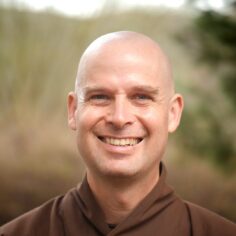
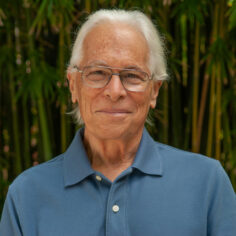
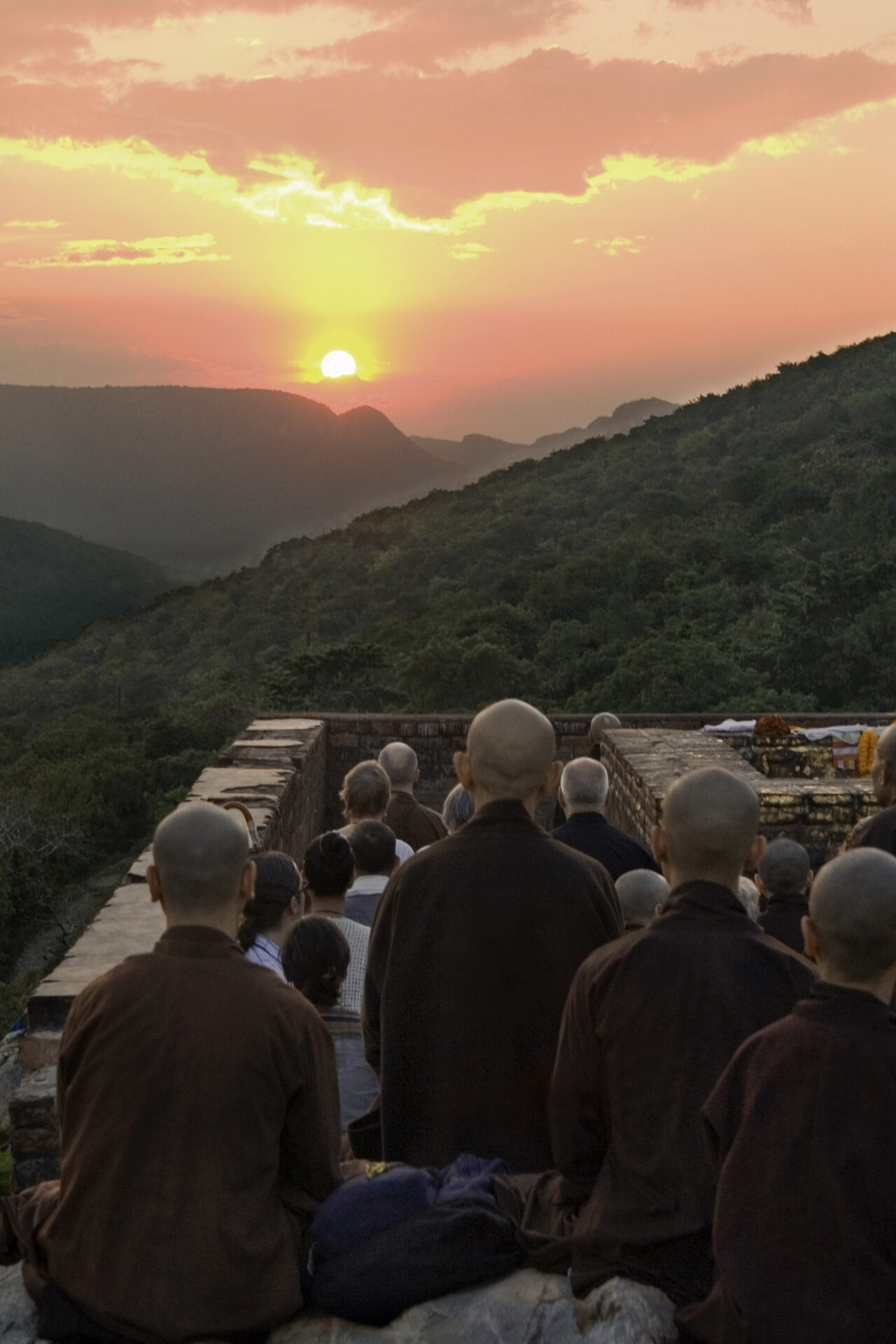
A candid conversation on the past, present, and future of the Order of Interbeing, early days with Thầy, and the role of Dharma teachers and monastics in the community.
By Brother Pháp Lưu, Fred Eppsteiner on
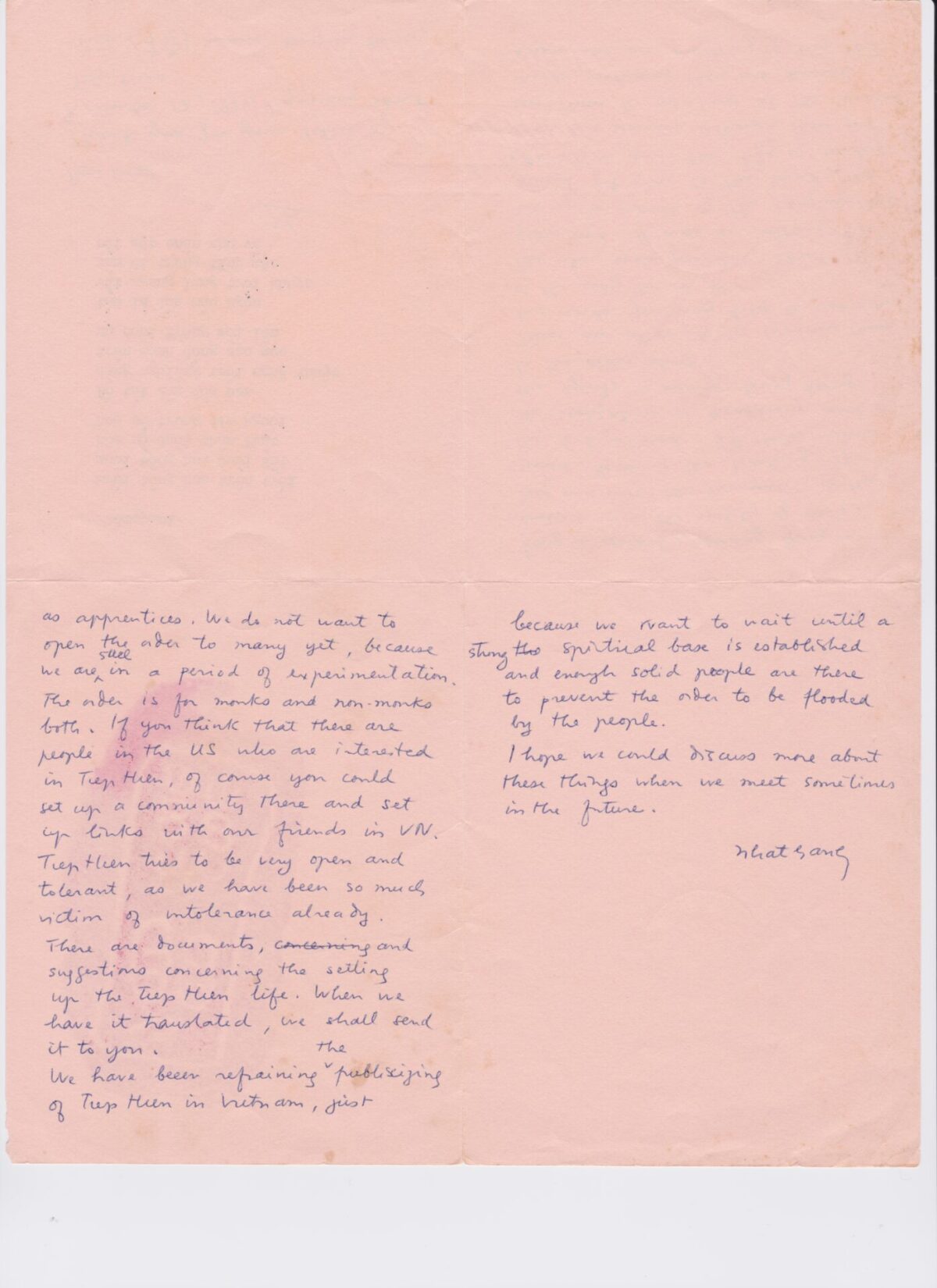
Brother Pháp Lưu: You were integral in working with Thầy to formulate the Order of Interbeing (OI) charter,
A candid conversation on the past, present, and future of the Order of Interbeing, early days with Thầy, and the role of Dharma teachers and monastics in the community.
By Brother Pháp Lưu, Fred Eppsteiner on
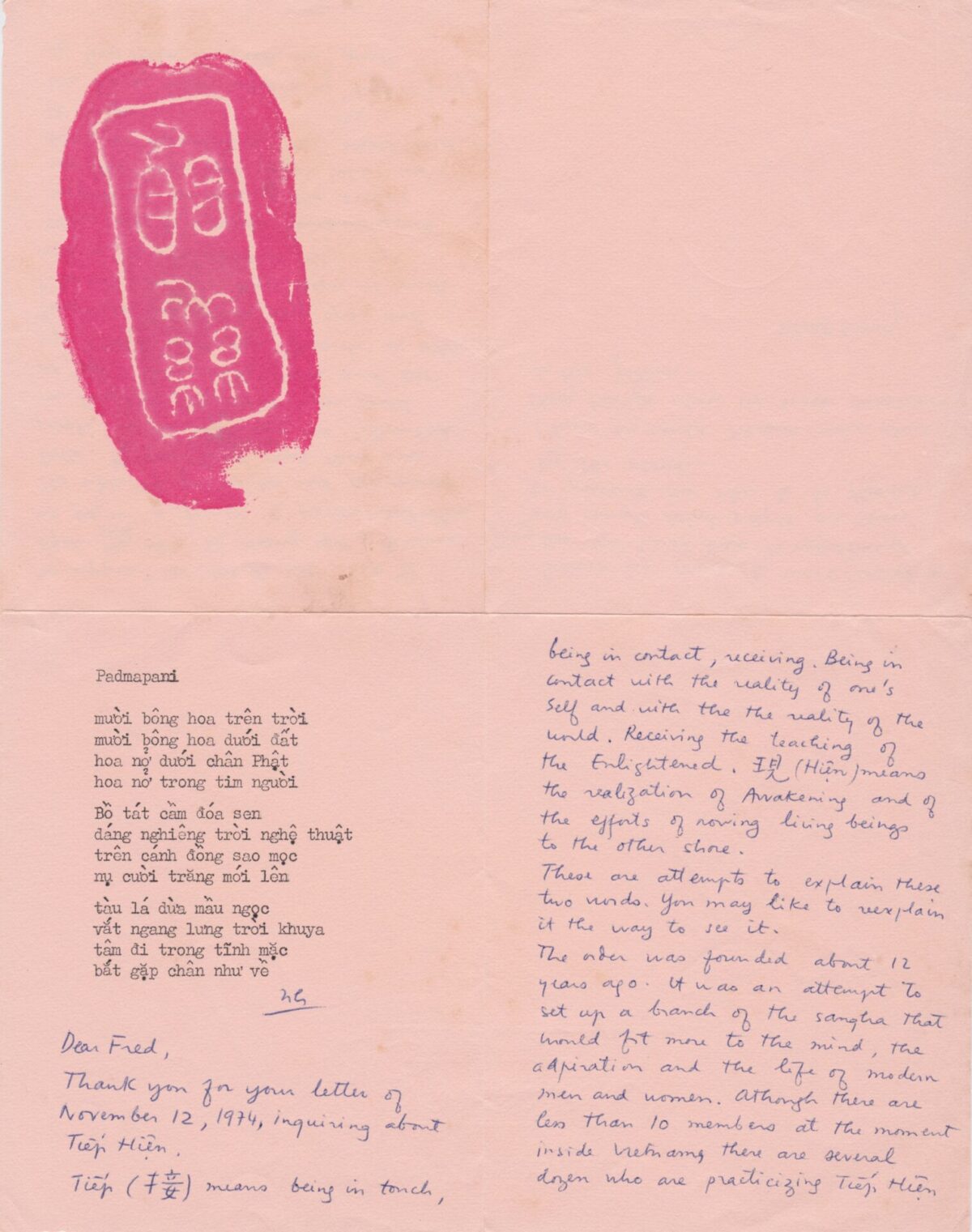
Brother Pháp Lưu: You were integral in working with Thầy to formulate the Order of Interbeing (OI) charter, to envision what the OI could be, and how it would work.
Fred Eppsteiner: When I met him in 1975 and he first started telling me about the OI, being both young and impetuous, I said, “Please ordain me right now!” [Laughter] But he was very reluctant because he was in this transition phase in his life and he didn’t know whether the OI had any life after Vietnam. He had not yet taken it beyond the context of Vietnam and the original six members [the Six Cedars]. He clearly indicated “Not yet,” because he didn’t know the future.
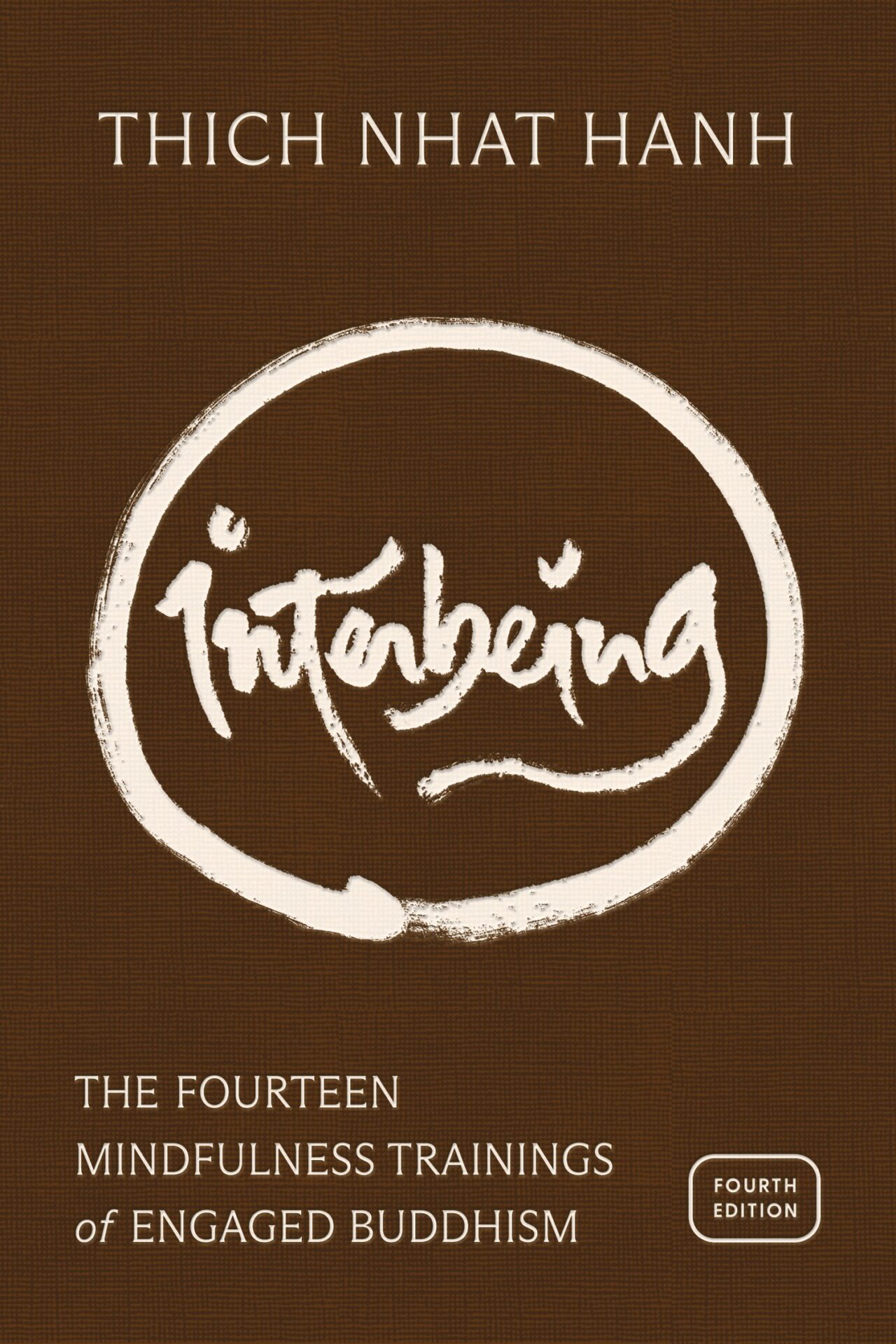
But when I saw him again in the early ’80s, he said, “It’s time.” Right before that, he had ordained Anh Hương. He came to [Mount] Tremper [at Zen Mountain Monastery] in 1983 to lead a retreat and he ordained me there. I think out of that came his willingness to publish and thereby make public The Fourteen Mindfulness Trainings and his commentary.1
Truth is, he really didn’t need me for content and any heavy editing of his text. He only needed me to help him adapt his language to how American Buddhists say things. He had a good grasp of English; it was simply that he didn’t know the lexicon of American Buddhism.
PL: I have this perception that in the ’80s Thầy was going around to many Dharma centers in the US and learning what worked and what didn’t work. I wonder if you have any comment on that—seeing how Buddhism has flourished [in the West].
FE: In the late ’60 and ’70s, most of the Asian teachers were here [in the US] to teach Buddhism. They were not evangelical, but they were here in America to teach Buddhism for all kinds of reasons or to share [Buddhist] practices. But Thầy was unique because he never had that Buddhist agenda. All Thầy wanted was to go back to Vietnam and participate in the rebuilding of his country once the war ended. That was his family. That was his country. It was in his blood. He had no desire to teach Dharma in the West. So he was curious when he encountered me. I really felt like I was a guinea pig, because he didn’t have experience with Western Buddhists. I felt he was very intensely grilling me [laughter] because he had a live specimen. Most of his other contacts were in the European or American peace movements, who were primarily of Christian faith traditions or they were from various charitable refugee organizations. He neither had an agenda to teach Buddhism in the West or even to live in the West. So that made him very unique. My sense is that after he worked through the reality of what had happened in Vietnam—that he was persona non grata and that he wasn’t going to be allowed back—he then found his footing in the West as a Buddhist teacher.
You want to hear something funny? In those early days, I never saw him as a “Vietnamese Buddhist.” He was so very free and open. Actually, in Plum Village, as Vietnamese people began to show up and he began to incorporate more Vietnamese Buddhists traditions or ceremonies, I was surprised in the beginning. In his personhood, he was very much a product of his culture, but he wasn’t selling Vietnamese Buddhism. I don’t know if he ever talked to me about Vietnamese Buddhism; rather, he talked about Zen and Engaged Buddhism. That’s one of his strengths: his openness. Like you said, when he first came to the West, he came to listen. Very different: he didn’t come to teach, he came to listen. And I think out of his listening and his openness, he understood how Americans—at least the ones who were coming to him—were suffering and what they needed to be taught so they could heal and transform.
And that’s why the development of his teachings was so relevant and why he became so popular. I remember him saying to me, as I’m talking to him all about the practices we did at the Zen center that I was part of then and how serious they were, and him saying, “Do they know how to love?” I mean, in those days nobody talked about love, relationships, or family life in Zen circles. It was all about meditation practice and awakening. So when you read his early books, you see where that arises from: his capacity to listen deeply and his aspiration simply to be of help.
PL: When I was being sent to Deer Park Monastery as a young monk with another brother, Thầy Pháp Hộ, we went to the Hermitage and Thầy told us, “Don’t get caught [in a duality] between the contemplative life and the active life.” Even in monastic communities, sometimes there are brothers and sisters who want to be more contemplative. And then there are others who say, “We need to be more engaged. We need to be with what’s going on in the world.” I was very happy to see that Thầy was very consistent about that point: that there is no separation between the two. I would like to hear you share more about that in your own experience.
FE: My experience of Zen prior to meeting Thầy was Japanese austerity and single-mindedness. Even though they talked about daily life practice, implied was that the real practice was what happened when you’re sitting on your mat in the Zendo and that was really the center of our practice life. We were simply told to be present to our daily life and be one with everything we’re doing. But when I met Thầy in his little apartment in Paris [laughter], living with Sister Phương and Mobi, and I saw how he lived, it just blew me away. He did everything slowly with a lot of presence. Never rushed, and no discrimination. When I met Thầy, I felt, “This is what a master looks like.” He’s incredibly pure. He really was the teaching: how he lived and how he expressed himself in everything. He was not remote. He was interested in you and everything around. He was impeccable in a very simple way, and you could just see it didn’t matter where he was. He just was himself, expressing the deepest truths of Dharma in a wordless way, though he was a man of many words. [Laughter]
PL: I’ve always had this feeling of complete trust around Thầy. Whenever I was close to Thầy, sitting next to him or working on a project with him, it felt like nothing else was more important than that present moment of being there with him.
FE: No artifice, no agenda, just being present to what is and working with what is. And yet, he was very strong. Some people think he’s like a pushover, but he’s no pushover, as I’m sure you know. [Laughter] In his own gentle way, he’s quite strong.
PL: What challenges do you find to be Thầy’s continuation as a teacher, especially in the US—or just generally?
FE: Right from the beginning of our relationship, Thầy was very clear with me: American Buddhism has to be American. He said that wherever Buddhism went, it always adapted itself and expressed itself in and through the culture. American Buddhism has to be expressed in the idiom of the American language. It has to be expressed in the idiom of American arts and American music. He also strongly emphasized the importance of experimentation: don’t think you know the right way, always experiment, and always be open. It was wonderful to work with him on the translation of the [OI] charter. It is one of the great documents he wrote when he was more non-denominational in his approach. He guided us to be open to see the wisdom in all the schools of Buddhism and that Buddhism always has to be renewing itself at the source. I have done my best to be very experimental. The OI is not just a transmission of the teachings and the practices, but goes deeper and is much more personal because it is founded on living community relationships.
PL: One young OI, who just ordained this year, read the charter and noticed that we’re supposed to get together every twenty years and update the precepts. What do you think about that?
FE: I think we’re supposed to get together every three years.
PL: Was it every three years? [Laughter]
FE: Originally Plum Village was supposed to be the home of the OI. The OI was going to be Thầy’s legacy: he was creating this order in which monks, nuns, and laypeople would all be equal and share the same principles. It was a radical vision, especially if you know about Vietnamese Buddhism or traditional Asian Buddhism.
But once his books started getting published and he began to give retreats and workshops and became more in demand, he was “discovered.” The number of people going to retreats with Thầy increased in the ’80s to the hundreds, when before there’d be maybe thirty or forty people there. [Laughter] The loss of intimacy with Thầy was painful for some people, but his influence just grew so quickly, almost exponentially year by year, and there was great demand for his personal presence and teaching.
During this rapid growth period, some of the original OI community of laypeople in Plum Village would leave after being there for a few years. Being laypeople, their lives pulled them in varied directions and I think Thầy needed people he could count on year after year. He began to look more and more to the monastic community for this stability and put more of his energy into nurturing it as his continuation. Much of the charter—the Council of Elders and how it’s supposed to meet every three years—just never happened.
PL: We as a monastic community are also kind of muddling our way through each day, each month, each year, figuring out through our daily practice what it is that Thầy wanted us to do with this or that. It’s not that we have to do exactly what Thầy told us to do, but each of us, I think, has a sense that Thầy gave us something to do and we have a debt to Thầy if we haven’t completed it. I certainly feel that on many fronts. How has meeting Thầy and learning from him impacted your life?
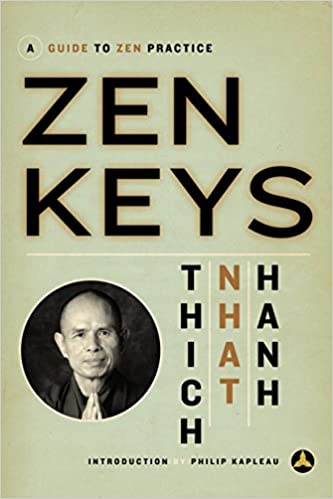
FE: Again, I think it changed over time. When I first met Thầy, he used to talk about enlightenment. He used to talk about breakthroughs. If you read Zen Keys, which is an early book of his, he talks a lot about the enlightened person. I don’t know how he was with his monastic community, but over time, he really dropped “breakthrough” and “enlightenment.” I think it’s because he didn’t have an agenda. He wasn’t selling anything. And I think when he saw the incapacity of modern people, how lost people were, his mindful living path and all the creative ways he’s elaborated it really became his focus. The way I understand it in my own mind is rather than teaching vertically, he taught horizontally.
PL: Building community.
FE: Yeah. And making it widespread.
PL: Maybe some people will go deep and go vertical themselves.
FE: Yes, but if you ask me what his inner message was, he wanted to produce awakened people. He said very clearly, if you look at Zen Keys, the world needs awakened people to show humanity that there’s another way to live. Did I talk about the last time I saw him?
PL: Yeah, I think so.
FE: So I hadn’t seen him in a while. I think those of us who had known him at an earlier stage, when it was much smaller, I’d get to Plum Village and go right to his cabin. Things began to change as the years went by. To be honest with you, some people resented that or felt left out. I never did. I mean, he’s the master and he’s manifesting to benefit as many as he can. So I wasn’t as present as I had been earlier. He was making his last trip to Hanoi, Vietnam, in 2008. And I don’t think I’d seen him since that 21-day retreat in maybe 1998, so it had maybe been ten years. Anyway, I was really missing him. I intended to go to Plum Village, but he wasn’t there. I found out that he had gone to Vietnam, so Angie [Parrish] and I went there. It wasn’t easy to get in to see Thầy privately in those days, but Brother Pháp Trí got me in.
In the beginning, we exchanged pleasantries and were catching up about life and a little bit about what I’m doing. All of a sudden, he turned and looked at me and said, “Fred, do you know why I’m teaching the same thing that I was teaching ten and twenty years ago?” I mean, this is apropos of nothing. I, of course, said, “I don’t know, Thầy,” and he said, “Fred, they don’t get it. I have to say it over and over again.” And that’s interesting, right? Because he always amazed me, I’m sure it amazed you even more, how he could day after day get up to that blackboard and make that circle as if it was never done before. Always fresh, always alive. He was incredible, right? I mean, he lived it. I’m not sure what he meant by saying that to me, but my sense is, he had a lot more to give, his realizations, but he wanted to help people where they were.
PL: There’s a question that came to me just as you were talking. Thầy had said early on in his peace activism in the US that we should try to figure out where the violence was coming from and how to transform the situation. Now when I ask myself, “What are we doing as a monastic community or as a larger Plum Village international community?” I see that we’re transforming collective consciousness. We’re not here to promote Buddhism. It’s not even necessarily about promoting mindfulness—although that’s a very helpful way to transform collective consciousness. Retreats are a way of transforming collective consciousness because you get people to come on retreat and then you all practice together. We all practice and then the collective consciousness is changed by that. That’s an effective way, but retreats aren’t necessarily the only way. The real question is, how do we facilitate transformation in the collective consciousness and grow awakened people? This speaks to what you shared about Thầy’s emphasis on experimentation. I’m seeing that in the monastic communities we can get caught in doing things by rote: we do these retreats every year and that’s our schedule and we forget about the larger vision. I respect that you’re one of the lay Dharma teachers who is actually building community and teaching actively. When I hear from someone in your community, I think, “Fred’s right on. He’s got it.”
FE: Well, you see people from your side, right? They come to Deer Park on retreat, and in that controlled environment, they get solid pieces of Thầy’s Dharma, or they stop long enough that they can get in touch with buried parts of themselves. That’s what you see. What I see, living in Florida, is when they come back, the forces of our materialistic and consumer culture are strong. If you read Zen Keys, written in the early days when Thầy had a more radical critique of materialism and consumerism, he was clear that unless human minds are changed, you can advocate for protecting the planet from climate change and all the good things forever. Materialism, consumerism, climate change: they’re all symptoms of how human beings have lost touch with who we are.
This is a sadness of mine: you can go to any urban area in America and you’ll find a Zen center, you’ll find a Tibetan center, you’ll find an Insight meditation center, and you won’t find a Thích Nhất Hạnh center. They’ll be meeting in some little church basement.
If you’re asking me about the big picture, that’s what’s missing. The energy went into the monastic community and the residential centers, which is wonderful. But like Thầy said, people can’t practice by themselves. Going to Plum Village or Deer Park once or twice a year can’t offset these other delusive forces that are in American culture and in their own storehouse consciousness.
You get people in ideal conditions when they’re on retreat. They’re away from their daily life, and they’re away from their responsibilities. You incubate them for five or seven days, or two or three weeks. And they change, right? Because those negative, afflictive, or delusive seeds within them aren’t being watered—only positive seeds are watered. The monastic community is wonderful at watering positive seeds, and so people thrive. And then when they come back home, unless there’s something to hold them and continue to support them, it’s very difficult for them to really maintain that transformation. So you get a kind of a syndrome where people think, “I gotta get back to Deer Park” or “I gotta get back to Plum Village” to get this sort of a fix. It’s a good fix.
When I met Thầy, he was dressed in the outfit of a worker priest. The worker priest movement, I don’t know much about it, but I think the way he explained to me time was a movement of Catholic priests who actually went and worked in factories. They worked alongside their Catholic community as opposed to traditionally residing in the parish.
PL: It makes me think of how we’re trying our best here to create more extensive training programs in house. So instead of just having retreats, we proposed a program here at Deer Park for staying here to train for fifteen months. This would be mainly for young people at the moment, maybe coming out of college, where they do two back-to-back Rains Retreats and in between, live in a community near the monastery doing some service connecting with the local community, but also practicing or possibly even working. I know Thầy started the movements of mindfulness practice centers, and there have been Wake Up houses, but they last for a couple of years and then they disappear. This new program would try to seed long-term lay communities in the Plum Village tradition in urban centers.
FE: In his early writings about the OI, Thầy said there has to be one person to hold it, to be at the core of each lay sangha. One person dedicated to practice, somewhat charismatic. Brother, this whole society is falling apart so quickly. Now, everywhere you look, the suffering and the delusion are increasing. The greed, the anger, the fear.... These are difficult times, when all hands have to be on deck. If you ask me, seasoned monastics could move out part of the year into the broader community and be in residence at these various sanghas to provide those seeds and that training in the communities where these people live. Having spent the last fifteen to twenty years doing that, I know if we could build a community like we’ve built here in Tampa, Florida, you can build them anywhere.
PL: Fred, how do you nourish your spiritual practice day in and day out? Because I think the main issue with monastics is that we feel nourished every day living as a community with the other monastics, in terms of our precepts body, in terms of our daily practice. You really have to have internal discipline if you’re going to go out even just as a small group of monastics to a center in an urban area. That’s the main reason why we don’t do it. It’s not because we don’t feel inspired. We just have to learn how to nourish our daily practice when there are fewer conditions around us to support it.
FE: [Laughter] Do you want me to give you the simple answer?
PL: [Laughter] Okay!
FE: Bodhicitta.
PL: Yeah.
FE: What has nourished me for the last fifty years? Bodhicitta. The desire to wake up, to be free, to benefit people.
I think once you have an inner connection, an inner refuge, where the Buddha, the Dharma, the Sangha, and Thầy live in your heart, that always nourishes you. That’s what always nourishes me. But again, I’m not alone; I am very fortunate that I’ve been able to inspire others and we have a large OI community. I have a community; you have a community. It’s wonderful to build things with people. I just love to practice the Dharma. When I received the Lamp Transmission from Thầy, I thought, “Since Thầy has ordained me as a Dharma teacher, then I need to start teaching.” I began in my home living room in the mid ’90s, and all of a sudden here I am, thirty years later with a community of over three hundred. I am much more than a Dharma teacher these days. I’m more like a village priest. I have a congregation that experiences birth, sickness, old age, and death, has all types of issues, and all along I share the Dharma to nourish and support them.. It’s wonderful.
But, I think the lay community needs you. The Dharma teachers need you. They haven’t continued training. I’ll tell you something very interesting. When Thầy started ordaining lay teachers in the early ’90s, I forget when he started doing this, but after the ceremony, every new Dharma teacher would give a Dharma talk.
PL: Yeah, I remember that. It took a long time.
FE: I’ll be honest, I would listen to those talks and think, These people don’t have a clue about the deeper meaning of Dharma practice. I mean, they’re all good, well-meaning people. And I asked Thầy, “Thầy, what are you up to here?” And he said, “Fred, I’m doing it differently than the traditional way. It used to be that you gave transmission at the end of years of practice, but I’m giving transmission in the beginning.” But this was Thầy, there was a kind of naiveness to him, he said, “I recognize their potential. And I’m just watering their potential. But I’m leaving it up to them to realize it.” So it was an interesting way he looked at it.
PL: We also understood that as a monastic Dharma teacher, when Thầy ordained us, it’s like we didn’t have a choice. We would have to become a Dharma teacher. And that it was not a certification, but it was a beginning. It means now you begin the training of being a Dharma teacher. And hopefully it will be the rest of your life figuring out what that is.
FE: Exactly. So again, if you ask me, I think the lay community needs the presence of the monastic community. And not just as a place to go, but as part of their lives, part of their communities, in creative ways. A strong member of our Florida sangha who has been part of it for twenty years and she is used to being part of a sangha that has its own home with a large membership. She recently moved somewhere with her family and there was a Thích Nhất Hạnh community [sangha] nearby, which they’ve been in this city for twenty years. And basically what they do is meet in a church or some facility once a week to sit together, and people read something of Thầy’s and then they talk about it. And they’ve been doing this same format for twenty years. There’s no path of development. There’s no training. There’s no accountability. I think one of the things about being a monastic is that there’s accountability. You’re accountable to your robe. You’re accountable to your community. You’re accountable to your teacher. I think just for lay teachers, there’s really no accountability. They can do whatever they want. And I don’t know who has the power to bring them back other than the monastic community, which I think in a certain way, Thầy really designated as his continuation. So I get that. I have no problem with it. But I would hope the monastic community could take more involvement with the lay community on an ongoing basis. Because there’s so many of these little groups [sanghas] all over the place, as you know, and they’re all on their own.
Thầy was a monk, true to his vows. But again, when I first encountered him, he was living with laypeople. Plum Village in the early years was primarily a lay community. Thầy was wonderful, he was seamless.
PL: Thank you so much, Fred, for your time. It’s very lovely to connect with you.
FE: Thầy has passed. So, the future direction of the community is being created now. This creates that. I see great thirst. I see great yearning. I think there’s a need for Dharma. It doesn’t have to be packaged with capital Ds, or capital Bs. The Buddhist teachings are priceless and really speak to people’s suffering. Thầy empowered us as Dharma teachers, and he wants us to teach the Dharma to people in creative ways, experimental ways, but always preserving its spirit.
This article is based on an online interview with Fred Eppsteiner in September 2024. It has been edited for clarity.
1 Thích Nhất Hạnh, https://www.parallax.org/product/interbeing-hardcover/ (Berkeley, CA: Parallax Press, 1987).