a message for young members of the Order of Interbeing
By Sister Annabel Laity on
Dear Wake Up Order of Interbeing members,
We, the older members of the Order of Interbeing (OI), know that you are there and we are very happy. We need you. If we can support you in any way, please let us know. Why are we happy to know you are there?
a message for young members of the Order of Interbeing
By Sister Annabel Laity on
Dear Wake Up Order of Interbeing members,
We, the older members of the Order of Interbeing (OI), know that you are there and we are very happy. We need you. If we can support you in any way, please let us know. Why are we happy to know you are there? It is because of your youthful energy of creativity and putting compassion into action. Some of you in the US were prepared to help Dharma teachers Larry Ward (Brother True Great Voice) and Peggy Rowe Ward (Sister True Original Vow) come to the June 2026 gathering in Plum Village. Now Brother True Great Voice is physically no longer with us, but that does not mean you will not bring him to the gathering. Your deep aspiration for inclusiveness and nondiscrimination is the continuation of his aspiration. In Europe and Asia, those of you who worked alongside Dharma teacher Hà Vĩnh Thọ (Brother True Great Understanding) will also keep his deep aspiration alive, and if you come to the June 2026 gathering you will bring it with you. It is the aspiration for Gross National Happiness to be our measuring rod in what we do and for happy teachers to change the world.
We need you. If we can support you in any way, please let us know. Why are we happy to know you are there? It is because of your youthful energy of creativity and putting compassion into action.
Dear young OI, what are the principles that guide us in our service, our studies, our practice, and our times of relaxation? They are: nonattachment to views (破執), appropriateness (契機), direct experience of the truth (實證), and skilful means (方便). Non-attachment to views means we break through a veil of attachment to our own way of seeing things and our beliefs. It means we are always ready and open to learn something new. To do this we train ourselves in the habit of deep listening, especially listening to those we do not agree with. We do not argue about small things. For instance, someone says, “Sư Cô Hội Nghiêm gave the talk last Sunday,” and we say, “I thought it was Sư Cô Lăng Nghiêm.” We stop there. We do not continue to prove our point. We accept there is a difference in our perceptions. Why waste time and energy arguing about insignificant things? We just say out loud or to ourselves, “Oh, I am probably wrong.” Of course if it is a matter of life and death we have to try and show the other why we have such a perception through compassionate dialogue.
Compassionate dialogue is linked to appropriateness. Appropriateness means how we share the teachings of the Buddha and our teacher with others. We ask ourselves, “Is the time appropriate to share the teachings, is the place appropriate, and do the teachings fit the needs and aspirations of the people we teach?” Before sharing, we should enquire about the audience. What is the suffering of people in this country at this time?
Direct experience of the truth means we have to realise for ourselves the truth of the teachings. In praising the Dharma, we say it is ehipassiko. It means that we come and see directly for ourselves the veracity and the effectiveness of the teaching. Others can point to the moon, but we need to see the moon for ourselves and not be caught in the finger that is pointing. We rely on the Three Trainings of mindfulness, concentration, and insight to realise this truth. It means the necessity to practise diligently mindful breathing, walking, and other actions throughout the day.
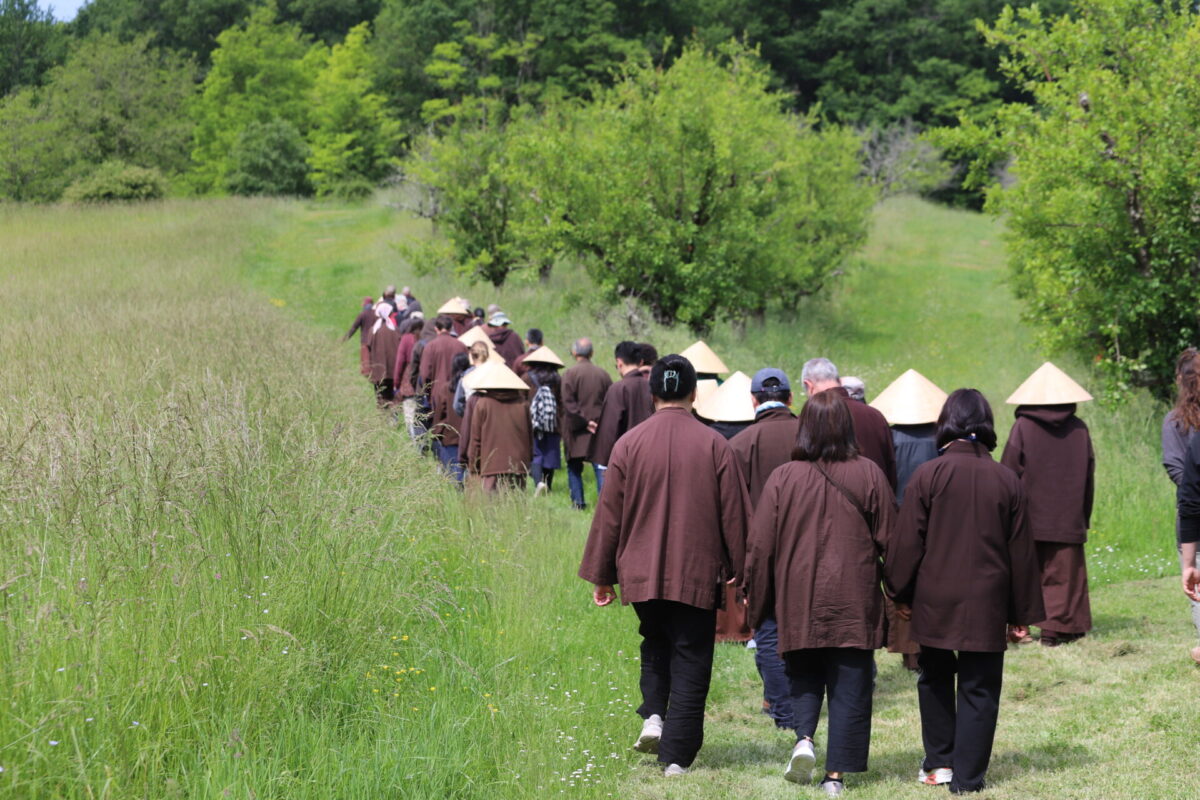
Skilful means comes from our aspiration to relieve suffering and bring more happiness into the world. We act not just from our intellect but from our heart and our intuition. To test our intuition, we always need good spiritual friends who can help us discover whether the means we are using to spread the Dharma are skilful or not.
There are times when you will want to practise with us, the middle-aged and elderly OI members, and there will be times when you need to be on your own to talk about the particular needs of your age group. Ideally, the OI has a Council of Youth as well as a Council of Older Members. We hope some of you will be ready to stand on this Council of Youth in order to work alongside more senior members. In this way there will be creativity in the policies of the Order.
In Vietnamese, the OI is called Tiếp Hiện (接現). The word Tiếp (接) means to receive, connect, continue. You receive the transmission from your blood and spiritual ancestors. You belong to the Linji (臨濟) school, the Liễu Quán line. You are a continuation of that school and that line. Liễu Quán made Linji teachings appropriate to his own time in central Vietnam. You want to make the Linji teachings appropriate to the time and the place where you are living. Master Linji was not caught in the outer form of the practice. Instead of our depending on a buddha outside of us, he wants us to depend upon our own awakened nature by living deeply in the present moment in all that we do. Thầy reminded us many times of Master Linji’s teaching that the miracle is to walk on the earth.
The word Hiện (現) means to bring into the present moment and to realise the truth for ourselves. We continue the transmission and bring it into the present moment, making it suitable for our times.
The English name Order of Interbeing is not the same as the Vietnamese name and that is why it is necessary for us to understand the Vietnamese. It is not possible to make a succinct translation of Tiếp Hiện into English such that it could become the name of the Order. Thầy coined the word “interbeing” in 1983 in a retreat he led in Tassajara Zen Center in California, US. Thầy explained that interbeing means we cannot possibly be on our own or make something be on its own. Interbeing, the Middle Way between being and nonbeing, has become one of the pillars of Thầy’s teaching. When we become a member of the Order of Interbeing, we commit to understand interbeing not as a theory but as a realisation in our daily life, in our relationships with each other, and with the world.
We hope to see many of you in June 2026 to celebrate sixty years of the Order of Interbeing.