Thích Nhất Hạnh responds to a question from a business leader on compassion, understanding suffering, loving speech, and deep listening.
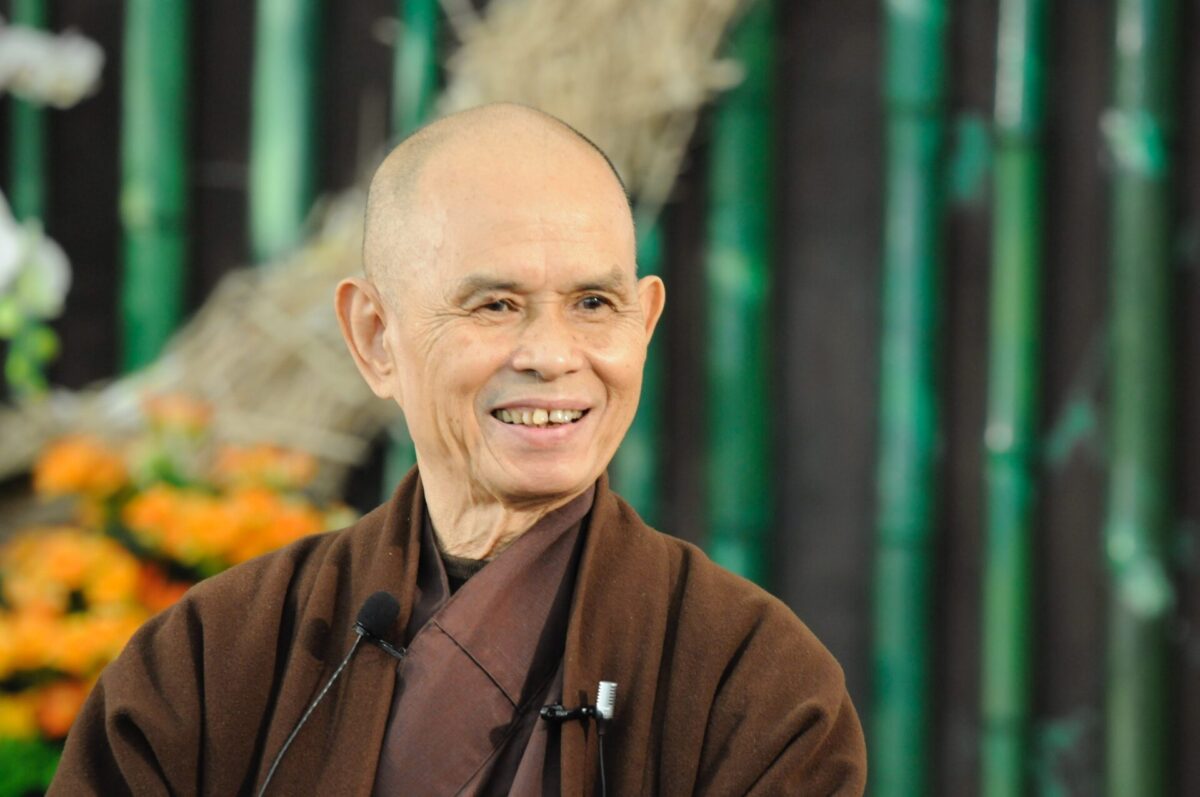
How Would You Define Compassion?
Compassion, according to our tradition, is the capacity to help someone suffer less. And you have to try it on yourself. If you cannot do it for yourself, you cannot do it for the other person.
Thích Nhất Hạnh responds to a question from a business leader on compassion, understanding suffering, loving speech, and deep listening.
How Would You Define Compassion?
Compassion, according to our tradition, is the capacity to help someone suffer less. And you have to try it on yourself. If you cannot do it for yourself, you cannot do it for the other person. Compassion is born from your understanding of suffering, like the lotus is born from the mud. And compassion helps you suffer less and helps you relate to other living beings much more easily. It’s one of the most important ingredients for true happiness. Compassion protects you better than power and money and an army.
In the time of Buddha, there was a businessman called Anāthapiṇḍika. He was loved by the whole city of Shravasti. He was very generous. He took care of the poor, the destitute people, the lonely people. That is why they gave him the name Anāthapiṇḍika. His real name was Sudatta. And he was a practitioner of mindfulness and a lay disciple of the Buddha.
Anāthapiṇḍika also went through bankruptcy. But he did not suffer during that time, because so many friends came and helped him rebuild his business. So brotherhood, sisterhood, and compassion protect us better than money in your bank account or the army under your direction. And compassion helps you sleep better, release tension, and helps heal your body much more easily.
Compassion is born from your understanding of suffering, like the lotus is born from the mud.
Last night we spoke with Dr. James Doty, a neurosurgeon at Stanford University, with over 700 professors and students. He said science has proven compassion can heal. It helps heal inflammation on the cellular level. It is good to practice compassion for oneself first, before you practice for another person.
Compassion is not possible when you have not understood the suffering. Listen to suffering. And before the other person tells you about her suffering, you should be able to use loving speech:
“Darling, I know you have suffered a lot during the past many years. I was not able to help you suffer less. In fact, I have made it more difficult for you by my way of reacting. I’m sorry, it’s not my intention to make you suffer, darling. Just because I did not see and understand the suffering in you. Now I have worked enough. Please help me. Please tell me what is in your heart, your suffering, your difficulties. I know if I understand your difficulties, your suffering, I will not react like I did before. You have to help me. If you don’t help me, who will?”
That is loving speech. If you have compassion, you can use that speech. Without compassion, you cannot say something like that. So when you look at him and see the suffering in him, compassion is born. Then you can use that kind of language. To be able to listen when he begins to tell you of his suffering, you have to practice mindful breathing, mindfulness of compassion. Because if you don’t, what the other person says may trigger anger, irritation in you, and you will lose your capacity to listen.
So mindfulness of compassion is like this. I am listening to him with only one purpose: helping him to suffer less. Therefore, even if he says wrong things, a lot of wrong information, I am not going to interrupt him and correct him. Because if I did, I’d transform the session into a debate that would ruin everything. In three, four, five days, I may have a chance to give him some information to help him correct his perception, but not now. So if you keep that awareness of compassion alive, you are protected. And what the other person says will not trigger that irritation in you anymore. It’s very effective. And you can listen for one hour and that is very healing for the other person.
Compassion is a complete practice, not just talking.
How would you teach that to a five-year-old?
The five-year-old is capable of feeling the energy of compassion—especially when we are a group of people sitting together, breathing together, and generating the energy of mindfulness, peace, and compassion. The five-year-old can feel that. He might suffer less just being there in the zone of collective energy. Even if a baby has not been born yet, if we allow the baby to be in that zone, it can get the wholesome energy generated by the practice.
I think it may be possible that we organize a one-week retreat for business leaders. Because with the practice we transform, we get calm, and we begin to see the truth by ourselves. And after that we can go home and transform our business, our corporation into an instrument for peace and compassion. And that is a good investment.
Time is not money. Time is more than money. Time is life. Time is love.
This is an excerpt from the question-and-response portion of a Dharma talk given by Thích Nhất Hạnh to business leaders at a private home in San Francisco, California during the 2013 US tour.