A conversation with Anh Hương, the first member of the Order of Interbeing in the West
The beginning of continuation
Sister Tại Nghiêm: You were the first person to whom Thầy transmitted The Fourteen Mindfulness Trainings in the West since he left Vietnam in 1966. Could you share the circumstances and how you felt?
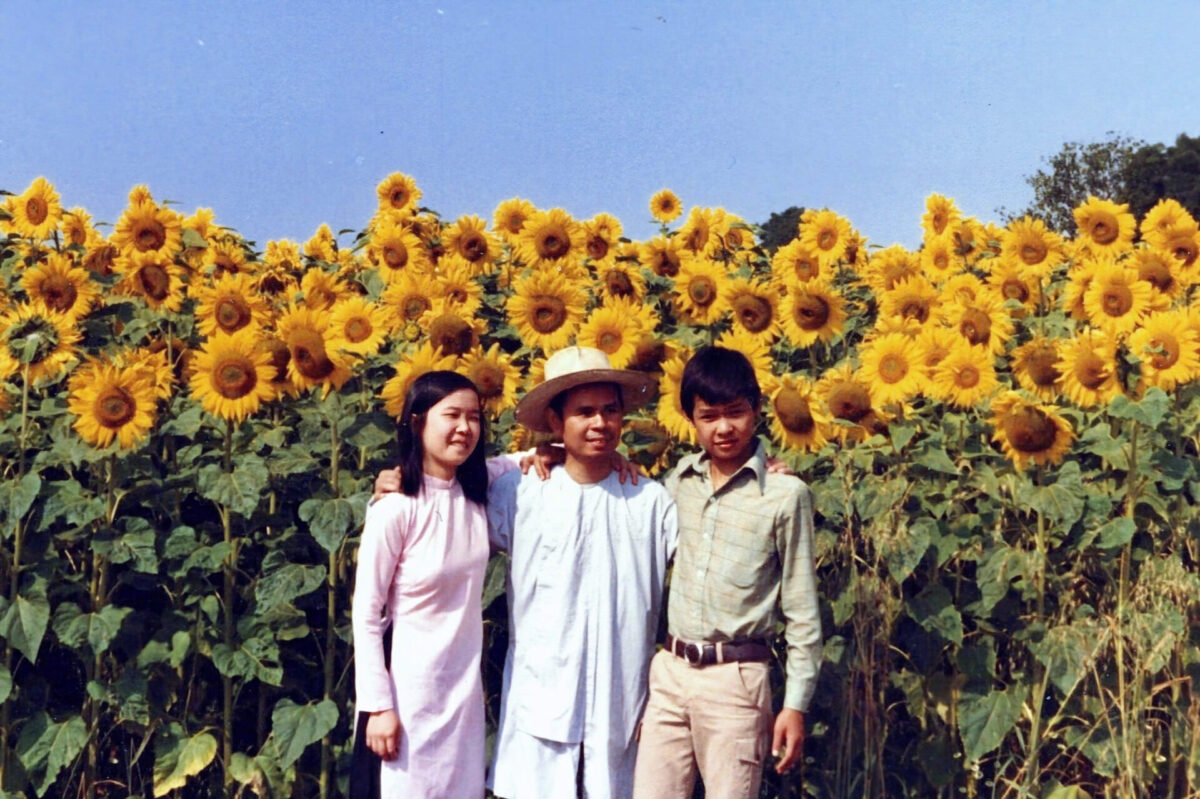
Anh Hương: In 1981, my younger brother, Đức, and I visited Thầy in France.
A conversation with Anh Hương, the first member of the Order of Interbeing in the West
The beginning of continuation
Sister Tại Nghiêm: You were the first person to whom Thầy transmitted The Fourteen Mindfulness Trainings in the West since he left Vietnam in 1966. Could you share the circumstances and how you felt?
Anh Hương: In 1981, my younger brother, Đức, and I visited Thầy in France. Thầy is my father’s younger brother. After spending a few days at Phương Vân (Fragrant Cloud) Hermitage, cô Phượng (later Sister Chân Không) drove us to Sơn Cốc, the hermitage where Thầy lived. I feel such gratitude for cô Phượng. It was a long drive, and she was the only one who could drive. Whenever she got sleepy, she sang to keep herself awake.
Every morning, we went to the backyard to garden—such happiness! Thầy planted vegetables, watered flowers, cut grass, chopped wood, dried firewood, and stacked the wood near the kitchen stove for cold mornings and evenings. Thầy also wrote, printed, and bound books there—including his own—by hand.
About a week before we were to return to America, after Thầy’s midday rest, Thầy called me to sit beside him, handed me some printed papers, and said, “Read this, my dear.” I read them from beginning to end. They were the text of The Fourteen Mindfulness Trainings. Thầy sat still, solid as a mountain, while I read.
A few minutes later, Thầy asked, “What do you think, my dear?” “It’s wonderful, Thầy,” I answered. Thầy had touched my bodhicitta, opening the path for me to step forward in service within the Order of Interbeing (OI). Something entirely new and fresh was unfolding within me.
After a few moments of silence, Thầy briefly recounted the history of the Order. Then, we went out for a walk. The next morning, while the mist lingered, Thầy went outside with a pair of scissors. I followed to see what Thầy was doing. Thầy cut a rose and placed it in a vase on the altar. Then Thầy called cô Phượng and said, “Today, Anh Hương will receive The Fourteen Mindfulness Trainings.” After reading each training, Thầy asked, “Do you vow to receive, study, and practice this training?” “Yes, I do,” I replied. That was August 20, 1981. When Thầy had an intention, Thầy acted on it right away.
As soon as the ceremony was over, Thầy asked cô Phượng to cook something to celebrate. Cô Phượng was a quick cook, so in no time it was ready. We had a breakfast of freshly made xôi bắp (sticky rice with corn) sprinkled with fragrant fried shallots. Thầy finished his bowl, then served us a little more, leaving a tiny bit for himself. After eating, Thầy smiled and said, “So wonderful!” The atmosphere at Sơn Cốc was as joyful as during Tết!
After resting for a while, Đức followed Thầy with a wheelbarrow to carry firewood and stack it beside the kitchen stove. After so many decades away from his homeland, Thầy was happy to once again immerse himself in the warmth and simplicity of a family atmosphere.
Each time Thầy “pushed” me,
I felt I had truly grown—
not in age or years of practice,
but beyond my small self,
beyond what I thought I was.
The gentle push of a teacher
TN: The story behind your OI transmission is so fascinating. What other interesting lessons have you received from Thầy?
AH: I first came to Plum Village in July 1984 and met many young people, including Brother Thư (Brother Chân Trí). During that Summer Retreat, there was a ceremony to recite The Fourteen Mindfulness Trainings at the Yên Tử Meditation Hall in Upper Hamlet. Everything was prepared and the lay practitioners had gathered, yet Thầy had not come. I felt obliged to go and invite Thầy.
When I entered the room, Thầy lay on his mattress on the wooden floor with his eyes closed. Thầy opened his eyes. I said, “Dear Thầy, there is a precept recitation ceremony this morning, and everyone is waiting for Thầy.” Thầy said simply, “You lead it.” I thought, “Dear Thầy, you have never taught me how—how can you tell me to do this?” I just stood there like a statue, unable to speak. Thầy turned toward the wall and added gently, “Go ahead, my dear. Go on.” I guessed Thầy had a stomachache and hadn’t slept well. On one hand, I felt tender concern for Thầy, knowing Thầy needed to rest. On the other hand, I had no idea what to do!
I had never guided a precept recitation ceremony—let alone in English. But Thầy had said, “Go ahead,” so I went. Once I entered the meditation hall, though, I thought, “Now what?” I felt very small in the solemn atmosphere of a ceremony Thầy had always led. I had never even offered incense before the sangha!
Looking around, I saw no one who could help. So I had to sit in Thầy’s place. And somehow, the ceremony was completed. My heart felt light and joyful. Thầy saw me clearly and “pushed” me forward. Thầy never “pushed” me in a way that made me fall. The question was always whether I was willing to move forward or not. Each time Thầy “pushed” me, I felt I had truly grown—not in age or years of practice, but beyond my small self, beyond what I thought I was.
One afternoon during the 1991 Summer Retreat at Plum Village, Brother Thư and I went to visit Thầy in Lower Hamlet. Thầy was resting in a hammock, and we were joyfully chatting together when, quite suddenly, Thầy said, “Next year, you two will receive the Lamp Transmission.”
We were startled and fell silent. “No, please, Thầy. We’re not ready.” I thought to myself that receiving the Lamp meant having to teach—and how could I teach when I knew so little? Thầy smiled, his eyes radiant and gentle, filled with love. Then he asked:
“Are you happy?”
“Yes, of course, dear Thầy.”
“Being here, do you have joy?”
“Yes, a lot of joy.”
“Then you just receive the Lamp.”
“But … I don’t know how to teach.”
“No need to teach. You have joy—just share your happiness.”
I wanted to reason a little more, but I knew that when Thầy “pushed,” it was time to “go.”
The following summer, Brother Thư and I returned to Plum Village to receive the Lamp Transmission from Thầy.
Here is my transmission gatha by Thầy:
Chân tâm ươm hạt quý
Ý vun bón vườn nhà
Thanh thản cùng năm tháng
Lòng đất tự đơm hoa.

Translated into English:

It is in the true Store that the precious seeds are entrusted
and it is the Mind that takes care of the ancestral garden.
Enjoy deeply the months and years that are offered to you
and the flowers of wisdom and love will naturally spring forth from the heart of the Earth.
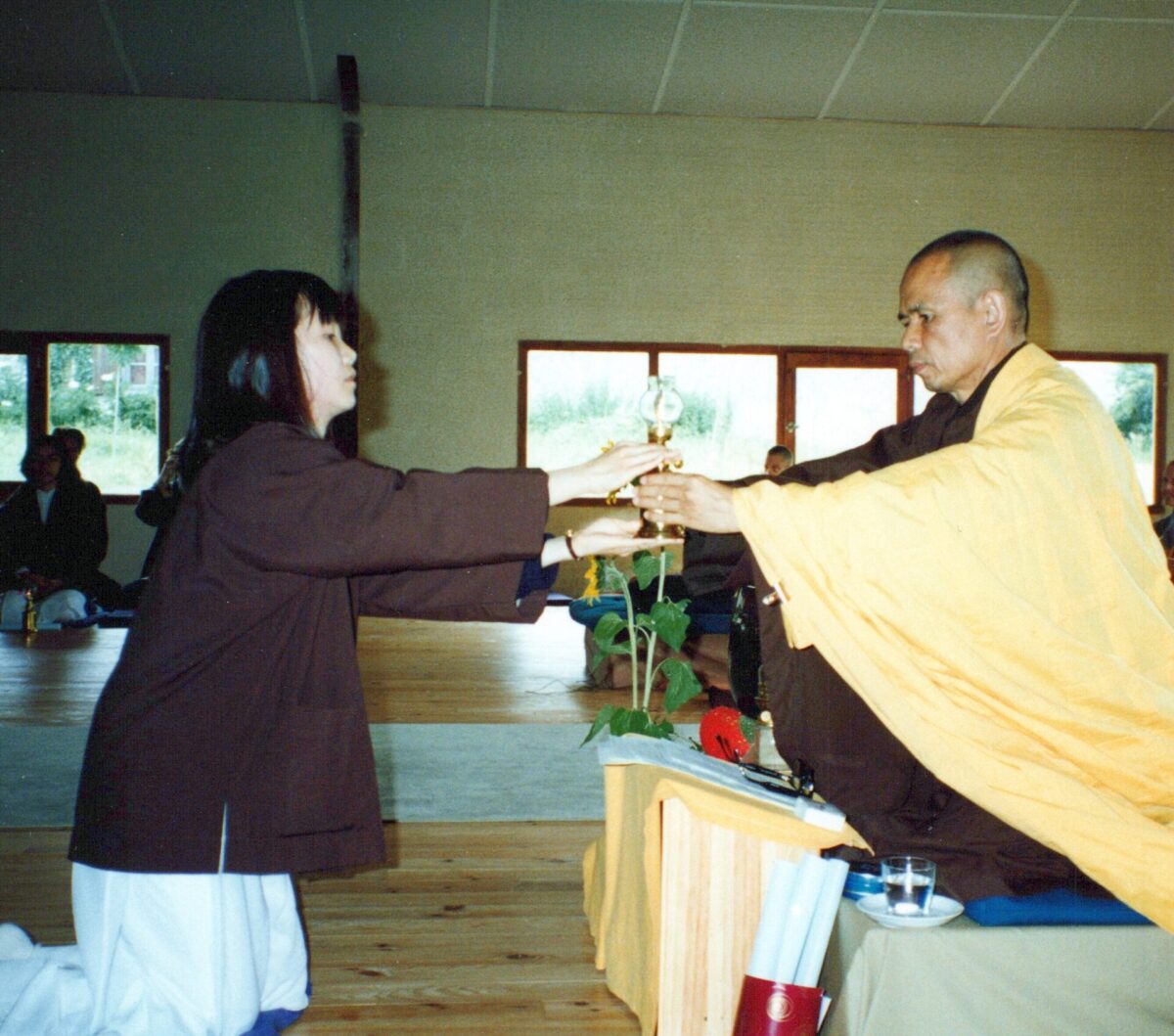
A few days later, I was having tea with Thầy at Sitting Still Hut (Cốc Ngồi Yên), along with Arnie Kotler (Chân Đắc) from Parallax Press. Thầy began to draft a flyer with us for a retreat I would be leading. He folded the paper and handed it to Arnie to finish the rest. Thầy had just given me the Lamp Transmission and immediately “put me to work” leading a retreat!
The retreat took place in December 1992 in West Virginia, with the theme Touching Peace. Thư and I looked at the freshly printed flyers on colored paper, and joy filled our hearts. We knew we could continue Thầy’s work on the path of practice and helping others.
The retreat began Friday afternoon. From the upstairs bedroom, I watched retreatants pulling their suitcases toward registration. Some looked like football players, while others were old enough to be my uncles, aunts, or even grandparents. I felt very small and began to tremble: “Oh no, I’m riding on a tiger’s back!”
The more I watched, the more nervous I became—yet curiosity kept me looking. I paced mindfully back and forth in my room until it was time for orientation. Walking down the stairs into the meditation hall, I held Thầy’s hand on one side and the Buddha’s hand on the other. Step by step, I asked the Buddha and Thầy within me to guide my footsteps. Just walking—without thinking, without striving, with nothing to do. I let the Buddha and Thầy carry everything for me. A gentle sense of lightness, ease, and happiness began to arise. In the meditation hall, everyone sat quietly and solemnly. I walked to the seat that had been prepared and sat down—together with the Buddha and Thầy.
In 1980, Thầy had first visited our home in New Jersey, six months after our family arrived in the US. One day, Thầy called, “Anh-Hương, come lie down here. Place your hands on your abdomen. Breathe. Do you feel your belly rise and fall?” Then Thầy quietly stepped out of the room. Just a few simple words, yet that lesson carried me through the retreat. Ever since, whenever I give a Dharma talk, I feel the Buddha and Thầy sitting beside me—one on each side.
TN: Did you share this with him?
AH: Yes. Thầy smiled and let out a small chuckle as he said, “I’ve been a bit naughty!” [Thầy was acknowledging that he put Anh Hương in a difficult situation, but he trusted that she would be able to handle it.]
Thầy told us many times that siblinghood
is the most precious of all. It is the loving
threads that weave our sangha blanket,
keeping us safe and warm during the
acute weather of global challenges.
“Just love!”—A mantra for the path
TN: Practicing for more than forty years, what is your reflection about the Order of Interbeing and Engaged Buddhism? What do you think Thầy wants us to continue?
AH: The Fourteen Mindfulness Trainings are the concrete expression of our bodhicitta—the deep aspiration to dedicate our energy to practice and to help others. Sangha is the soil that nourishes and protects this aspiration. Engaged Buddhism, as embodied in the Order of Interbeing, is the path of deep understanding and fierce compassion. This bodhisattva path is sustained by the energy cultivated through the practice of precepts, mindfulness, concentration, and insight.
Since Plum Village’s first Summer Opening in 1982, Thầy consistently emphasized the practice of mindfulness in everyday life and in sangha building. Thầy called the sangha a “community of resistance” that resists the collective momentum of greed, anger, and ignorance.
Through investigation and deep looking, we recognize that what is happening in the world and within the sangha is also happening within ourselves. Non-blaming is the secret to maintaining genuine compassion. When our inner suffering is not yet cared for, we often project and vent it into our relationships with family, sangha, and our activism.
We stand now at a crossroads of how Buddhism will evolve in this country and on this planet. As members of the Order of Interbeing, our challenge is to live our daily lives so that the bodhisattva ideal is truly embedded in the fabric of our existence. How do we find peace, stillness, nourishment, and healing while still engaging deeply with social, political, and environmental issues?
Seeing the danger of activists burning out due to a lack of deep spiritual training, Thầy shifted the emphasis from “Engaged Buddhism” toward “Applied Buddhism” and sangha building. Thầy’s calligraphies—such as “I have arrived, I am home,” “Peace in oneself, peace in the world,” and “The way out is in”—serve as essential reminders of the importance of individual practice as the foundation for collective awakening. This is the essence of Applied Buddhism.
I can still hear Thầy saying, “This is a happy moment!” If we are not peaceful and happy right now, how can we truly be present for our loved ones, much less those who are suffering and crying for help?
Thầy is happy to see his students practicing wholeheartedly—healing wounds, nurturing siblinghood, and building sangha everywhere. As Thầy once said, “You are all Thầy’s continuation. You are bringing Thầy into the future; in whatever you do, Thầy is always there beside you, walking with you.” Wherever there is a Sangha, there is the Buddha, the Dharma, and Thầy.
These days, our local sangha practices the mantra, “Just love!” We don’t need to strain or try hard to love—because understanding is love.
TN: Have you ever found practicing “Just love!” difficult? Were there times it felt impossible to love, yet you found a way?
AH: As Thầy’s student, I have vowed to learn to understand and to love, knowing love is the miraculous medicine that heals the suffering of all beings. Yet there are moments when I encounter someone simply too difficult to love—and sometimes that “someone” is myself. I make an effort and learn to be patient, but when the situation remains unchanged, my strength to love wanes. At times, the thought surfaces: “Everyone has their place in the universe—why bother?” What I thought of as “contemplating suffering” might be more or less an intellectual reflection, a tiny corner of reality. The insight I had felt limited; love arising from such a shallow well cannot embrace truly difficult situations.
I ask myself, how long must I contemplate this suffering before I can understand it deeply enough to give rise to great, unconditional love? How long before the spring of love within my own heart can truly begin to flow?
When the well of effort runs dry, when I no longer know what to do, “Just love!” becomes the ultimate practice. It is not an idea, but a surrender. Once the sword of intellect is laid down, and the agonizing illusion of a separate self evaporates, this mantra can carry us directly into the ultimate dimension, even as our feet still tread the muddy ground of the historical dimension.
Practicing mindfulness is like digging a well. The mantra “Just love!” can help us reach the water and draw it up. When that spring of loving-kindness flows forth, we become the hands, eyes, and heart of the Bodhisattva Avalokiteshvara. When the self is fully released, selfless wisdom guides our steps, and love becomes boundless.
Oases in the desert
TN: Do you have a wish for the OI family on its sixtieth anniversary?
AH: Order of Interbeing sanghas are like oases in a scorching desert—a vital place for us to return to for refuge and renewal.
Recently, I shared this with our young OI members: building sangha and walking the bodhisattva path is deeply engaged spiritual practice. The Sangha door is wide open to all; it excludes no one and makes no distinction based on background, identity, or political orientation. A true sangha cultivates loving speech and deep listening, creating a safe space for everyone to share their views—even when they differ from our own.
Where I live, one of my neighbors has a sign on their front lawn: “Hate doesn’t have a home here.” I tell my friends that even the mind of hatred can have a place to rest in the sangha. The collective energy of mindfulness and all-embracing love is what makes the sangha a safe place for those who come.
We must continually renew the sangha. No matter how healthy the seed of bodhicitta may be, if the soil is not fertile and nourishing, the seed cannot sprout—it will wither away.
The very heart of The Fourteen Mindfulness Trainings is understanding and love. When our collective mindfulness is fragile, small frustrations can unfortunately spiral into cycles of justification and conflict, sometimes even leading to the weaponizing of precepts to assign blame. Suffering is not a problem to be solved; it is a wound to be tended with the medicine of understanding and love. Thầy often reminded his students, “You have the right to suffer. You do not have the right not to practice!”
Thầy’s simple yet profound calligraphy, “The way out is in,” calls us to turn inward, recognizing that the root of our distress always lies within. Our practice is to listen deeply and care for the pain we find inside. This internal work is mirrored in the community practice of Beginning Anew, which is vital for the well-being of our Sangha. By renewing ourselves, we naturally renew our bonds with our siblings. Our ability to live harmoniously and lovingly with one another—especially those we find challenging—is the measure of our practice’s success.
Throughout Thầy’s life—even after his stroke, until his final days at the root temple—Thầy never stopped nurturing the bonds of teacher and students, of brotherhood and sisterhood. Thầy reassured us, “Each of you is a continuation of Thầy. When you care for, love, and support one another, you are nourishing Thầy.”
In the midst of an increasingly complex and challenging world, my deep wish is for us to prioritize coming together, nurturing siblinghood, and caring for our OI family.
With every moment, every day, we dedicate ourselves to spiritual growth, moving forward as a sangha—a beloved community, a peace movement where healing, happiness, and compassion are palpable in the light of interbeing. Our local sanghas are like creeks, sustaining life wherever they flow.
Thầy told us many times that siblinghood is the most precious of all. It is the loving threads that weave our Sangha blanket, keeping us safe and warm during the acute weather of global challenges. As this blanket expands, it offers comfort and relief to those in desperate situations.
Thầy is still walking in front of us and with us always. Who is walking behind us? What legacy are we leaving for the next generation? The younger generations, our children and grandchildren, are watching how we live and how we treat one another. As their blood and spiritual ancestors, we must live in a way that can help them discover the true meaning of their existence and move forward on the path of love and beauty as a beloved community.
To truly be Thầy’s continuation means keeping the stream of love flowing. The powerful energy of Thầy’s compassion once touched our hearts so deeply; now, it is our turn to practice in a way that the younger generations can feel closer to us—and touch that same love within themselves. True transmission is only possible through true continuation.
This interview was held in Plum Village, France, during a May 2025 retreat for Order of Interbeing members. Originally in Vietnamese, it was translated by Sister Trăng Mai Thôn.